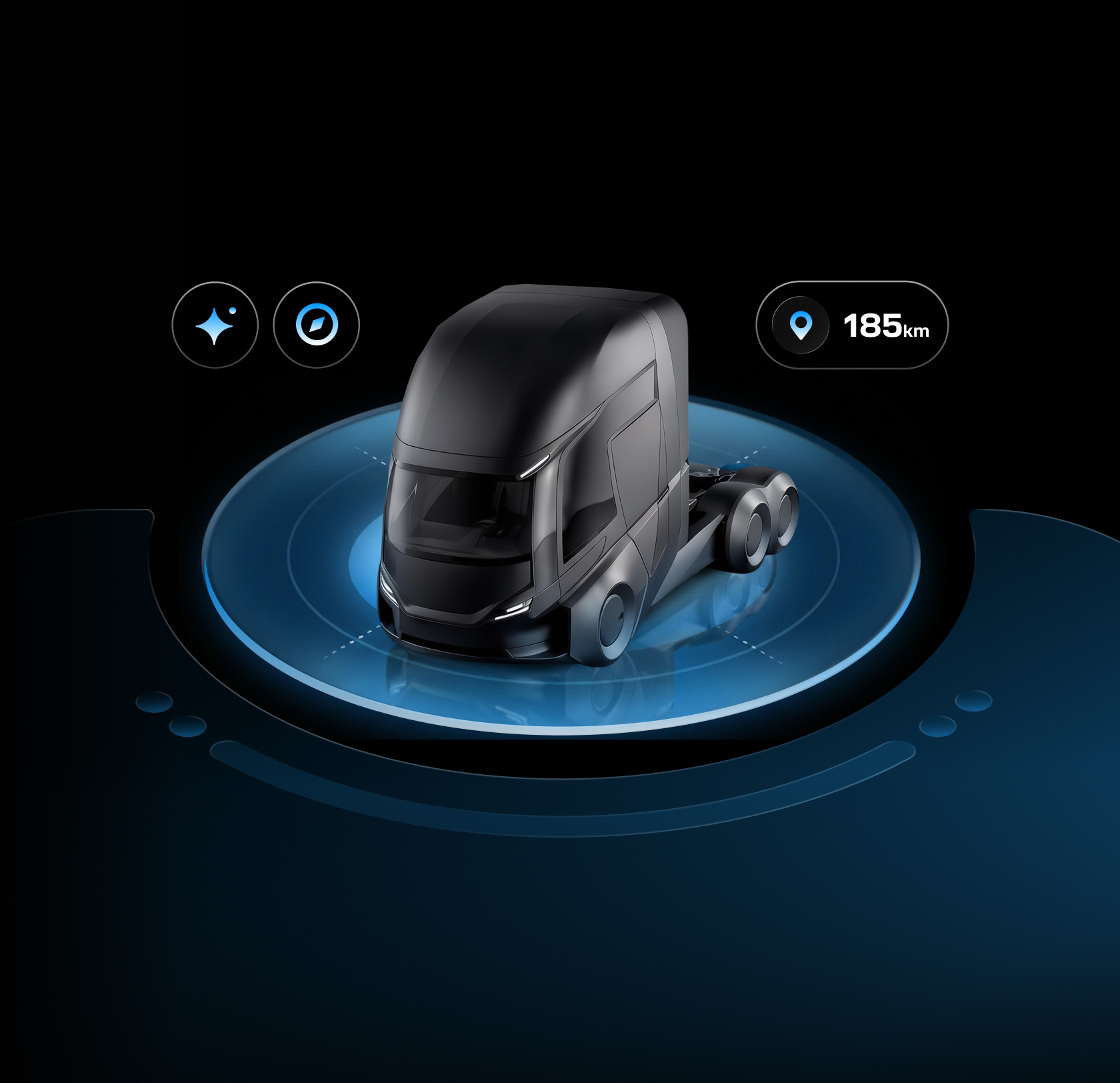
AI in fleet management: turn connected-vehicle data into fleet decisions
Star helps commercial vehicle OEMs add an AI decision layer to existing telematics, diagnostics, OTA, service, and fleet platforms - converting fault codes, update windows, and compliance signals into trusted actions for drivers, dealers, fleet managers, and OEM uptime teams. AI in fleet management doesn't require a platform rebuild — just one high-value workflow, proven fast.
The infrastructure is built. The decision layer is missing.
Commercial vehicle OEMs have invested $100M+ in connected infrastructure — telematics, diagnostics, OTA rails, uptime centres, fleet portals. The data is there. What it lacks is the interpretation layer above it.
The gap is not more data collection. It is the AI layer that interprets vehicle, service, route, and compliance signals into role-specific next actions - reducing decision delay across fleets, dealers, drivers, and OEM teams.
$448–760
Cost of one truck down for a day — the unit every uptime solution is measured against.
−70%
Diagnostic time cut by connected remote diagnostics; up to −80% on-road tow events.
−73%
Crash-rate reduction over 30 months for full-AI safety fleets (175+ vehicles).
24%
Fewer unplanned stops for regularly OTA-updated trucks— the uptime case for AI-optimized update scheduling.
THE DECISION GAP
The winning OEM will be the one that turns data into trusted fleet actions.
Fleets do not need more dashboards. They need faster decisions, fewer calls, clearer accountability, and less downtime.
The portal has the data. The AI decision layer turns that data into a traceable recommendation.
Before AI decision layer
Fault appears → driver calls dispatcher → dispatcher checks portal → raw J1939 code, no context → dispatcher calls dealer → dealer checks repair order → service advisor calls fleet → fleet decides whether to continue or stop.
After AI decision layer
Fault appears -> AI triage -> severity + safe next step + likely service path + action owner -> driver, fleet, dealer, and OEM uptime team align on the next move.
The decisions AI must support
- What is wrong, and what evidence supports that interpretation?
- How urgent is it?
- Can the truck keep moving safely?
- What should the driver do now?
- Who owns the next action?
- When should OTA, service, or dealer escalation happen?
- What parts, repair path, or service capacity may be needed?
- What compliance or safety risk is emerging?
- What should the fleet manager see in plain language?

WHY NOW
Regulation, fleet complexity, and service economics are forcing the next connected-services layer.
The AI opportunity is practical because the data layer already exists. The missing layer is interpretation, workflow, and productization.
REGULATION
More mandatory data
Safety, driver-attention, emissions, and vehicle-health requirements are increasing the amount of data OEMs and fleets must interpret, explain, and act on.
OPERATIONS
More mixed complexity
Human-driven, ADAS-heavy, EV, ICE, OTA-enabled, and eventually autonomous trucks will operate in the same commercial fleets. Fleet teams need cross-system clarity, not another isolated portal.
ECONOMICS
Uptime is the product
Dealer throughput, warranty exposure, service-contract attach, subscription revenue, and fleet retention increasingly depend on how usable connected services become.
PACKAGED OFFERS
Three connected-services AI programs you can validate on existing infrastructure
- Typical workflows: fault-to-action triage; driver-facing fault explanation; dealer/fleet communication copilot; service event UX prototype; likely parts and repair-path suggestion; uptime center decision support.
- Data needed: DTCs, J1939 context, vehicle profile, service rules, repair history, dealer capacity, parts status, route or dispatch windows.
- Pilot KPIs: median fault-to-action time; manual calls avoided; tow/escalation reduction; service communication cycle time; fleet manager confidence score; dealer advisor time saved.
- Typical workflows: ADDW fleet dashboard; driver distraction coaching loop; emissions/OBM compliance reporting; fleet-level risk scoring; safety coaching loop; audit-ready vehicle-health summary.
- Data needed: safety events, driver behavior data, vehicle-health events, emissions or OBM signals, fault history, route context, policy thresholds, fleet hierarchy.
- Pilot KPIs: time to produce compliance summary; risks surfaced before escalation; safety action completion rate; driver coaching engagement; audit preparation effort.
- Typical workflows: OTA scheduling assistant; EV range and charging planner; mixed-fleet health aggregation; software-version and feature-readiness view; OTA feature recommendation engine; route-aware service planning.
- Data needed: OTA package metadata, vehicle status, route and dispatch windows, fleet schedule, charging availability, vehicle configuration, service windows, depot operations data.
- Pilot KPIs: OTA acceptance rate; update completion rate; missed update windows; unplanned service events; fleet operations time saved; range or charging exception reduction.
AI uptime workflow
pilot
Reduce fault-to-action time across driver, fleet, dealer, and OEM uptime teams.
AI compliance & safety intelligence
Turn required vehicle and driver data into fleet-facing products, coaching loops, risk scoring, and audit-ready workflows.
AI fleet operations intelligence
Help fleets manage mixed, electric, OTA-enabled, and software-defined trucks through decision workflows.
PRIORITIZED MATRIX
Choose pilots by buyer pain, data readiness, integration effort, and measurable KPI.
Effort alone is not enough. A strong pilot has four traits: a painful workflow, available data, low integration dependency, and a measurable KPI.
Near-term AI workflow pilots that can be validated on existing connected-service infrastructure.
Fault-to-action AI triage
LLM-assisted triage grounded in OEM service rules, diagnostic mappings, vehicle context, and confidence thresholds. Interprets DTCs into severity, safe next step, likely service path, and owner of the next action.
- Pilot output: working triage prototype, workflow map, KPI baseline, and production-readiness risks.
- Measured by: median fault-to-action time, manual calls avoided, escalation rate, dealer communication cycle time, and fleet manager confidence.
Service event communication copilot:
Drafts readable dealer-to-fleet updates, ETA explanations, repair status summaries, parts-delay notes, and next-step messages using approved service context.
- Pilot output: communication prototype, message templates, escalation rules, and review workflow.
- Measured by: service communication cycle time, fewer manual calls, advisor time saved, and fleet satisfaction with updates.
OTA scheduling assistant
Recommends update windows around route, load, depot time, vehicle status, update criticality, and dispatch patterns.
- Pilot output: scheduling prototype, update-readiness rules, fleet approval flow, and integration backlog.
- Measured by: OTA acceptance rate, update completion rate, missed update windows, and manual scheduling effort.
Driver performance coaching AI
Converts driving, efficiency, idling, braking, and distraction signals into personalized coaching loops for drivers and fleet safety teams.
- Pilot output: coaching UX prototype, feedback loop, risk scoring approach, and user testing plan.
- Measured by: coaching engagement, risk-event reduction, safety action completion, and fleet safety manager confidence.
Strategic accelerators that need deeper integration, business rules, or product roadmap alignment.
EV range and charging AI planner
Optimizes charge-and-deliver decisions using SoC, payload, route, terrain, weather, charger availability, depot constraints, and service windows.
- Pilot output: planning prototype, exception rules, required data model, and operating assumptions.
- Measured by: charging exceptions reduced, dispatcher time saved, missed route risk, and range-confidence score.
AI-adaptive service interval engine
Recommends dynamic service timing based on actual vehicle use, load, idle, terrain, maintenance history, fluid/oil signals, and OEM service rules.
- Pilot output: adaptive service model concept, rule hierarchy, data-readiness assessment, and service-contract implications.
- Measured by: planned maintenance adherence, avoided unplanned stops, service-cost variance, and maintenance planner time saved.
Euro VII / OBM compliance AI
Aggregates emissions and vehicle-health signals, flags emerging compliance risks, and generates audit-ready reporting summaries for fleets and OEM teams
- Pilot output: compliance dashboard concept, reporting workflow, escalation logic, and data/source traceability requirements.
- Measured by: time to produce compliance summary, risks surfaced before escalation, audit-preparation effort, and exception resolution time.
OTA feature recommendation engine
Recommends paid OTA features based on duty cycle, current vehicle configuration, usage patterns, feature catalog, pricing, and estimated operational benefit.
- Pilot output: recommendation prototype, benefit model, subscription flow concept, and sales/service enablement requirements.
- Measured by: recommendation acceptance, attach-rate lift, feature activation, and fleet-perceived value.
Longer-horizon intelligence bets with higher upside and higher dependency on data access, model validation, or neutral platform position.
Aftertreatment failure prediction
Predicts SCR/DPF risk windows from DTC sequences, temperature curves, DEF use, route patterns, maintenance history, and known failure cases.
- Pilot output: prediction concept, data-quality assessment, model-validation plan, and service escalation workflow.
- Measured by: predicted failure capture, false-positive rate, avoided emergency repairs, and warranty/service planning value.
Mixed-fleet health aggregation AI
Normalizes vehicle-health and fault semantics across OEM brands into a single risk-prioritized view for large fleets, TSPs, and maintenance control towers.
- Pilot output: normalized health taxonomy, cross-OEM mapping approach, risk-prioritized view, and data-sharing assumptions.
- Measured by: time saved in fleet health review, higher-priority risks surfaced, cross-brand coverage, and action completion.
3-6-12 MONTH PROGRAM
From first prototype to production roadmap
A strong engagement proves one workflow, clarifies the data and integration path, and creates the roadmap for production.
Discovery + proof of value
0-3 MONTHS
- Goal: identify the highest-value workflow and prove that AI can improve decision quality, speed, and usability.
- Outputs: prioritized workflow, pilot scope, data and integration requirements, experience prototype, AI guardrail requirements, KPI measurement plan, and production-readiness risks.
Pilot design
3-6 MONTHS
- Goal: build a working pilot around one connected-services workflow and validate it with target users.
- Outputs: working pilot, validated user flows, technical architecture, guardrail and evaluation plan, integration backlog, security and privacy requirements, and pilot KPI report.
Productization roadmap
6-12 MONTHS
- Goal: turn the pilot into a scalable product capability within the OEM connected-services ecosystem.
- Outputs: production roadmap, engineering backlog, architecture documentation, model evaluation framework, security and compliance plan, rollout plan, and business case for scale.
WHY STAR
Strategy, UX, AI prototyping, and product delivery in one operating model.
Star helps OEMs move from AI opportunity to working connected-services product. We combine the strategy needed to choose the right workflow, the UX depth needed to make AI usable across driver, fleet, dealer, and OEM roles, and the engineering capability needed to connect with real systems.
- Connected-services product strategy
- Automotive and mobility UX
- AI workflow prototyping
- HMI and driver-facing experience design
- Cloud, data, and platform engineering
- Fleet and service workflow design
- Dealer and aftersales experience design
- Compliance-aware product thinking
- Production roadmap and backlog creation
Turn one connected-services workflow into a working AI prototype.
Whether it's fault triage, OTA adoption, or compliance reporting, Star designs and engineers the AI experience layer on your existing connected-services platform — no infrastructure rebuild required. Let's scope the first working prototype.
FAQs
AI in fleet management is the layer that interprets connected-vehicle data — fault codes, diagnostics, OTA status, and compliance signals — and turns it into a specific next action for drivers, dealers, fleet managers, and OEM uptime teams. Most commercial vehicle OEMs already have the data infrastructure (telematics, diagnostics, OTA rails); AI in fleet management adds the interpretation layer on top, without requiring a platform rebuild.