


Healthcare interoperability is the ability of health IT systems, devices, applications and organizations to exchange, interpret and use health information reliably within real clinical and operational workflows.
No longer only a useful technical capability, healthcare interoperability has become a regulatory and competitive necessity. Without this function, fragmented data can pose a risk to patient safety through slow decisions and duplicate work. For MedTech, pharma and digital health companies, products that don’t fit cleanly into provider systems create friction for clinicians, buyers and patients.
In this article, we’ll explain what healthcare interoperability means, why it matters, which standards and use cases are involved, and how to build an interoperability strategy.
If your organization is ready to put your strategy into practice, Star’s interoperability services can help.
What is healthcare interoperability?
Healthcare interoperability is the ability of systems, devices and applications to exchange, interpret and use health information without manual re-entry. Data must arrive in a usable format, carry clinical meaning and fit organizational workflows.
Healthcare data integration is the implementation work that connects systems (e.g. a medical device, an EHR, a data platform) so data can move between them. Interoperability makes the exchange reliable and meaningful, whether data moves one way or both.
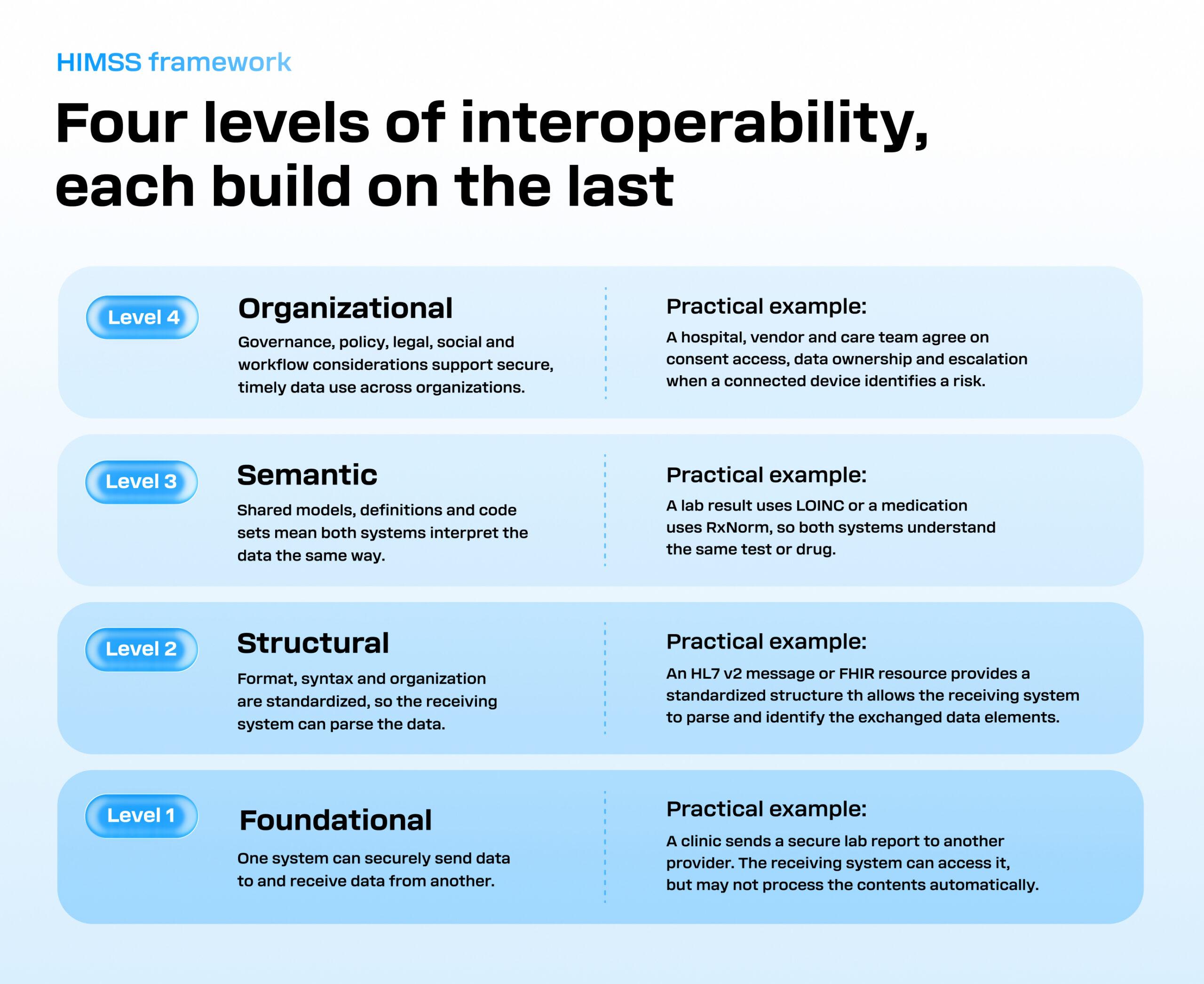
HIMSS describes four levels of interoperability, progressing from basic system communication to shared workflows and governance:
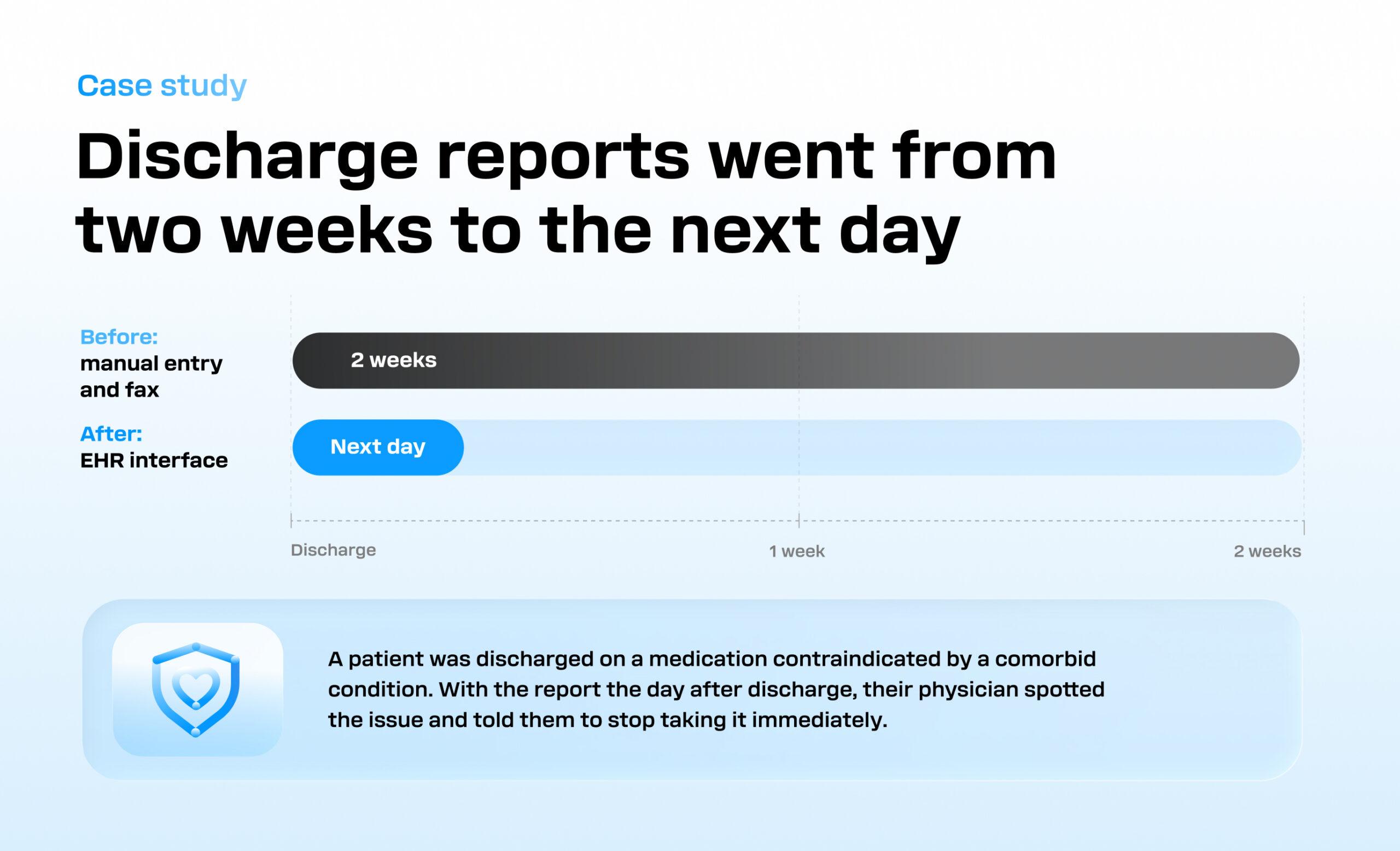
A recent Star case study shows the stakes of what interoperability can change in practice: A patient was admitted to hospital, treated, and discharged with a medication that was contraindicated because of a comorbid condition. Under the old process, the hospital manually entered and faxed admission reports to family physicians. The patient’s primary physician did not receive the report for around two weeks. After the hospital introduced an electronic health record (EHR) interface, the report arrived the day after discharge. The physician spotted the medication issue and advised the patient to stop taking it immediately.
The levels build on one another. A secure connection is not enough if data cannot be parsed, and accurate data creates little value if organizations have not agreed who can access it or how it fits into care.
Why does healthcare interoperability matter?
As stated earlier, interoperability in healthcare is more than a mandate to meet. It affects patient safety, clinical workload, product adoption and the value organizations can get from their data.
It supports safer, more coordinated care
When relevant information is available at the point of care, clinicians spend less time searching for records, re-entering data and reconciling disconnected sources. Better information exchange can reduce duplicate testing and miscommunication, improve care coordination and help clinicians identify potentially harmful treatment interactions sooner.
The cost case is significant. A 2013 West Health Institute analysis estimated that medical device interoperability could help avoid $2 billion in adverse-event costs and $3 billion in redundant testing annually in the United States. The report describes these as directional estimates based on assumptions and extrapolations, rather than observed savings, and older estimates should be read as historical context rather than current benchmarks.
It influences whether products get adopted
For MedTech, pharma and digital health organizations, interoperability is increasingly part of the buying decision. A device, companion app or connected therapy that does not fit existing EHRs, PACS, LIS or remote-monitoring workflows creates work for clinical teams, and is less likely to be adopted.
It creates a foundation for analytics and regulation
Reliable healthcare data interoperability creates a stronger foundation for analytics, artificial intelligence and real-world evidence. It still requires consistent formats, shared terminology, trustworthy identity, data provenance and clear access rules. Centralized healthcare data platforms show how connected data can support care, research and product development.
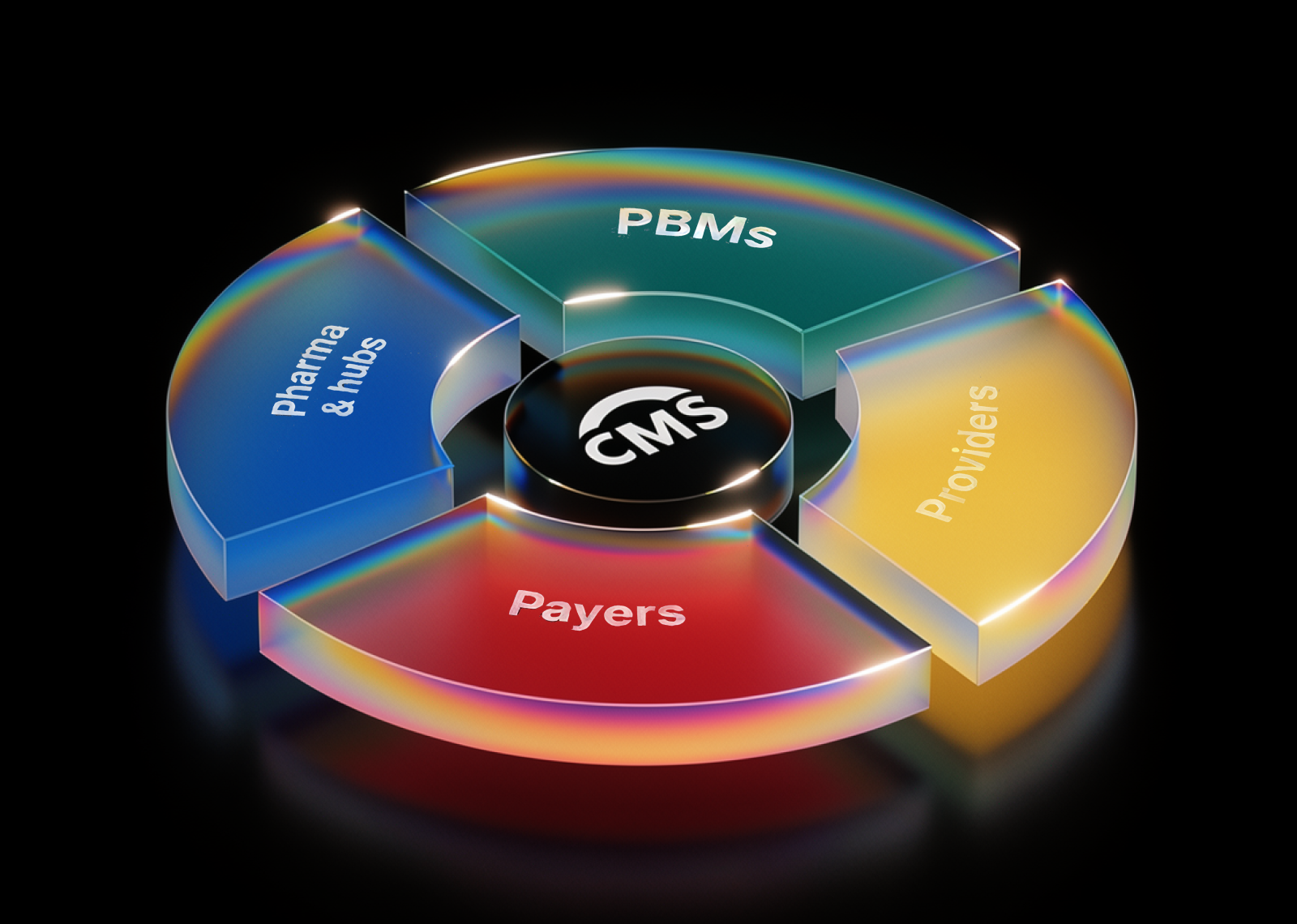
Regulatory policy is moving in the same direction. In the United States, CMS-0057-F requires certain impacted payers to implement and maintain FHIR-based APIs intended to improve health information exchange and streamline electronic prior authorisation. It does not apply to every organization or market, but the broader implications are clear.
How do you build a healthcare interoperability strategy?
There is no universal architecture or fixed delivery timeline. The right approach depends on the organization’s goals, existing systems, data sources, regulatory environment and priority workflows. These nine steps provide a practical starting point.
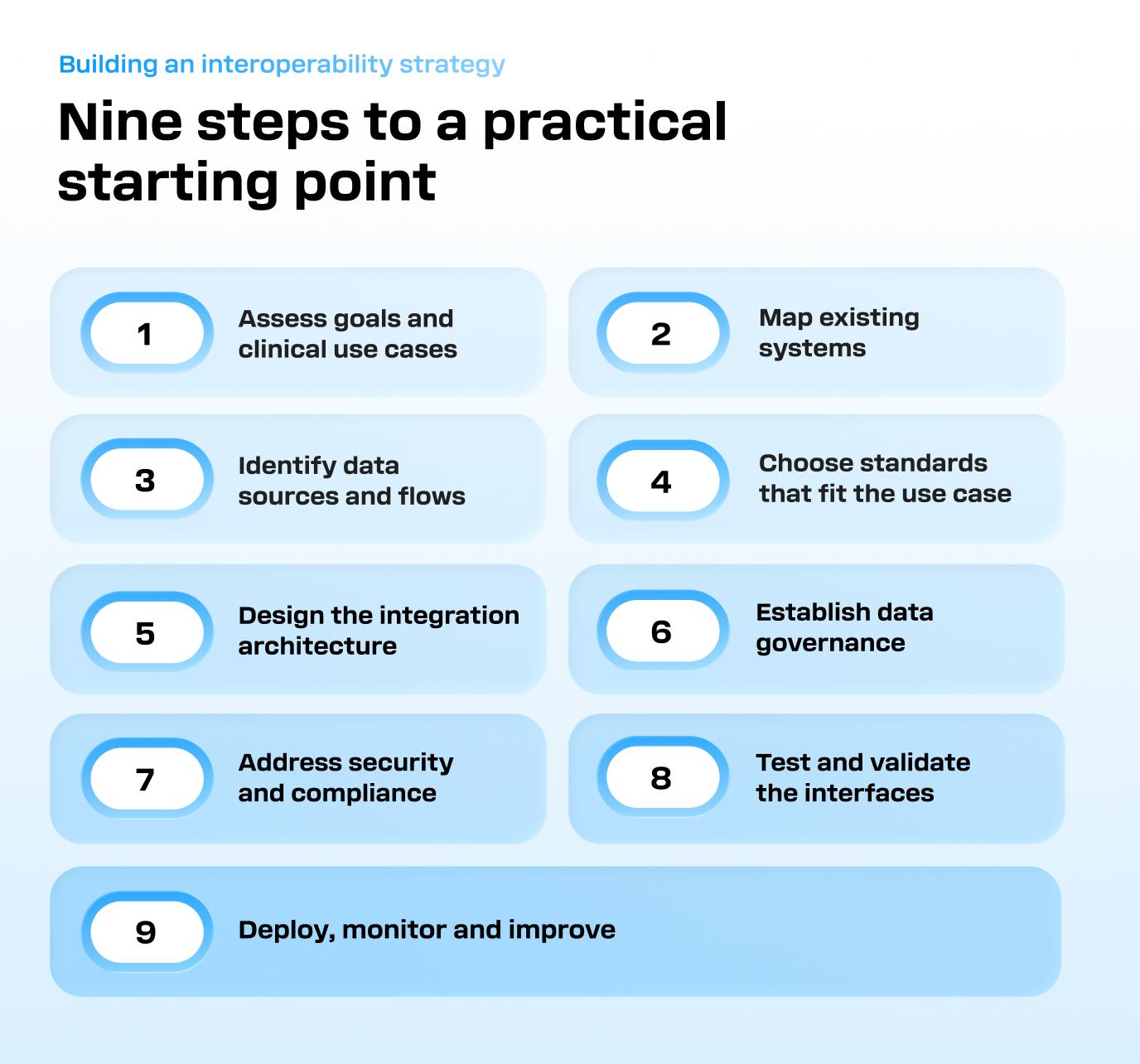
1. Assess organizational goals and clinical use cases
The first step in building an interoperability strategy is to define the specific goals and use cases it must support, and how they align with the organization’s broader strategy and business priorities. Healthcare providers, MedTech companies and IT leaders should collaborate to identify the core challenges they need to solve, whether that means streamlining clinical workflows, enabling device-data sharing or improving IT system reliability. These priorities will shape the standards, technologies and tools best suited to each organization’s needs.
2. Map existing systems
Inventory every system in the priority use case, including EHRs, PACS, LIS, devices, interface engines and data platforms. Record vendors, versions, owners, interface types and constraints. Include shadow systems and manual workarounds. The map should show existing connections, legacy interfaces needing a bridge and changes that could affect live workflows.
3. Identify the data sources and flows
List the information the use case needs, where it originates, who owns it and where it must go. Include clinical records, device observations, patient-generated data, claims, orders and results where relevant. Define exchange direction, frequency, source of truth, identifiers, provenance and retention. Map reconciliation rules for duplicates, corrections and conflicts.
4. Choose standards that fit the use case
Select standards from the workflow and systems involved, not a generic checklist. FHIR often suits new API-based exchange. HL7 v2 may remain essential for admissions, laboratory and pharmacy interfaces, while DICOM supports imaging. SMART on FHIR supports controlled app access. Add the profiles, implementation guides and terminology the use case requires, then document where a custom integration is appropriate.
5. Design the integration architecture
Decide whether the use case needs point-to-point interfaces, an interface engine, API gateway, event-driven pattern or broader healthcare integration platform. Account for transformation, routing, versioning, retries, error handling, monitoring and future systems. A bridging layer may connect legacy HL7 v2 or proprietary interfaces to FHIR services. Keep the design proportionate, but avoid another isolated connection that cannot scale.
6. Establish data governance
Define who owns each data set, who can change it and what makes it complete, current and fit for use. Set rules for terminology mapping, patient and device identity, consent, access, provenance, reconciliation, retention and stewardship. Include clinical, operational, technical, privacy and security stakeholders so teams agree what the data means and whether they can rely on it.
7. Address security and compliance
Build security into the architecture and workflow. Consider authentication, authorization, least-privilege access, encryption, audit logging, data minimization, threat modeling and incident response. Map obligations such as HIPAA, GDPR or medical-device quality requirements. Keep certifications, technical standards and legal obligations distinct.
8. Test and validate the interfaces
Test more than structural validity. Validate terminology, clinical meaning, field mappings, identity, duplicates, retries, reconciliation, error handling, performance, security and workflow acceptance. Test realistic edge cases with users. Where relevant, IHE Connectathon-style conformance testing can expose issues before go-live, but a structural pass does not prove a workflow is safe or useful in context.
9. Deploy, monitor and improve
Start with the highest-priority use case and roll out in phases. Define go-live criteria, rollback arrangements, ownership and escalation paths before launch. Monitor availability, latency, failures, data-quality exceptions and outcomes. Provide training and a feedback route. Use the first release to refine the architecture, governance and next use case over time.
What are the most common healthcare interoperability use cases?
EHR integration
EHR integration connects devices, applications and platforms with systems such as Epic and Cerner. Data may flow one way or in both directions through FHIR APIs, HL7 v2 messages or C-CDA documents, subject to vendor-specific profiles and workflows.
Medical device integration
Medical device integration moves measurements into patient apps, clinical dashboards or physician EHRs. Account for calibration, device identity, units, timestamps and clinical relevance.
Remote patient monitoring
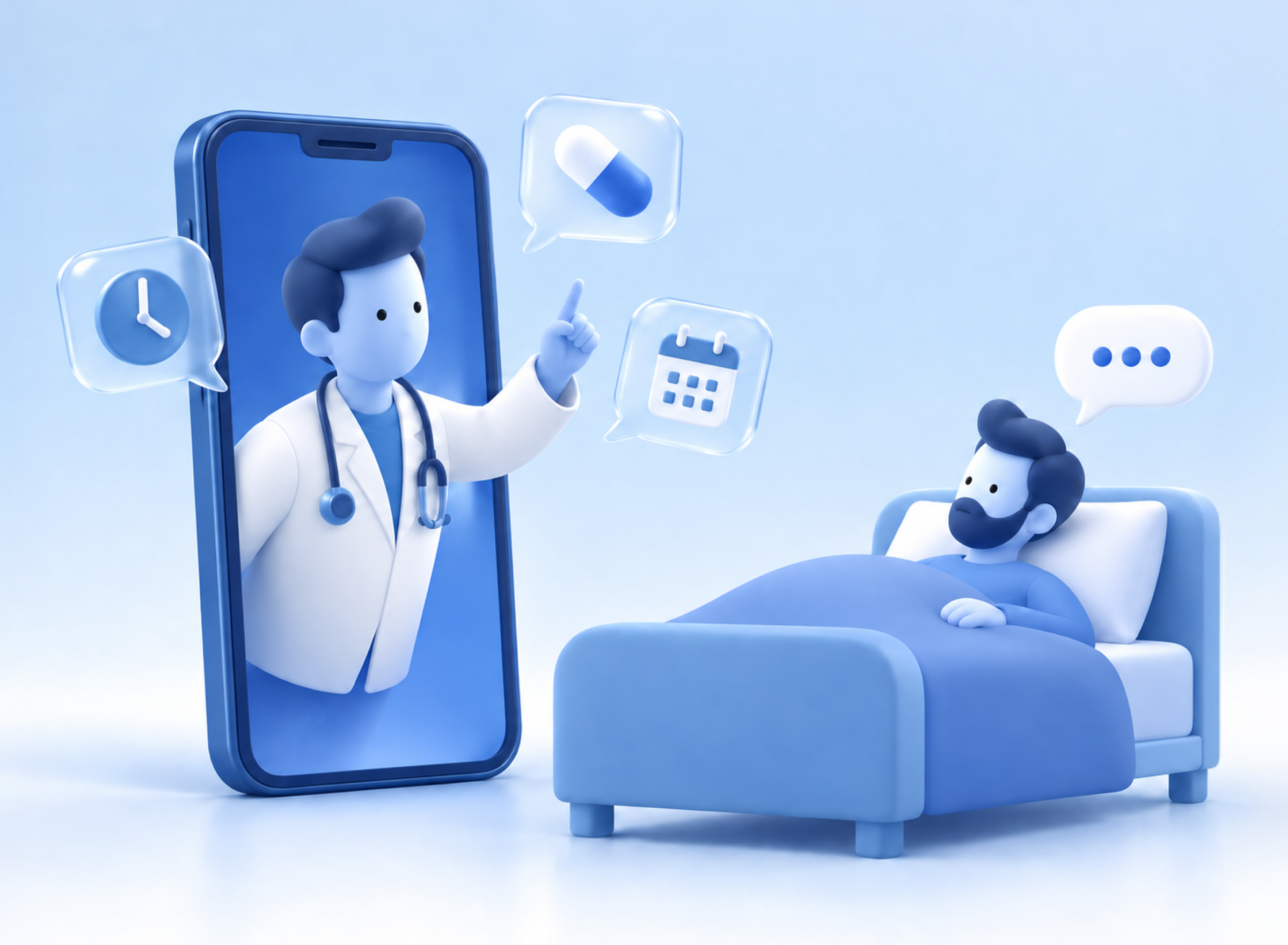
Remote patient monitoring combines sensor, wearable, home-device and patient-reported data so care teams can identify changes earlier. Star’s aging-in-place IoMT work brought multiple sources into one caregiver dashboard and reported 80% lower hospitalizations and 97% user satisfaction over two years. These are reported outcomes, not proof of causation.
Patient-generated health data
Wearables, mobile apps and patient-reported outcomes can extend the clinical picture beyond a consultation. Useful patient-generated health data needs consent, matching, provenance and validation. Distinguish patient-reported observations, wellness metrics and clinically validated measurements.
E-prescribing
E-prescribing connects prescribing and pharmacy workflows so requests, renewals and dispensing information can move securely. In the United States, NCPDP SCRIPT is an important standard.
Clinical data exchange
Clinical data exchange supports sharing between hospitals, clinics, laboratories and payers. FHIR, C-CDA, HL7 v2 and IHE profiles may all play a role, but standards do not settle identity, consent, provenance or accountability.
Healthcare analytics and AI
Analytics and AI depend on healthcare data that is complete, consistent, traceable and available in context. Interoperability can bring together clinical, device, operational and real-world data, but teams must address metadata, bias, access controls and model governance.
What standards does healthcare interoperability rely on?
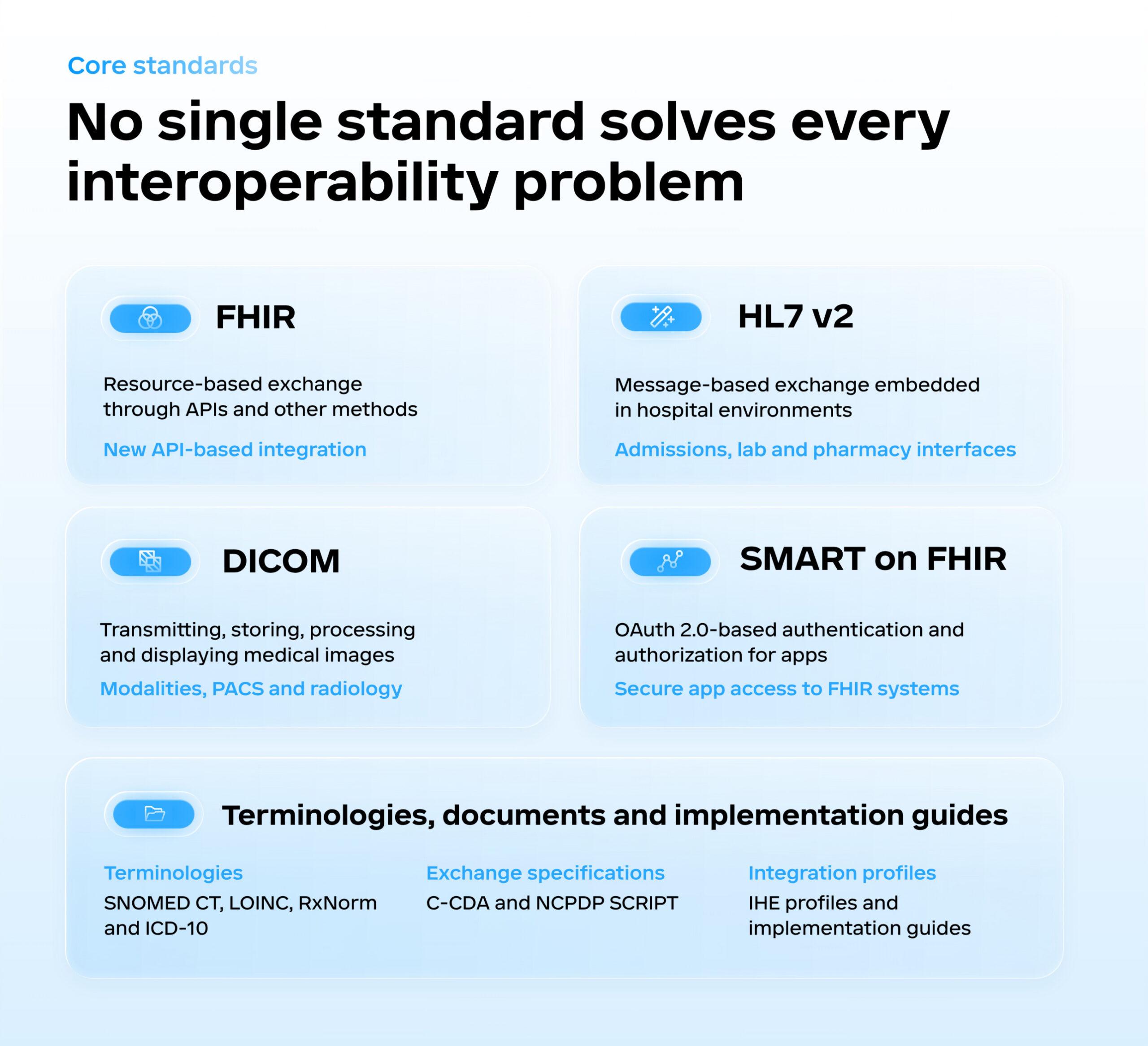
No single standard solves every interoperability problem. These are the core healthcare interoperability standards and implementation layers used in real-world environments.
FHIR and HL7 v2
FHIR provides a resource-based approach to exchanging healthcare information through APIs and other methods. HL7 v2 remains embedded in hospital environments, particularly for admissions, discharges, transfers, laboratory and pharmacy interfaces. New architectures often need both.
DICOM
DICOM is the standard for transmitting, storing, retrieving, processing and displaying medical imaging information. It is central to workflows involving modalities, PACS and radiology systems, alongside FHIR or HL7 for clinical and administrative information.
SMART on FHIR
SMART on FHIR defines standardized application launch and authorization patterns using OAuth 2.0, with OpenID Connect supporting user authentication, enabling applications to securely access FHIR-based systems. It can reduce vendor-specific effort, but teams still need to understand each EHR’s capabilities, scopes, profiles and workflows. It is not a replacement for data modeling or governance.
Terminologies, documents and implementation guides
Semantic interoperability relies on clinical terminologies and classification systems such as SNOMED CT, LOINC, RxNorm and ICD-10. Exchange specifications such as C-CDA and NCPDP SCRIPT, together with IHE integration profiles and implementation guides, address complementary requirements for structured information exchange and interoperable workflows.
How Star supports healthcare interoperability
Star helps healthcare providers, MedTech, pharma and digital health organizations plan, build and operate standards-based connectivity, including:
- interoperability strategy and stakeholder alignment
- integration architecture, engineering and development
- FHIR, HL7 v2 and DICOM integration across EHR, PACS and LIS environments
- interface testing, monitoring and operational support
- quality, security and regulatory expertise for healthcare products and platforms
Explore our work on Clarify Health’s intuitive physician portal, or see how we built an AI in vitro diagnostic medical device in only 7 months.
Healthcare interoperability is not a one-time technology project. It is an ongoing strategy that connects organizational goals, clinical workflows, standards, governance and implementation. Starting with clearly defined use cases helps organizations prioritize investment, measure progress and scale integrations without creating unnecessary complexity. As needs, regulations and technologies evolve, the strategy should be reviewed and refined to keep data exchange secure, useful and sustainable.
When should you run an interoperability workshop?
An interoperability workshop is most useful before choosing standards or architecture, when goals, systems, data sources or ownership are unclear. It should produce a scoped problem statement, a systems map, an initial data-flow view, a standards recommendation and clear next decisions.
Ready to build your interoperability strategy?
Not sure where your organization sits across the nine steps above? An interoperability workshop with Star’s team maps your goals, systems and data sources in a single session, giving you a concrete starting point.
FAQ
It is the ability of health IT systems, devices and applications to exchange, interpret and use health information across four levels: Foundational, Structural, Semantic and Organizational.