
A MedTech’s guide to designing caregiver and patient dual interfaces for home care
MedTech teams developing patient-facing home care products are at a turning point. As populations age and expectations change, it’s becoming clear that many device interfaces aren't designed for the realities older users face every day.
This article identifies key AgeTech healthcare trends for 2026 and translates them into actionable interface UX design principles for patient monitoring, diagnostics, and rehabilitation. Discover where current solutions fall short, what aging users require in real-world settings, and how to design health tech interfaces that enhance safety, adherence, and long-term use.
By applying modern technology to at-home care, aging-focused MedTech teams have a major opportunity to support independence, improve health at home, and reduce avoidable pressure on hospitals, caregivers, and families.
Designing interfaces for aging users is not a niche accessibility exercise. It is one of the most important UX challenges in healthcare technology, with lessons that can improve safety, usability, and confidence for a much wider patient population. Get it right, and you raise the standard for everyone.
Understanding the four physiological design realities of an aging user
Linda is 69 and managing multiple chronic conditions from home. She owns a smartphone, uses streaming services, and downloads apps when they offer clear value. But every new medical device she receives arrives with an interface that assumes perfect vision, steady hands, a quiet environment, and unlimited patience.
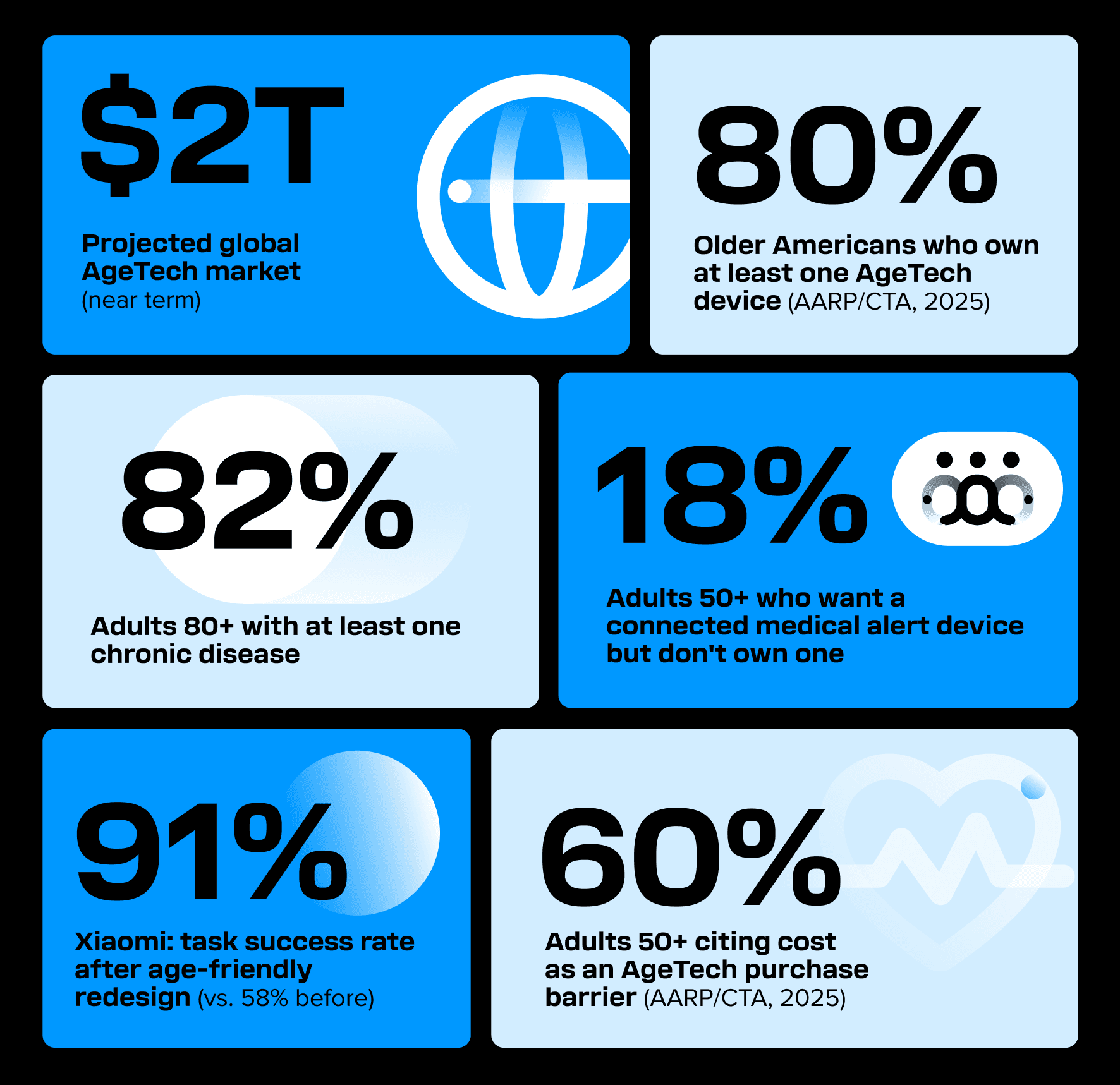
That mismatch is one of the most pressing product challenges MedTech teams face today, and its importance will only grow over time. In 2030, about 1 in 5 Americans will be age 65 or older, and healthcare systems will be forced to evolve to meet unprecedented population change.
Designing interfaces for older adults is not about stereotyping capability. It is precision engineering responding to documented changes in how bodies and interfaces interact. Ignoring these realities will result in the device being abandoned, but designing for them unlocks large-scale adoption.
Vision: readability and contrast must be built in
Reduced contrast sensitivity, slower adaptation to low light, and glare sensitivity can make visually minimal interfaces harder to use safely in home-care settings. Research on age-inclusive design consistently points to readability, clear iconography, and simplified layouts as critical factors.
Rather than treating these as optional design choices, MedTech teams should ground interface decisions in established accessibility guidance such as WCAG and platform accessibility standards. High contrast, scalable text, and clear information hierarchy are foundational to safe, usable experiences.
Motor control: small touch targets are errors waiting to happen
Fine motor control often declines with age and may be further affected by conditions such as Parkinson’s, arthritis, neuropathy, or post-stroke effects. When key actions require precise tapping, errors are likely. Apple recommends a minimum touch target size of 44×44 points.
Cognitive load: the interface design can be the barrier
Working memory, processing speed, and tolerance for multi-step workflows can change with age. Dense dashboards and nested menus increase fatigue and reduce confidence. Systematic review evidence on app design for older adults consistently points to simplified navigation and reduced complexity as core success factors.
Digital literacy is diverse
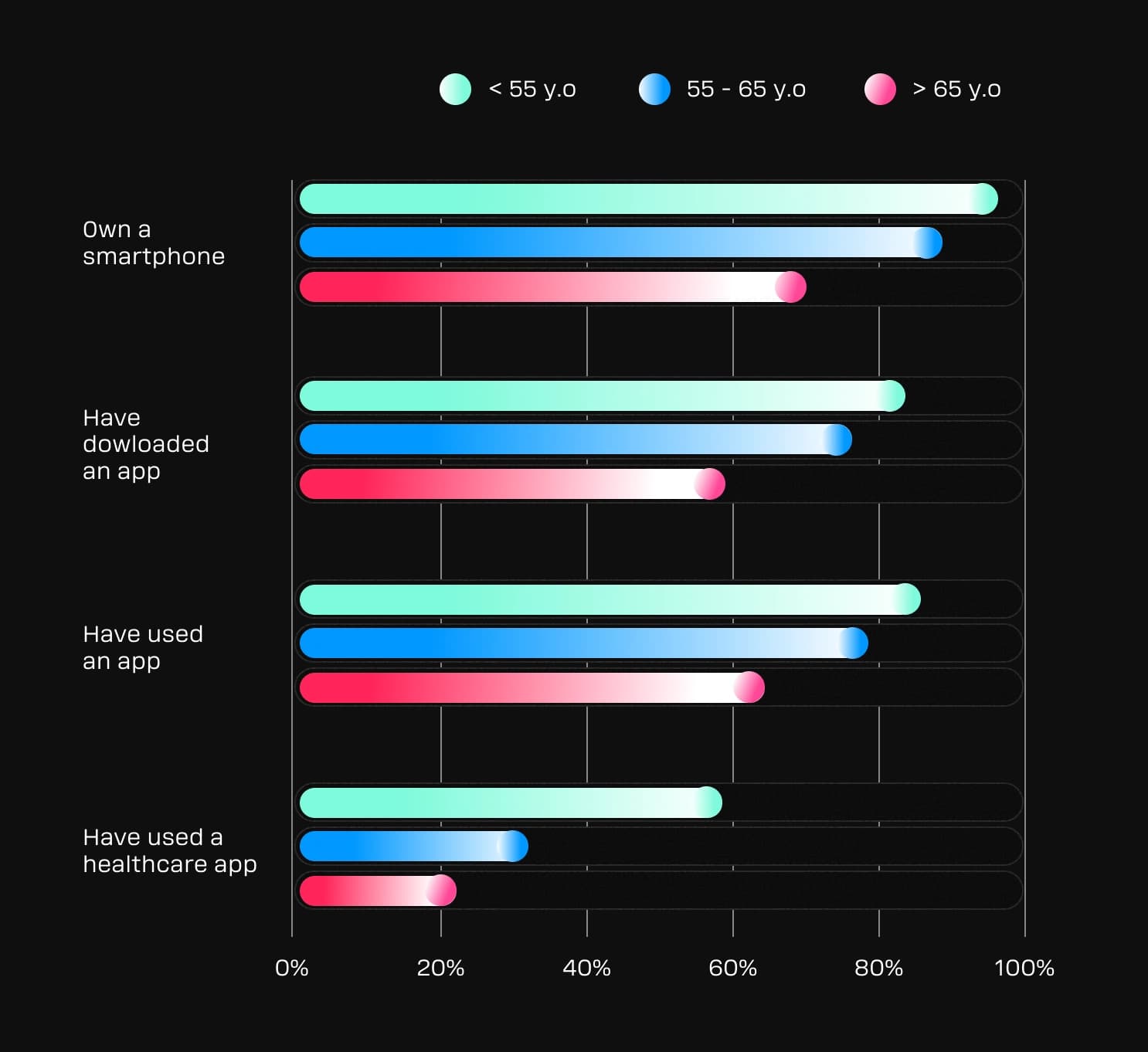
The 65+ population is not homogeneous. Digital habits, confidence, and reliance on support can shift over time, particularly across different stages of later life. According to AARP, belief in technology as a tool for healthy aging is increasing among adults over 80, but remains limited (46% in 2025, up from 39% in 2024). Segment users rather than averaging their needs. An interface suitable for a confident 54-year-old may not be accessible to a 65-year-old with ailing health living alone.
Patient monitoring: Providing continuous care for aging populations
Remote patient monitoring is rapidly expanding in age-focused MedTech, shifting care from episodic visits to continuous support. However, in aging populations, the primary challenge is not sensor reliability but the interaction model. Older adults are more willing to adopt technology when it offers clear value, yet usability and trust remain significant barriers.
AARP and CTA’s joint research highlights the “interest gap”: only 3% of adults aged 50 and older own a connected medical alert device, while 18% are likely to purchase one. Similar trends appear for continuous glucose monitors (CGM) (6% own, 8% likely to buy) and over-the-counter (OTC) hearing aids (3% own, 10% likely to buy).
Bridging this gap requires more than better interface design alone. Cost, perceived value, trust, and ease of use all shape adoption. Once a device is accessible and affordable, the interface plays a critical role in making setup, daily use, and next steps clear, even when patients are tired, in pain, or anxious. Two monitoring categories illustrate how these challenges show up in practice:
Medication adherence and smart dispensers: For someone like Linda, managing multiple medications at home is not just a scheduling task. It is a daily cognitive burden shaped by dosage timing, changing routines, and the risk of missed or repeated doses. This is where designing interfaces to improve adherence becomes critical: effective solutions reduce decision-making pressure, make the next step clear, and ensure missed-dose recovery feels safe and reassuring.
Fall detection and safety monitoring: The most valuable interfaces often require little to no patient interaction. Passive, always-on monitoring is “invisible by design,” while escalation and caregiver notifications remain clear and manageable.
Rehab devices: designing motivation back into recovery
Rehabilitation challenges user experience design, as patients are often in pain, fatigued, and adapting to new routines when they must use the interface correctly. Two patterns matter most in aging rehab:
Progress must feel attainable
Older adults are more likely to disengage if the experience is punitive or confusing. Interfaces that highlight incremental progress, minimize fear of mistakes, and provide clear, non-judgmental guidance help sustain participation.
Rehabilitation involves both the patient and the caregiver
For many patients, caregivers manage schedules, review progress, and resolve issues. The optimal approach is to design a simple experience for patients and a comprehensive one for caregivers through a dual interface.
Voice interaction is also becoming a practical accessibility layer in telemedicine, especially for aging-population monitoring and at-home interaction models where frequent input, symptom check-ins, and routine guidance can otherwise create unnecessary effort. Research on telemedicine user experience for older adults emphasizes the need to reduce interaction burden and align with users’ preferences and capabilities, making voice interaction design for older adult healthcare an increasingly important consideration for MedTech teams.
Diagnostics: making clinical intelligence legible at home
Home diagnostics are expanding rapidly, with clinician-recommended over-the-counter monitoring and device-led pathways bridging the gap between wellness and regulated care. For aging populations, the fundamental interface problem is that a number is not guidance. Knowing how to make diagnostic results understandable at home is now a core design challenge for MedTech teams, because a blood pressure reading, rhythm indicator, or symptom trend means very little without context, thresholds, and a safe next step.
At-home diagnostic interfaces must do three jobs reliably:
- Interpretation: What does this mean for me today?
- Action: What do I do next, right now?
- Escalation: When is a clinician, caregiver, or monitoring service alerted, and what happens next?
Trust is especially vulnerable at this stage. If the interface is unclear, patients may miss or ignore important information, or escalate concerns unnecessarily, both of which undermine effective care.
Cognitive load reduction: an underinvested priority in MedTech
Cognitive load refers to the mental effort needed to operate a device and interpret its feedback. For the older adult managing chronic disease regimens, cognitive resources are already strained.
Cognitive load reduction is not simply about making devices easier for seniors. It is a form of clinical risk management and a key factor in reducing errors in patient monitoring apps for older adults:
- Fewer steps reduce abandonment
- Fewer choices reduce errors
- Fewer surprises increase user confidence
- Clearer explanations reduce anxiety-driven non-use
This is also where trust can be rebuilt. Older adults express openness to valuable technology but also highlight concerns about complexity, cost, and security. The interface design helps determine whether these concerns are addressed or intensified.
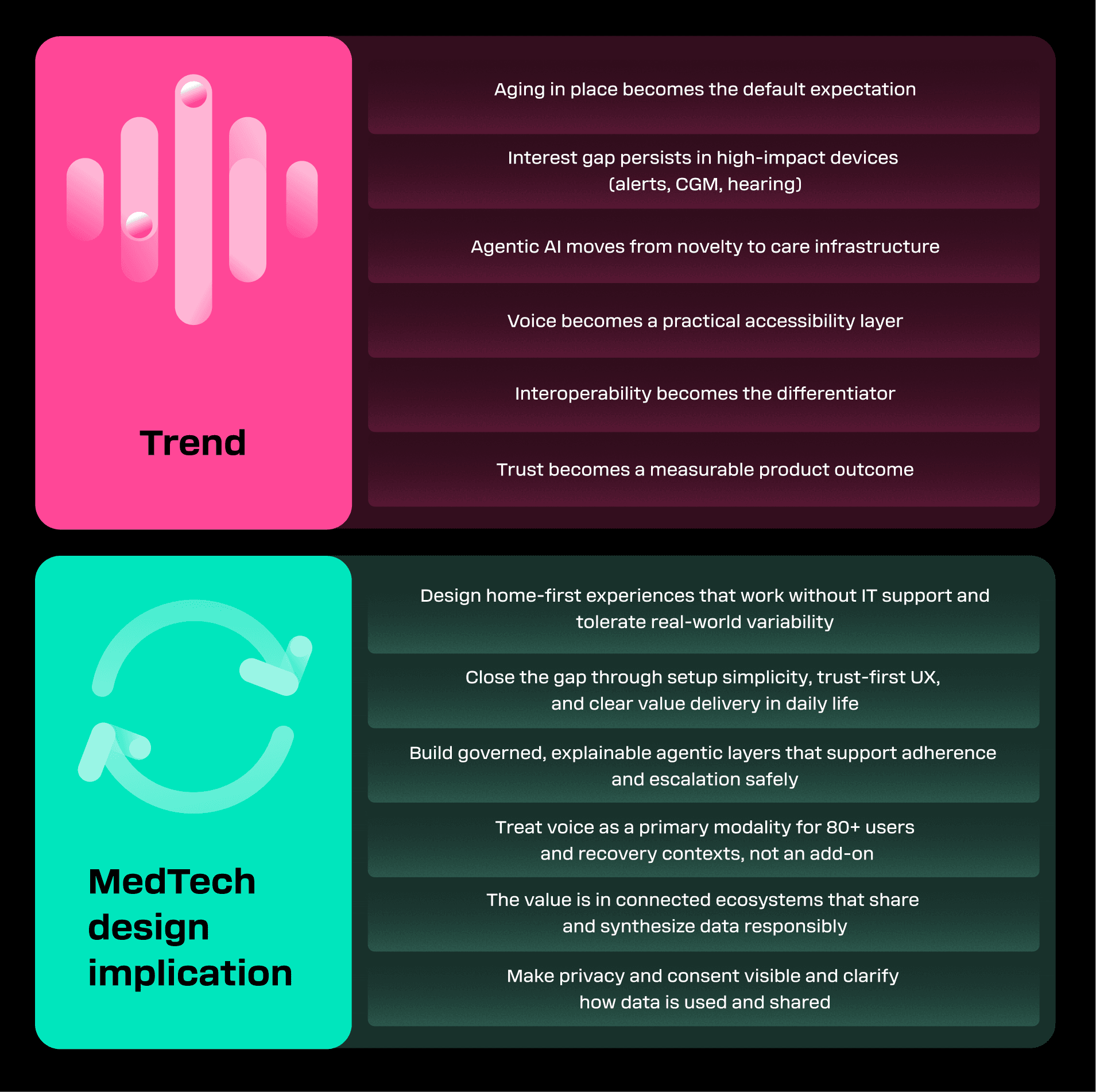
Key trends of AgeTech healthcare and patient interface design for older adults in 2026
The real opportunity in AgeTech is agentic support for safety and adherence
Many interface and accessibility patterns in digital health are increasingly expected. The more important shift is toward systems that can monitor, interpret, prompt, and escalate appropriately to support older adults more safely at home.
For aging users in particular, agentic support can help bridge the gap between collecting data and acting on it. Rather than simply displaying readings or answering questions, these systems can monitor patterns over time, interpret changes in context, prompt the next appropriate step, and escalate to a clinician, caregiver, or monitoring service when intervention is needed.
In practice, that can include:
- identifying sustained changes in health signals, such as rising blood pressure
- prompting repeat measurements, hydration, medication checks, or follow-up actions
- triggering alerts or escalation workflows based on predefined thresholds
- documenting what was flagged, what action was taken, and why
This is where AgeTech products can become materially more valuable: not just easier to use, but more capable of supporting safe, independent living at home.
Interest in these technologies is growing, but trust remains a barrier. Older adults continue to express concerns about reduced human interaction, unclear boundaries, and how these systems are governed, which makes explainability, transparency, and human fallback essential.
From age-inclusive design to adaptive adherence support
Designing for older adults remains an important starting point, but the bigger opportunity is to move beyond static interfaces altogether. In digital health, the same fixed app is often expected to work for very different people and care contexts, even though their needs, abilities, confidence levels, and support requirements vary widely. Star’s Human Agentic Interaction (HAI) Model offers a different approach: instead of forcing every patient through the same predefined experience, it uses agentic AI to understand the user’s context in the moment and dynamically shape how support is delivered.
With this model, AI can adjust the app experience in real time for different user groups rather than relying on one static solution that has to fit everyone. That means an older adult with vision and motor limitations, a patient recovering from stroke-related fatigue, or a younger user dealing with anxiety and dyslexia can each receive a different combination of guidance, pacing, modality, and interface structure, while the underlying care pathway remains clinically governed. In practice, the system can adapt across voice, text, visual, and haptic interactions, respond to user behavior and feedback, and personalize how care is communicated without changing what care is clinically appropriate. This is the shift from static apps to living apps, and it creates a more practical path to real-world adherence across diverse patient populations.
If you are developing patient monitoring, rehabilitation, or diagnostic solutions for aging users and want to explore this model further, review our Living Care guide on the Human Agentic Interaction model.
Download Star's Living Care report on the Human Agentic Interaction Model
Explore how adaptive patient-facing AI, companion apps, or connected device ecosystems can support adherence across different user groups
FAQ
The biggest trends are aging-in-place becoming the default care expectation, rapid growth in home monitoring and diagnostics, voice-first accessibility, increasing caregiver involvement, and the shift toward agentic support that can guide, monitor, and escalate safely.