



Automation promises are not new; programmatic buying, algorithmic bidding, and rules-based optimization have been reshaping media operations for nearly two decades. In 2026, agentic AI is shifting from pilot projects to the operating backbone of leading agencies, with autonomous systems planning and executing across major platforms under human supervision. Yet adoption is outpacing impact: most agencies now embed AI tools in their workflows, but only a minority can show consistent performance gains, forcing leadership teams to redesign processes, data foundations, and governance rather than simply bolting new tools onto legacy ways of working.
From rule-based programmatic advertising to outcome-based agentic media ops
Programmatic advertising transformed media buying by forcing consistency: standardized ad units, standardized targeting logic, standardized buying protocols. That consistency enabled scale. But it also exposed a fundamental architectural problem with rule-based systems: they can only handle scenarios that were anticipated in advance.
Unlike rule-based programmatic advertising, agentic AI operates toward goals. It reads incoming data alongside the context around it, then adjusts within whatever constraints the team has set,
Because agentic systems reason toward outcomes rather than fixed steps, media buying workflows that were previously fragmented across teams and platforms can be connected into a continuous, coordinated system. A campaign monitoring agent can track delivery in real time and flag underperformance. An optimisation agent can generate cross-channel reallocation recommendations based on live signals. A reporting agent can surface insights before the account team has opened their dashboard. None of this requires a human to trigger each step, it requires humans to define intent, boundaries, and oversight.
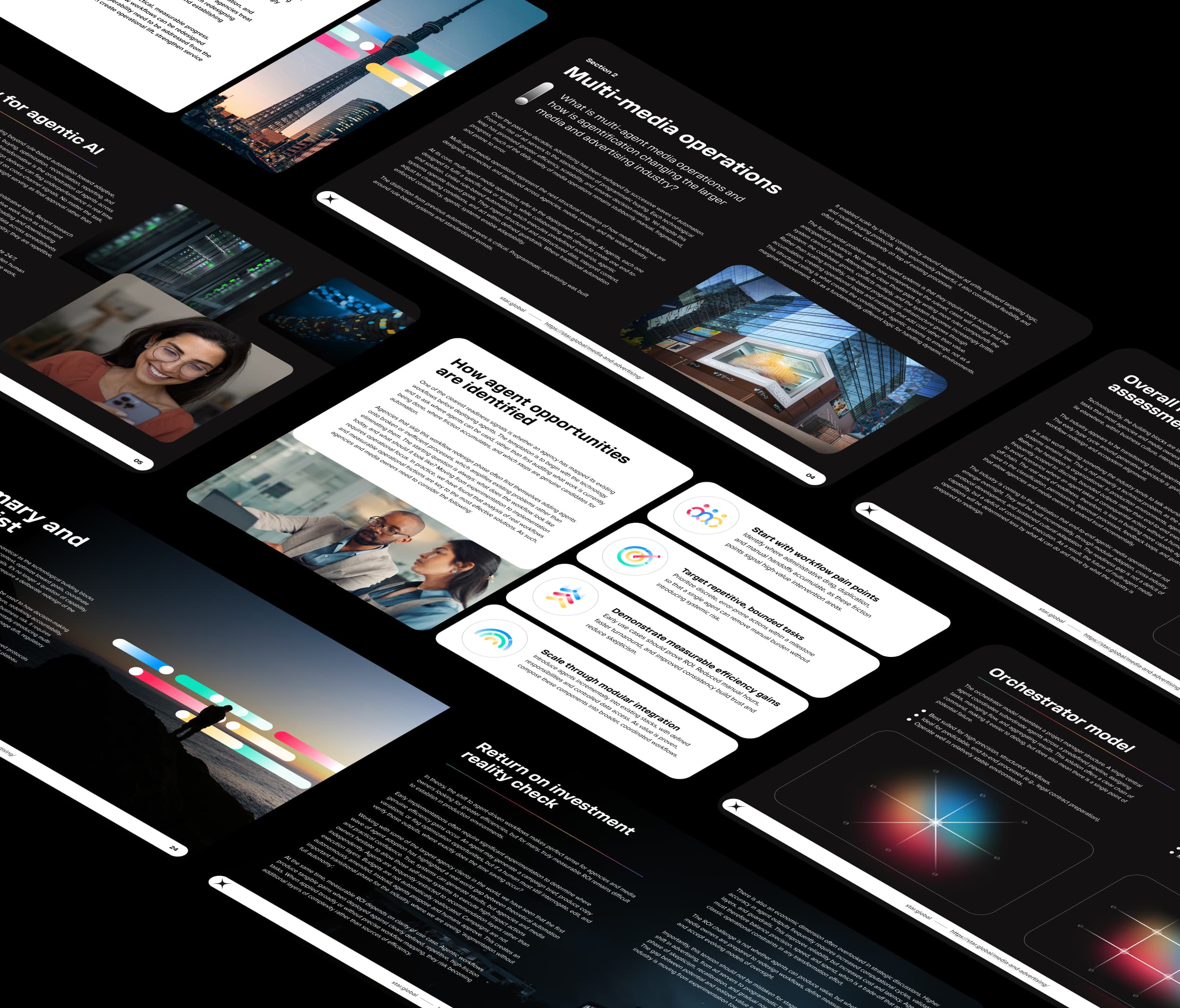
See what multi-agent media operations look like in practice.
Multi-agent media operations take this further. Rather than a single AI tool performing a discrete task, a network of specialized agents — each responsible for a defined function — can collaborate to execute end-to-end workflows across the entire campaign workflow from audience research to media planning, campaign setup all the way to real-time optimization and financial reporting can increasingly be connected into a single governed workflow.
Where programmatic enforced consistency, agentic systems enable adaptability. They are not replacing the logic of media buying, they are replacing the fragmentation that has historically made that logic expensive to execute.
Real examples of AI in media buying today
The early picture is one of augmentation before full autonomy. Based on our work with some of the world's largest agencies, the first wave of agentic adoption has concentrated in specific, high-friction areas:
Manual campaign setup and admin drag
Agents are already taking on the repetitive, error‑prone “platform work” such as filling in campaign forms, matching the right assets to the right line items even pre‑reconciling spend across systems before finance sees it. Recent research suggests that roughly a quarter of working hours are spent on routine administrative work such as document management and manual processes. Agents not only don’t get bored by those tasks, they are also 24/7 with the ability to run these routine tasks in the background, flagging only what needs human judgment.
Creative scaling, localization, and AI-on-AI QA
On the creative side, agents are being used less to “make the ad” and more to scale and protect it. Agencies described using AI to localize and adapt assets across markets (language, models, backgrounds, formats) and to dynamically version creative for different audiences, especially in display, social, and video.
A second layer of specialist agents then acts as brand and compliance QA: checking that logos are visible, text follows brand guidelines, and that stereotypes or sensitive content are flagged before anything goes live, in some cases explicitly “AI checking AI” as a guardrail.
Brief‑to‑plan and RFI/RFP support
Rather than jumping straight to end‑to‑end autonomy, agencies are using agents to automate the glue work between brief and plan. Agents help teams respond to RFIs and RFPs, research audiences, summarize past performance, and draft the skeleton of a media plan or proposal that humans then refine.
In more advanced cases, agents query inventory systems and internal tools to suggest channels or packages that fit the brief, but pricing, deal structure, and final negotiations are still handled by humans because of trust, relationship, and risk considerations.
Performance monitoring and “always‑on” intelligence
Instead of waiting for weekly reports, some agencies now run monitoring agents that watch live delivery: spotting anomalies and suggesting reallocation in real time. Others use agents to scan unstructured sources — presentation decks, PDFs, historic reports — to answer questions like “what worked for this audience last year?” or to generate bespoke performance summaries on demand. Humans still decide which recommendations to act on, but they’re reacting to live signals rather than static dashboards.
The common pattern: agents as doers, humans as governors
There is a consistent pattern across all the uses cases above which is agents are "doing” the work and humans are "checking” them and setting goals, constraints and validating outputs. This “augmentation without full autonomy” model seems to be a deliberate strategy from leading agencies to build internal buying and trust that agents can in fact take away mundane works from staff and give them time to focus on more high-value, strategic and creative work for clients.
Understanding agent-to-agent protocols: AdCP & AAMP
For agentic workflows to move beyond the boundaries of a single agency's internal stack, the ecosystem needs a shared technical language and standards that allow agents built by different organizations to communicate, negotiate, and transact with each other. Two initiatives are accelerating this:
AdCP: Agentic Decisioning & Commerce Protocol
Agentic Advertising published AdCP in 2025 – an open, standardized protocol that enables autonomous agents representing advertisers, agencies, publishers, or platforms, to communicate, negotiate, and transact in real time. It defines a common foundation for how intelligent agents express intent, evaluate inventory opportunities, and execute media transactions across platform boundaries.
On the buy side, advertiser agents using AdCP can translate campaign objectives into machine-readable intent, solicit inventory proposals across multiple publishers simultaneously, evaluate offers against performance and brand safety parameters, and automatically negotiate pricing and placement terms. On the sell side, publisher agents can dynamically package inventory based on demand signals, optimize yield in real time, and engage in counter-negotiations based on audience composition or strategic priorities.
AdCP transforms media buying from static deal-making into continuous, adaptive market interaction — closer to how financial markets operate than to how insertion orders have traditionally been processed.
AAMP: Agentic Advertising Management Protocols
The IAB Tech Lab's AAMP initiative is the broader industry standard under which the ecosystem's agentic infrastructure is being built. AAMP is organized around three pillars:
- Agentic Foundations defines how agent services operate safely and deterministically inside advertising systems, including real-time bidding environments. Its ARTF (Agentic Real Time Framework) cuts latency by 80% and upgrades real-time decisioning for quality and trust.
- Agentic Protocols provides the schemas, tools, and reference implementations for integrating agentic AI into buyer, seller, and adtech provider systems, including Agentic Direct for direct transactions, Agentic Audiences for identity and targeting, and Agentic Ad Object for standardized creative handling.
- Trust and Transparency establishes agent identity verification and disclosure through a neutral Agent Registry, providing accountability infrastructure for a world where agents are transacting autonomously across organizational boundaries.
How should agencies deploy agentic media operations
Workflow mapping before agent deployment
The agencies seeing the strongest ROI are the ones that start by mapping how work actually gets done today, across teams, platforms, and handoffs, before they choose any technology. By surfacing where effort, duplication, and manual touchpoints cluster, they create a clear blueprint for where agents can add the most value and how roles should evolve.
Client workflows are never identical. However, the claim that full remapping is unavoidable for every client conflates methodology with effort. The mature approach is to build a reusable discovery layer that client leads can use and then capture only client‑specific deltas.
Agent cataloguing and governance
Before agents can be coordinated, agencies need a clear view of what already exists. Building an internal agent catalogue, including how each agent is used, what data it can access, and whether it is client-specific or cross-client, creates the foundation of practical governance. With that visibility in place, the key questions become: what data does each agent touch, what approvals and documentation are required, and under which conditions is it allowed to run?
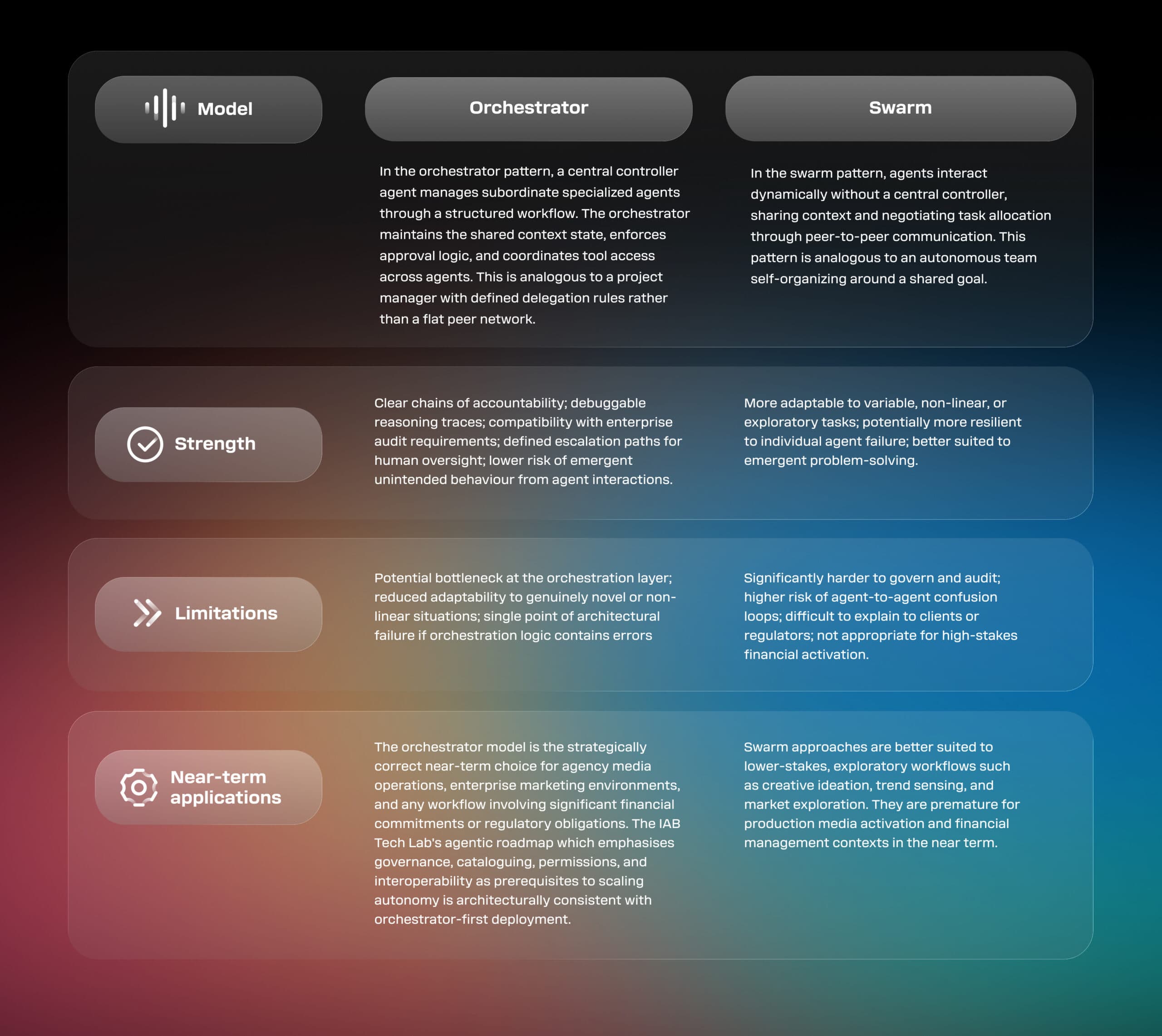
Orchestrator vs. Swarm Architecture
As agencies begin to operationalize multi-agent systems, the choice of coordination architecture becomes a strategic one as it has direct implications for accountability and governance.
Governance as the new agency imperative
For agencies, the most consequential design decision in agentic deployment is how accountability is structured on behalf of the brand. As agents start to transact and delegate among themselves, the locus of oversight shifts from approving individual steps in a campaign to shaping the rules, permissions, objectives, and monitoring frameworks that constrain how those agents can act in a client’s name. Clients are trusting agencies not just with media budgets but with autonomous systems that can touch their data, their customers, and their brand reputation.
That makes brand governance a new differentiator for agencies (or a deal breaker if done poorly). The operating disciplines now required include reasoning-trace transparency (being able to show a client what an agent did, which tools it called, and why), confidence scoring on agent outputs, meta-agent or guardrail validation, and clear escalation policies for high‑stakes or high‑risk decisions. Regulatory complexity raises the bar further: multinational agencies increasingly default to the most stringent applicable regime, often EU‑style requirements, which in practice means building explainability, auditability, and human‑in‑the‑loop controls into the core architecture so they can prove that agents are safe to trust.
A phased approach to multi-agent media operations
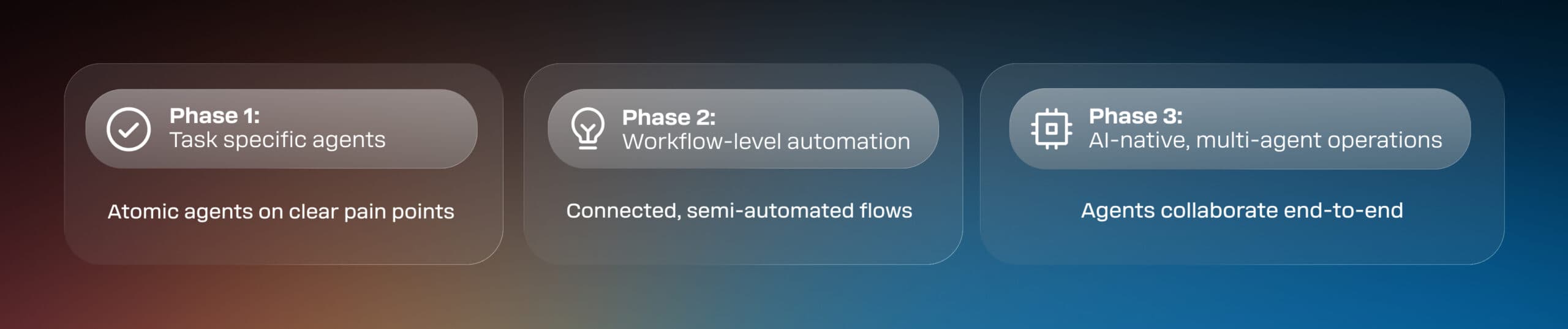
We believe agencies should take a pragmatic three‑phase path by starting with deploying task‑specific or atomic agents against clearly defined pain points; progress to connecting those agents into coherent, semi‑automated workflows; and ultimately move toward AI‑native, multi‑agent media operations where agents collaborate across the end‑to‑end lifecycle.
Instead of waiting for weekly reports, some agencies now run monitoring agents that watch live delivery: spotting anomalies and suggesting reallocation in real time.
Across all three phases, agent governance is not a final hygiene step but the backbone of the operating model. Given current levels of trust and maturity, the hard work is organizational: defining which agents are allowed to do what, on whose data, under which constraints; deciding when agents must escalate decisions to humans; and putting in place transparent reasoning traces, guardrail systems, and feedback loops so teams can see how an agent arrived at a decision and correct it when it drifts.
As autonomy increases, the number and importance of these rules grows, even though the underlying guardrail technology stays broadly the same. For agencies, treating governance as a horizontal layer from day one is what turns agentic AI from a collection of experiments into an asset they can safely scale and defend to clients.
How Star can help
If you are at the stage of defining your first agents, connecting existing pilots into workflows, or rethinking your operating model for AI‑native media, our enterprise AI development services bring domain experts and in‑house AI governance specialists to help you design the right use cases, guardrails, and roadmaps for your organisation.