

Marketing has survived many existential disruptions. Television arrived and the ad industry rebuilt itself around it. The internet came and upended the channel mix. Then smartphones, social feeds, and programmatic advertising, each adding a new layer on top of the last. Each time, the discipline adapted, absorbed the new tools, and continued operating around a fundamentally unchanged premise: that the job of marketing is to get the right message to the right person at the right time through the right channel.
That premise is about to break. The aspiration was always right. AI is simply making it technically achievable for the first time, and in doing so, it is dismantling the entire operational architecture that marketing built to approximate it. When the approximation becomes reality, the infrastructure you built for it no longer fits.
For my fellow CMOs, let's take a journey into our world in 2030.
AI is changing what customer value means
Imagine a bright summer morning in 2030: your coffee machine makes your espresso exactly the way you like it, while your personal AI agent quietly reviews your day and orders everything you need for your daughter’s birthday party.
The biggest change CMOs will face in the AI era is what customers come to expect from brands. As those ecosystems mature, brands will need to earn relevance and trust in ways the campaign model was never built for. That means the marketing stack itself will need to change.
Consider what is already happening. Conversational AI interfaces are increasingly the starting point where purchase decisions begin. OpenAI began testing advertising within ChatGPT for U.S. free-tier users this year. Amazon's AI shopping assistant and Google's AI Overviews are reshaping how consumers navigate from intent to transaction. The linear funnel of awareness, consideration, preference, and purchase is being collapsed into a single, algorithmically mediated moment.
In this environment, marketing's job is no longer primarily to move people through a funnel. It is to be present, relevant, and trusted within the AI-mediated contexts where those decisions are increasingly being made. That is a fundamentally different challenge and one that requires a different operating model.
The future of customer value lies in being embedded in the decision-making infrastructure of people who are already ready to act. That takes data fluency and continuous intelligence at a scale that cannot be built one campaign at a time.
The problem with how marketing currently operates
Most marketing organizations are not presently built for this. They are built for campaigns. The campaign is the organizing unit of modern marketing: a defined objective, a creative brief, a budget, a channel plan, a flight, a measurement report. Campaigns are how agencies scope work, how in-house teams plan budgets, how performance gets attributed, and how success gets reported to the board.
The campaign model was optimized for a world of finite media inventory, batch audience targeting, and periodic measurement cycles. In that world, it was the right structure. In a world where audiences interact with brands continuously across AI-mediated touchpoints, real-time content surfaces, and personalized digital environments, the campaign model creates organizational and operational friction that is becoming increasingly expensive.
In the gap between campaign-level insights and real-time performance signals; in the disconnection between first-party customer data and the campaign targeting decisions that should be informed by it; in the inability to adapt creative and messaging dynamically without triggering an entirely new production and approval cycle; and in the persistent failure to connect marketing investment clearly to commercial outcomes rather than channel metrics.
Most marketing organizations have an abundance of data and tools. What they are missing is the integrated operating layer that connects those tools, activates that data, and lets the intelligence generated by marketing activity flow continuously into the decisions that marketing makes next.
The Marketing Operating System: What it is and why it changes everything
The answer is a new organizing concept for how marketing operates: what we call the Marketing Operating System.
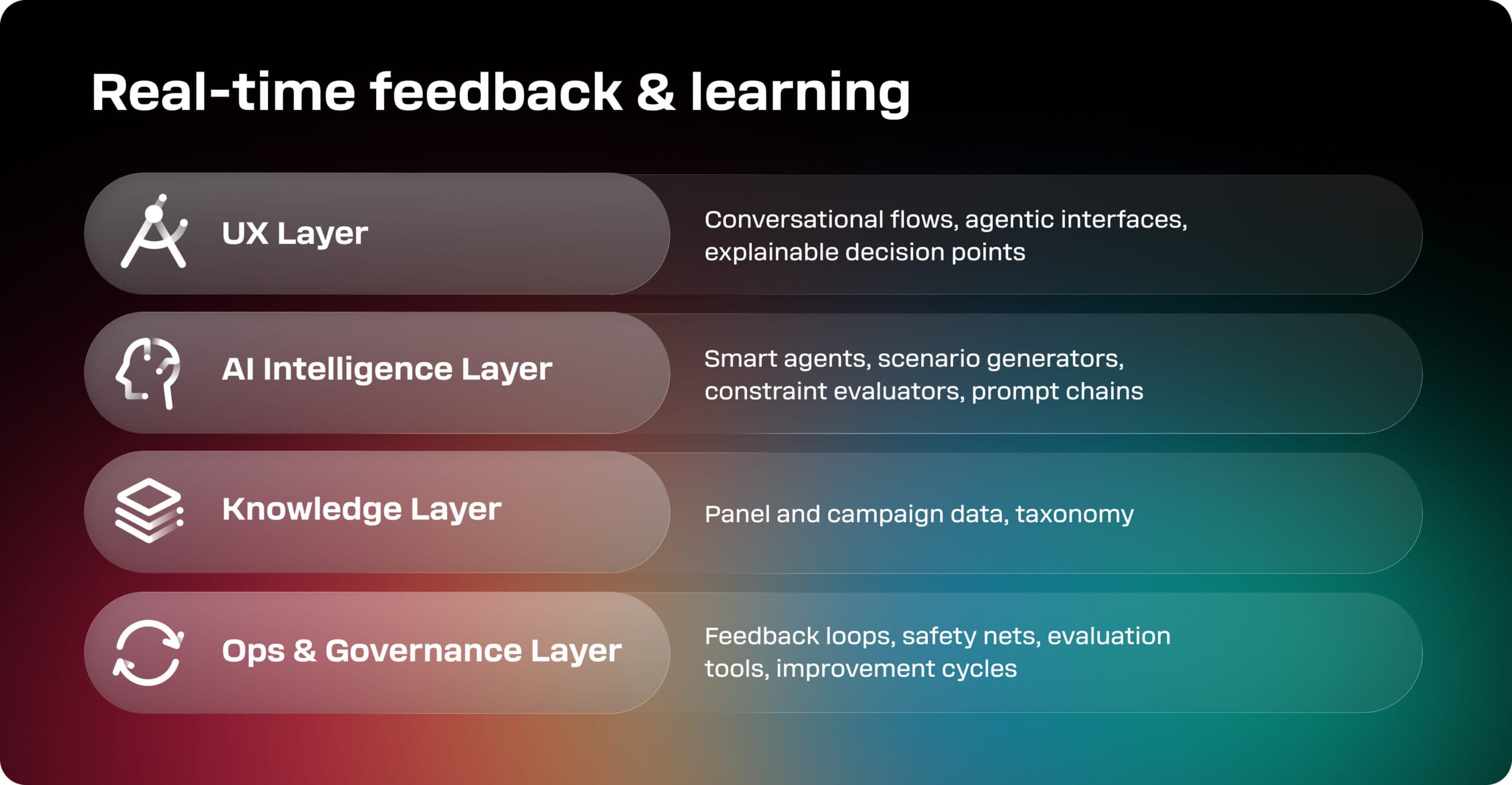
The Marketing OS is owned by the brand, not delegated to an agency. It is the connective tissue between the core marketing technologies a marketing organization uses — the data layer, the intelligence layer, and the experience layer — organized into a single, integrated operational architecture in an AI-native marketing platform.
The foundation layer: Integrated Data
At its foundation is an integrated data layer: first-party customer data, behavioral signals, campaign performance, brand sentiment, sales data, and third-party intelligence, connected via APIs and direct martech integrations into a unified data environment. Unlike the data warehouses marketing analysts occasionally query, this is a live, continuously updated substrate that every marketing decision draws from and contributes back to. Core technologies include a Customer Data Platform, CRM, cloud data infrastructure, and clean-room connectivity for privacy-safe first-party data collaboration.
The intelligence layer: continuous AI- driven insight
On top of that sits an intelligence layer: AI and machine learning systems that continuously monitor performance, identify emerging patterns in customer behavior, and surface recommendations in real time rather than at the end of a quarterly reporting cycle. The toolset spans predictive analytics, Marketing Mix Modeling, and attribution. But what makes it useful is that it runs continuously, not in reporting sprints.
The experience layer: personalization at scale
Where the foundation and intelligence layers do their work invisibly, the experience layer is what customers actually encounter. Content that adapts to user context in real time. Journeys that evolve based on behavioral signals rather than pre-built decision trees. Advertising and owned media running in a continuous feedback loop with the intelligence layer. The core technologies here are real-time personalization, omni-channel activation, account-based workflow, and a direct marketing-to-sales handoff.
What makes this transformative is not any single component. Customer data platforms, CRMs, marketing automation platforms, and analytics tools have existed for years. What is new is the AI-native orchestration layer that connects them and specifically the use of AI agents to automate the workflows that have historically required marketing teams to manually bridge those systems.
Agents are the operating infrastructure of the future marketing organization
The most consequential shift in the Marketing OS is the introduction of AI agents as operational infrastructure not as AI features within existing tools, but as the connective layer that makes the system function as an integrated whole.
An agent-enabled Marketing OS can monitor campaign performance across every channel simultaneously, flag anomalies in real time, and initiate optimization actions within defined guardrails without waiting for a human to open a dashboard. It can identify a high-value customer segment exhibiting early churn signals and trigger a personalized re-engagement sequence before the next campaign cycle. It can adapt creative assets dynamically for different audience contexts, testing variations and updating performance-weighted distributions continuously rather than through periodic A/B testing sprints.
The 80/20 principle applies here in a useful way: approximately 80% of a Marketing OS is standard across organizations - the same core technologies, integration patterns, and intelligence workflows. The 20% that is customized is the brand’s proprietary data and the workflow configurations that reflect how that particular organization actually operates. That combination of standardized infrastructure and proprietary intelligence is what creates defensible differentiation.
The marketing team that operates this system looks different from the marketing team of today. Fewer people are needed for execution tasks that agents handle. More people are needed for brand strategy, creative direction, ethical governance of AI behavior, and the relationship management that underpins long-term customer trust.
Get the strategic playbook for AI in media operations
What brands need to build now
What ties all of this together is a single shift: value is moving from messages to the systems that deliver them, in context, over time.
That is why the Marketing OS cannot remain an abstract idea. It is the enabling infrastructure for tomorrow’s consumer value propositions. A stack still organized around episodic campaigns and batch reporting cannot keep pace with AI-mediated discovery journeys or the always-on decisioning customers will expect.
Only a unified OS with integrated data, continuous intelligence, agent‑driven workflows at its core, gives brands the ability to show up inside delegated decisions and make every interaction feel recognizably human.
The question CMOs need to be asking is no longer “What’s our next big campaign?” but “What operating system are we building that will allow us to deliver the next decade of customer value?” The brands that treat this as a core enterprise investment will be the ones whose propositions still make sense when assistants do the searching, agents do the choosing, and customers judge them by the compound experience those systems create.