

The most honest question any advertising agency leader can ask right now is not 'how do we adopt AI?' It is 'what business are we actually in?' Because the answer is changing faster and more structurally than most agency strategies currently reflect.
AI will not replace advertising agencies. But it is already replacing the economic logic that most agencies were built around. That is a more consequential disruption, and understanding the distinction is the difference between strategic clarity and strategic drift.
The changing value of agency services
The traditional agency value proposition rested on three pillars: access, expertise, and execution. Access to media inventory and buying leverage. Expertise in channel strategy, creative development, and audience targeting. Execution delivered at scale through large, specialized teams. All three pillars are under structural pressure simultaneously.
Buying leverage as a moat is declining as platforms automate inventory management at the channel level. Expertise in channel execution is increasingly replicable by platform-native tools and AI-augmented in-house teams. Execution at scale is being repriced by the same automation economics that agencies are trying to benefit from, if agents can manage campaign trafficking, pacing, and optimization, the labor cost structure that underpinned service pricing no longer holds.
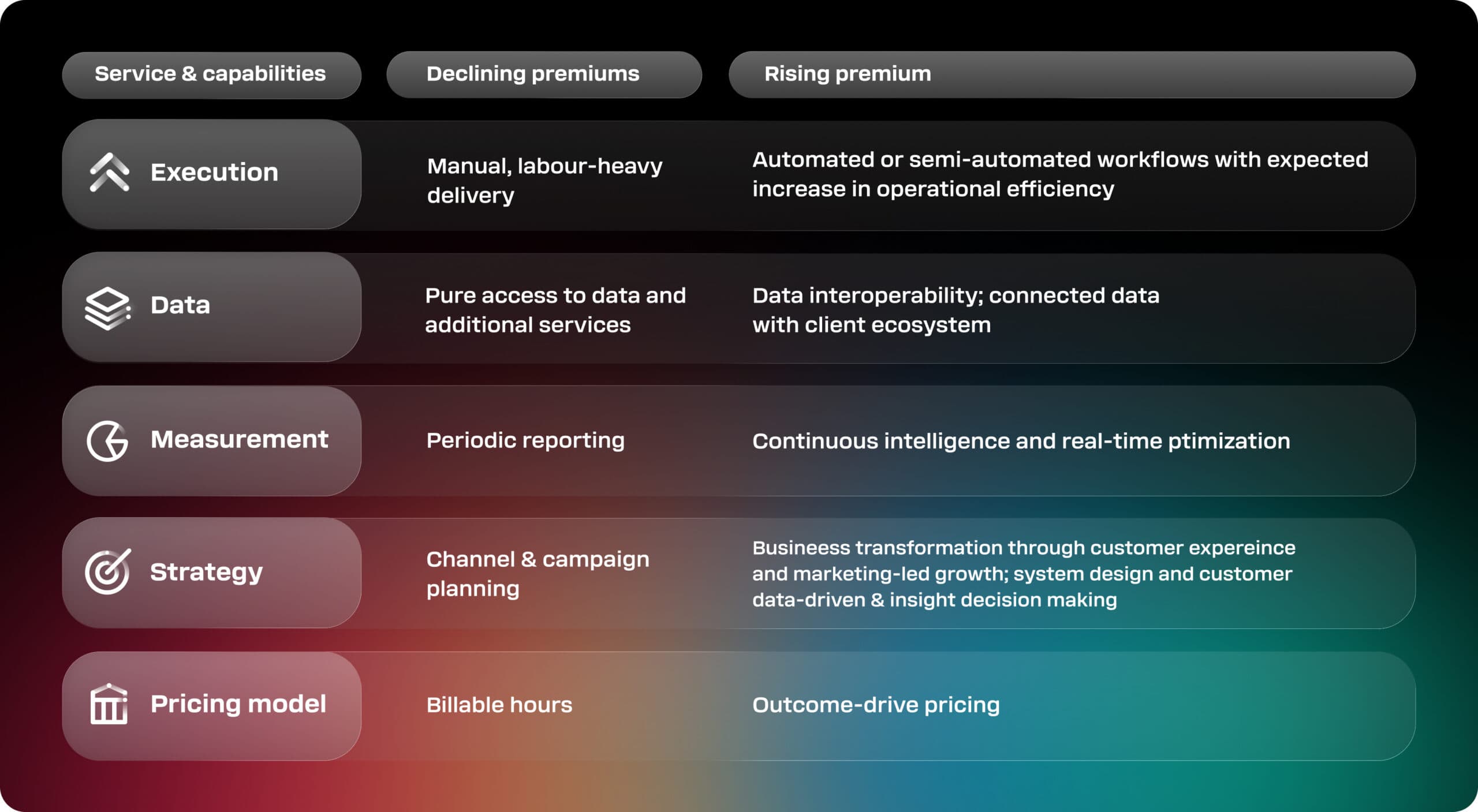
Based on our independent Forrester study, there is a clear client-side tension with 47% of CMOs saying agency platforms fall short on AI-driven automation; 32% view agency platforms as interchangeable and a direct threat to pricing power, while42% expect agencies to clearly demonstrate technology ROI.
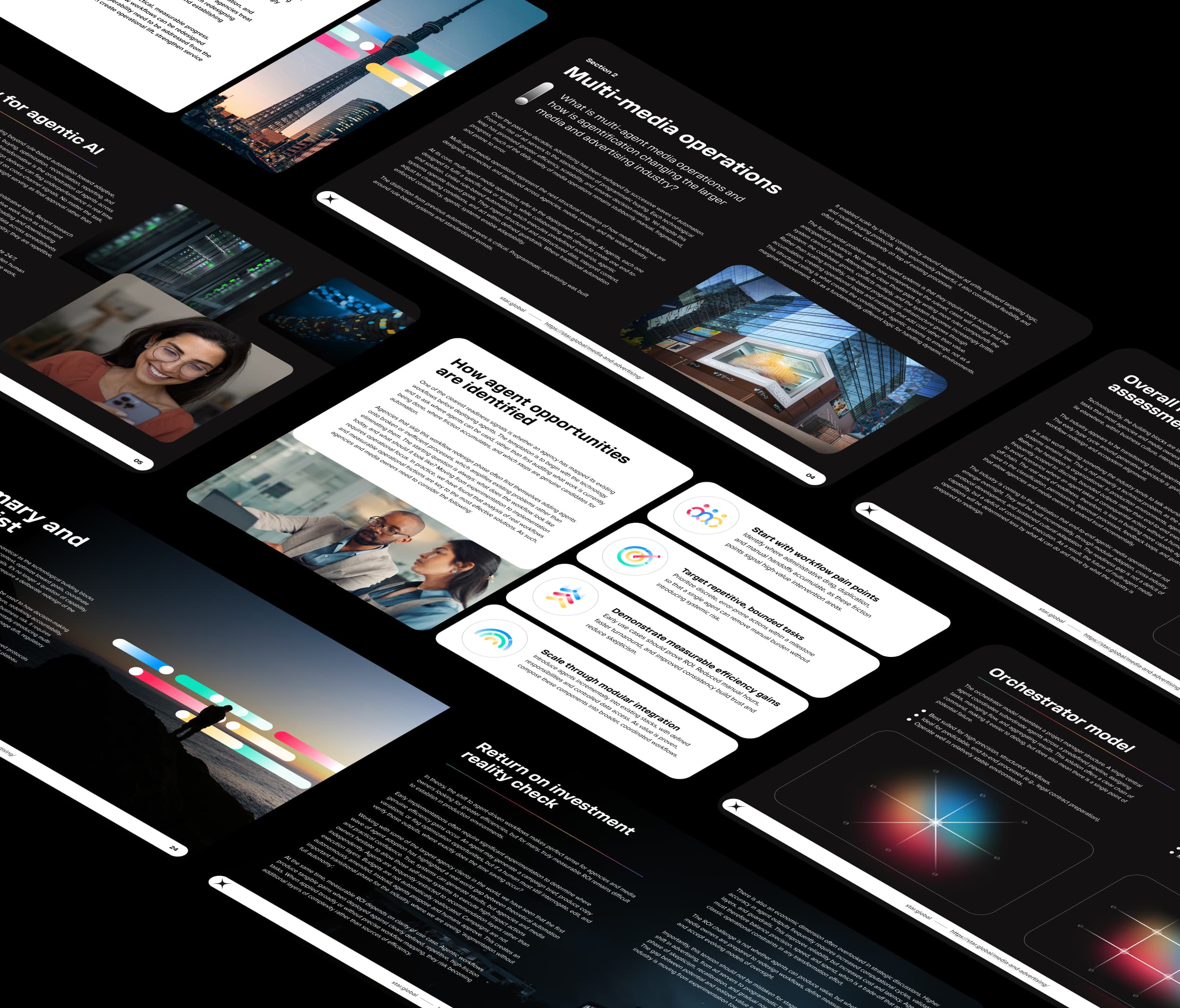
Increase speed, accuracy and margin in media operations
Meanwhile, global advertising investment is forecast to surpass USD 1 trillion for the first time this year, but the composition of that growth matters more than the headline number. WARC analysis shows that forecast upgrades for 2026-2027 are overwhelmingly concentrated within a handful of platform ecosystems: Alphabet, Amazon, and Meta absorbing the majority of incremental spend, and possibly soon OpenAI. Retail media, social video, CTV, and automated performance products are capturing most of the growth. The traditional agency role of coordinating fragmented channels and specialist teams is worth progressively less in a media landscape that is algorithmically concentrating.
Agencies that cannot clearly articulate what they provide that platforms and in-house teams cannot replicate are already in a pricing compression spiral they may not be aware of.
How the advertising industry is coping with the AI disruption
The advertising industry is not responding to these pressures uniformly. A three-way stratification is emerging, and where an agency ends up in that structure will be determined by decisions being made right now.
1. Holding companies: The platform gamble
The major holding companies are making large, visible bets on proprietary platforms as their primary defense against commoditization. Publicis’s recently expanded strategic partnership with Microsoft combining Azure cloud, 365 Copilot for 114,000 employees, and a full‑stack agentic marketing platform is now a credible proof point that platform‑led differentiation can translate into real strategic advantage in an industry traditionally known for its creative service.
Beyond Publicis, every major network is now signalling the same strategic bet: Omnicom is rebuilding around Omni as an AI operating system, WPP around WPP Open, while others push their own “intelligent” stacks as the new center of gravity for client relationships.
What is being built in each case is an attempt to shift the basis of competition from individual service capability to platform-level lock-in. The risk is execution. Networks are confederations of agencies, P&Ls, geographies, cultures, and legacy systems. The decisive variable for holding companies is more if they can transform fast enough and unlock connected growth for clients to stay relevant.
2. Technology-forward Independents: The specialist bet
For independents, the strategic logic is inverted. They cannot win by being smaller versions of holding companies. The path is selection, not breadth: identify the workflows where AI and agentic tooling create maximum differentiation, integrate those deeply, and turn narrow domain expertise into a defensible, productised operating capability.
AI is qualitatively different for independents than it is for networks. Where a network uses AI to harmonize existing scale, an independent uses AI to simulate scale it does not have. They can now deliver intelligence, automation, and experimentation capabilities that previously required ten times the headcount.
That is what makes the current environment unusually favourable for independents. They can use AI and workflow tools to reimagine services that were once highly manual, especially optimization, reporting, experimentation, or selected strategy tasks, without losing the focus, responsiveness, and client intimacy that already differentiate them. A well-positioned independent should lean into its agility, operate with more sophistication than its size might suggest, stay tightly focused on the client problem it solves best, and aim to become the CMO’s most trusted specialist partner.
3. Local execution shops: Human touch stands out
At the other end of the spectrum, small, execution‑focused shops still have space to play when they are solving very local problems that platforms and big networks are structurally bad at: community activation, grassroots partnerships, and hyper‑specific creator and influencer work that depends on real-world relationships rather than just reach models. In an AI era where content is cheap and AI chat becomes a generic interface between brands and people, the scarce asset is no longer output but trust, the human context, continuity, and local credibility that make a message feel like it comes from “one of us” rather than from a machine. Shops that can turn that human proximity into commercially relevant intimacy will remain valuable even as generic execution gets automated away.
What agencies must do to remain indispensable
The hard question every CMO is now asking their agencies is still: “What can you do that my stack and in‑house team cannot?” If the answer is only scale or cheaper delivery, the agency gets treated as interchangeable and priced accordingly. In an AI-native market where software and services blur, the real test is not whether you are “big” or “boutique”, but where you sit on two axes: degree of automation, and the level of commercial value you actually create.
X-axis: Degree of automation
- From high-touch / human-led services to automated / productized services
Y-axis: Commercial value orientation
- From cost driver / efficiency play to growth driver / strategic value
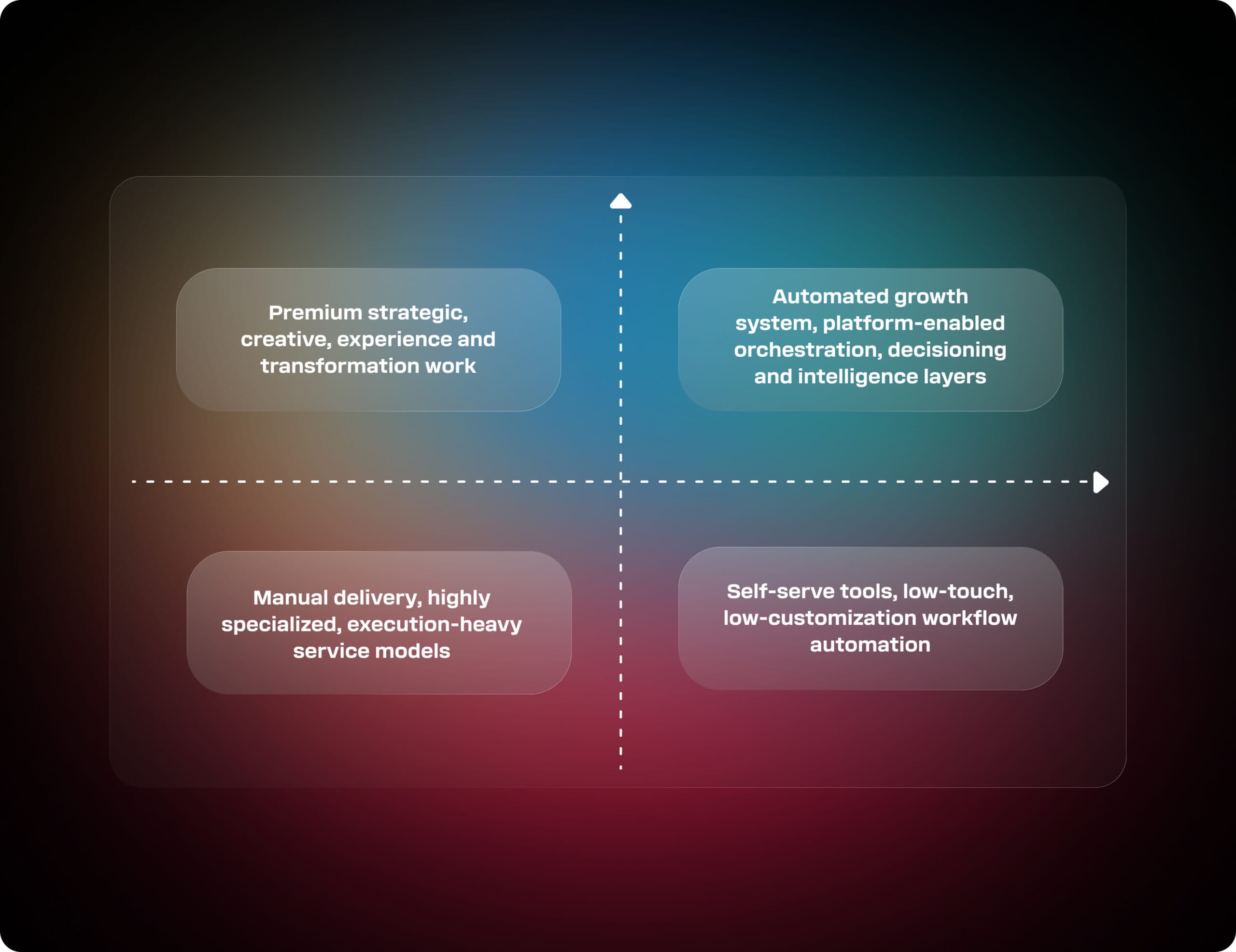
Define your operating model and differentiate it
If we borrow Michael Porter’s logic, agencies can still compete on differentiation or scale, but the expression of those strategies has shifted. The horizontal axis is now the degree of automation in your delivery model (from high-touch, human-led services to highly automated, productized workflows); the vertical axis is your commercial value orientation (from cost/efficiency play to genuine growth driver and strategic partner). Most AI-era competitors (platforms, tools, creator ecosystems), consultancies are simply choosing different coordinates on this grid and building operating models to suit.
For agencies, that makes the operating model non-negotiable:It is how you deliver value: the system of data, workflows, talent, automation, governance, and measurement that turns briefs into outcomes.
The growth model is what value you deliver and get paid for: efficiency, growth, risk reduction, category expansion, customer lifetime value. The common mistake is to confuse the two. talking about “value” while still running a labour-based operating model that is optimized for selling time, not outcomes. In an AI environment, your operating model must be designed to support the growth model you claim, or the strategy will collapse under its own contradictions.
Practically, this means agencies must choose and commit. One path is to stay relatively low on automation but very high on value: concentrated, outcomes-led differentiation in areas like cross-channel orchestration, identity and data strategy, causal measurement, complex transformation, and creative capabilities that are hard to replicate in-house. The other is to move high on automation and build a tech‑first model, where the core asset is an operating platform (data spine, clean-room and cloud integration, orchestration and agentic workflows, measurement infrastructure), with advisory and creative services as value‑adding layers on top.
Define your growth model and defend it
Once automation enters the stack, the traditional billable-hours model becomes structurally misaligned with both AI and client expectations. AI compresses the time required to perform many tasks; billing by time rewards slowness, while AI rewards speed. The result is an “efficiency paradox”: the more effective your AI-augmented delivery becomes, the harder it is to justify legacy fee structures tied to effort rather than impact.
Agencies that want to extract premium economics from AI need growth models that are explicitly linked to value, not hours billed. That means moving toward outcome-linked, performance-shared, subscription/platform-fee, or hybrid models where fees are anchored in the business impact delivered — revenue, profit, retention, lead quality, customer value — rather than the number of hours deployed.
To do this credibly, agencies must invest in real measurement infrastructure: data pipelines that connect media and experience to commercial outcomes, frameworks for incrementality and causal attribution, and governance that makes those numbers auditable. The operating model enables value creation; the growth model is how you get paid for it. Getting those two aligned and being very clear which point on the automation/value grid you want to own is now the core strategic job for agency leadership.
Explore how agentic advertising is reshaping media operations
Solve real client problems, the revenue will follow
In the end, the real moat is still the client relationship. Technology is the enabler and agencies only become indispensable when they are deeply embedded in how a client actually grows and solves their real business challenges through marketing and customer experience. Therefore, investing to build a connected, interoperable ecosystem between client and agency systems is both strategic and necessary. It turns platforms into shared infrastructure, makes collaboration smoother across vendors, and steadily compounds the commercial value of the relationship in a way that is very hard for a replacement partner to replicate quickly.