The creative industries have long set the bar for shaping culture and building iconic brands, but today’s marketers face a fundamentally different reality. Agencies that once thrived by adding the latest analytics tools or automating campaigns now operate in an environment where every new platform increases complexity, fragments operations and makes it harder to deliver unified, measurable growth. As marketing organizations evolve toward AI marketing platforms and enterprise platform architectures, agencies must rethink how technology, data and creativity work together to drive impact.
The fragmentation challenge in the marketing ecosystem
The advertising industry is caught in a martech trap. Over half of senior marketing leaders at $1B brands struggle to track ROI due to disconnected systems and siloed vendor solutions, according to our Forrester-backed research. These fragmented ecosystems limit the effectiveness of media workflow automation, data orchestration and AI-driven campaign optimization.
As enterprise CMOs take a more influential role in shaping technology decisions at the highest level, they become pivotal architects of their organizations’ digital and AI agendas. While this presents new opportunities for agencies and marketing vendors, it also creates challenges: as more brands build AI and platform solutions in-house, the risk of operational and technological fragmentation increases, making it harder for external partners to demonstrate unique value.
Tech giants such as Google, Meta, Amazon, ByteDance and Alibaba are capturing more than half of global ad revenues – over $1 trillion in 2024 – while advancing platform-native AI advertising solutions at a pace agencies must now match or risk irrelevance.
Against this backdrop, the typical agency/client relationship is under strain, with average tenure shrinking to just two to five years for many brands. Meanwhile, CMOs are demanding partners who don’t just execute quickly but can bring genuine business impact through deep integration, agility and strategic technology leadership to help them accelerate growth.
Why AI is reshaping the marketing value chain
AI and platform technologies are fundamentally reshaping how marketing and advertising are executed. This shift is directly impacting how agencies, martech and adtech vendors and media owners create and deliver value to brands, and the perceived value of their deliverables.
Today, automation and machine learning are shouldering tasks that previously relied heavily on human labor. The rapid rise and adoption of AI, as well as advanced platform technologies, are transforming the core of marketing value creation and delivery.
In the past, innovation was largely about new channels or creative formats.
Now, it’s about how quickly and intelligently brands can orchestrate their operations – enabling real-time data intelligence, process automation and end-to-end personalization engines. There are also new ad and media formats that use AI that significantly reduce production cost and create new customer engagement opportunities.
In sum, marketing operations are steadily becoming AI-first with automation powering the entire campaign lifecycle.
AI and machine learning now power about 17% of all marketing operations and marketers expect it to surge to 44% within three years, according to the 2025 edition of The CMO Survey from Duke University's Fuqua School of Business.
At the same time, the importance of platform technology and connected data infrastructure has come to the forefront.
CMOs today recognize that an AI-first marketing strategy can only succeed when systems are integrated, scalable and designed for seamless collaboration. Our research with Forrester confirms that fragmented tech and disconnected data sources remain significant barriers to track marketing ROI.
AI-native vs AI-enhanced marketing platforms: key differences
In today’s marketing landscape, agencies and brands are no longer judged solely by how quickly they execute or scale campaigns. Instead, true value now lies in platforms that offer advanced orchestration, integration and the ability to prove how every marketing dollar drives impact.
It is essential to draw a clear line between AI-enhanced and AI-native platforms because not all systems branded as AI-enabled fulfill the same promise.
AI-enhanced platforms are legacy systems with AI features bolted on retrospectively. While these solutions can automate some tasks, there is still operational friction with teams switching between applications and reconciling fragmented data.
AI-native platforms, on the other hand, are engineered from the ground up with artificial intelligence at their core. In these platforms, AI is in the foundational layer which allows the system to learn and adapt continuously.
The practical implications are significant.
AI-native platforms can handle both structured and unstructured data, make predictions and autonomous decisions with minimal human intervention and scale both operations and intelligence through modular, API-first architectures. AI-enhanced systems, constrained by their legacy design, struggle to keep pace with the rapidly evolving AI landscape and often require incremental scaling costs tied to traditional unit economics.
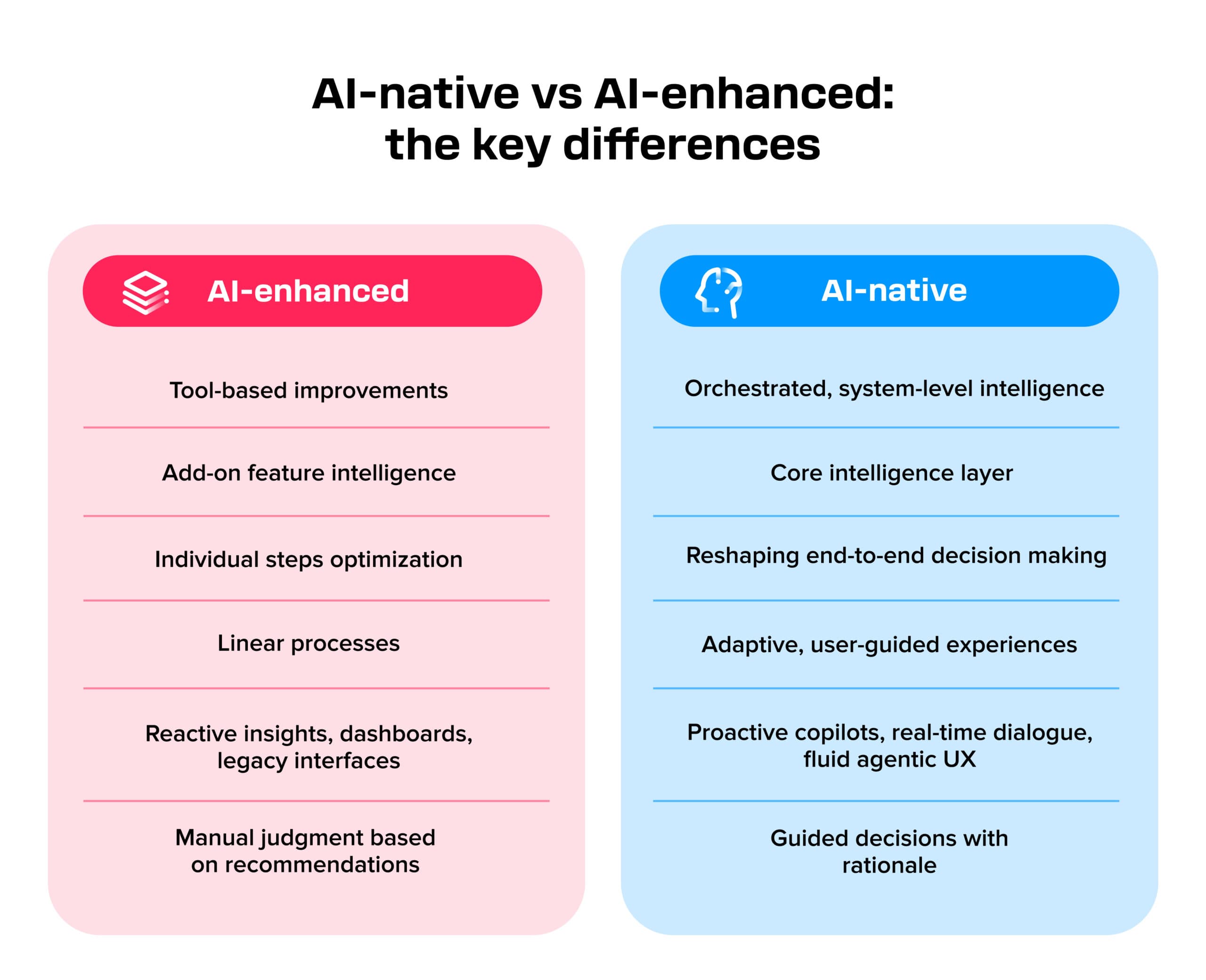
AI-native reimagines how work gets done by designing systems around intelligence from the start. Every process, decision and interaction is shaped by AI to guide, explain and evolve, naturally and continuously.
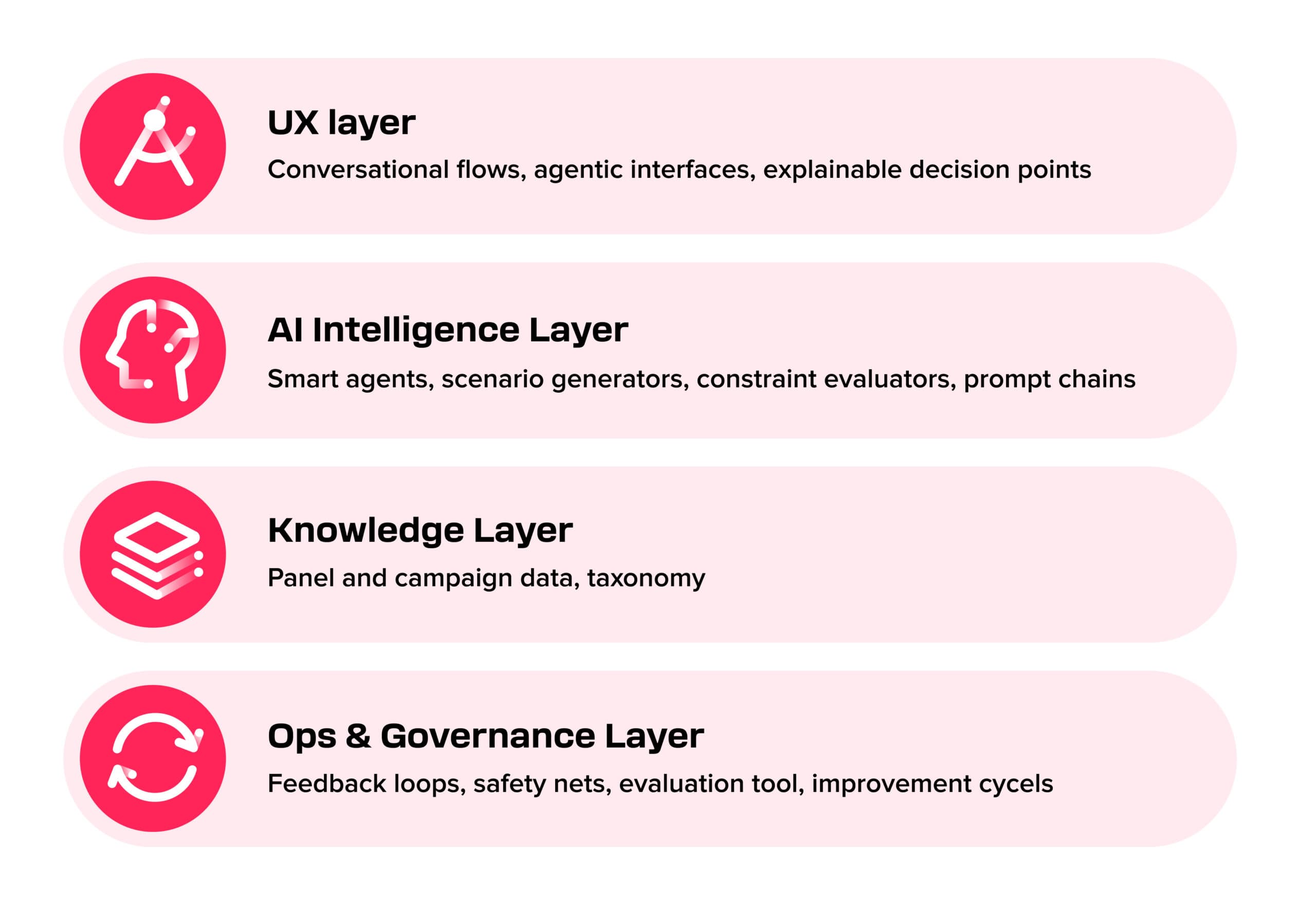
To navigate this new operating logic, it's essential to understand the four foundational architectural layers that collectively enable AI-native platforms to deliver outcome-driven marketing at scale. Each layer is designed to scale with use, adapt to market shifts and remain explainable.
Building the core: The four architectural layers
1. The UX layer
This is the surface layer where human and AI collaboration truly happens. It is built around conversational and agentic interfaces that act as a user's co-pilot.
For example, a media planner can ask a question in natural language and the AI agent can instantly provide a complete media plan, audience insights and performance forecasts by pulling data from across the system.
This layer's true value lies in translating complex concepts and workflows into intuitive, simple actions, freeing up an agency’s talent to focus on strategy and creativity.
2. The AI intelligence layer
This is the engine room of the platform, where smart agents and machine learning models live. It’s where data is processed to generate predictions, analyze trends and automate complex decisions.
This layer is responsible for everything from dynamic creative optimization to real-time bid adjustments.
3. The knowledge & data layer
This is the absolute foundation of the system.
AI is only as good as the data it’s trained on. This layer unifies fragmented data ecosystems into a single, clean source of truth, creating a competitive moat that off-the-shelf solutions can’t match.
It includes a unified identity graph that links a customer's behaviors and a data interoperability system that ensures fluid data flow between different platforms. This foundation is critical for enabling AI to create unique, client-facing intelligence that goes beyond generic models.
4. The operations & governance layer
This layer ensures the entire system is trustworthy and secure. It’s where CTOs and CIOs become not just managers of code, but managers of intent.
This is where we define the “why” behind the AI’s actions and set the guard rails to ensure it operates within legal and ethical boundaries.
This layer includes real-time behavioral audits, traceable decision logs and role-based access controls to prevent data leakage and misuse. This is what allows an agency to scale AI confidently, without exposing its clients to unnecessary risk.
Strategic benefits of an AI-native marketing platform
The strategic benefits for agencies and marketing vendors of an AI-native platform extend far beyond simplification and operational efficiency. By rooting development in principles like rapid experimentation, human-in-the-loop governance, modular low-code pathways and robust quality assurance, agencies are able to create platforms that continuously learn and adapt automatically.
Building around multi-model AI environments and automated feedback loops means systems stay reliable and relevant as market needs change. Incorporating MLOps from the start ensures every process is monitored and enhanced over time, while hybrid data retrieval techniques enable richer, more contextual intelligence.
For agencies, this approach powers faster onboarding and creative amplification and also positions them as strategic innovators delivering intelligence-led solutions, capturing new value and impressing clients with platforms that unify creativity and automation without sacrificing control.
By embedding rapid experimentation and automated feedback loops into the development process, agencies reduce complexity, speed up onboarding and naturally improve reliability and output quality over time. Modular, low-code system design supports seamless integration and fast adoption, while human-in-the-loop approaches and thoughtfully designed UX account for real client needs and niche agency/vendor expertise.
Human and AI collaboration in the creative industry
In AI-native systems, the balance between automation and human judgment is amplified. Our guiding principle: humans define the “why,” AI explores the “how.” At every stage, AI rapidly generates options, scenarios and insights, while human creators remain the final arbiters, bringing storytelling into every campaign.
This collaboration model fundamentally redesigns agency workflows with traditional linear processes replaced by iterative, AI-augmented cycles where humans and machines continuously refine outputs together.
Human sets the vision and direction
A critical starting point is for the human to define the strategic objective. The account team or creative director provides the "why", the big idea, the emotional hook, the business outcome we're trying to achieve. This provides the AI with the necessary context and purpose, a critical first step in any meaningful collaboration.
For a creative director, this means setting the emotional core of a campaign and providing the nuance that AI cannot. For a brand strategist, it's about identifying a cultural zeitgeist or a specific consumer need for the AI to explore.
It's the human's role to provide the qualitative layer, the intuition, and the moral compass that an algorithm lacks.
AI-powered idea brainstorming and exploration
Once the human sets the "why," the AI acts as a sophisticated agent, taking that high-level goal and translating it into an actionable plan. It analyzes vast, fragmented data sets from across the company from CRM platforms and social media analytics to sales figures and website traffic that a human couldn't possibly process in time.
Based on the human’s vision, the AI can then generate multiple scenarios and provide the "how", the most effective channels, the optimal budget allocation and the right creative variations to achieve the objective.
This is a powerful co-pilot that provides data-driven options that would be impossible for a human to produce alone. It can forecast the performance of different creative assets and media channels, giving the human a clear, data-backed set of options to choose from.
A media planner no longer spends hours manually pulling data. Instead, they get an AI-generated dashboard with real-time performance insights and suggested budget reallocations. This frees them up to focus on explaining the "why" behind the numbers to the client.
Human definition and refinement of AI-generated ideas
The human is still in the loop, acting as the final arbiter and editor. They review the AI’s suggestions, refining the output with their own creative judgment and intuition, and making the final decision.
This is where the human asks critical questions that the AI cannot: "Does this feel authentic to the brand?" "Will this genuinely resonate with an audience, or is it just statistically sound?" This oversight ensures that campaigns maintain a nuanced, authentic voice that resonates with real people. This critical step ensures that the system is trustworthy and the output is aligned with a brand’s values and expertise.
In short, AI-native collaboration is less about replacing what humans do, and more about amplifying vision and precision at scale.
The future of AI-native marketing ecosystem: What's next for agencies and marketing vendors
The next era of success in the marketing ecosystem will not be won by deploying more tools but by delivering genuine, integrated growth for brands. While technology is the enabler, results – not technology ownership – define value.
As a partner to some of the world’s largest agencies, we believe leaders on the supply side of marketing must be clear on what defensible strategic value they want to deliver to their clients, the role they want to play in a fragmented market, and how they’ll solve for integration to unlock CMO growth agendas. Only then can they map back to the internal digital maturity, AI readiness and infrastructure investments required to bring that vision to life.
Agencies and vendors that grasp this will drive the shift from “more tech” to “meaningful transformation,” – positioning themselves as indispensable partners in an era that will reward adaptability, unified data, and commercial accountability.
Looking ahead, the future of marketing is not just always on, it’s always learning. CMOs and brand leaders need to adopt ecosystem thinking and look to vendors as strategic collaborators, not just suppliers. The bar is rising fast for what truly integrated, outcome-driven marketing can accomplish.
Those agencies, publishers and platform builders that anchor their strategy around business outcomes – and work backward to orchestrate people, processes and technology – will be the ones that define what partnership and leadership look like in the AI-native era.