

Launching a mobile app in 20 countries with AI-translated screens and localized app store listings may seem like a success. But language support alone does not guarantee strong performance. While localization can significantly improve results – one study found 128% more downloads and 26% higher revenue per country after adding a local language – many global launches still underperform because translation is only one part of the system.
Most failures occur when products are designed for a single language and context, then retrofitted for other languages and contexts. This approach does not scale, and global users quickly reveal the cracks. The outcome is often technically accurate translations that are functionally incorrect, inconsistent interfaces, and products that feel unfamiliar or unreliable.
AI translation for mobile apps needs more than access to a tool. It needs the right prompting, the right context, and the right configuration by people who know how to use it properly. Many teams see AI as something they can simply switch on and expect human-level results. In reality, that is rarely the case.
What is localization engineering?
Localization engineering is the technical discipline of making mobile applications work consistently across languages, markets, and cultures. It covers content structure, interface behavior, feature variation, deployment, and ongoing maintenance.
Translation is only one output of that system.
Localization is not just about translating strings. It’s about defining the inputs, the context, and the way those translations are applied so the product actually works in each market.
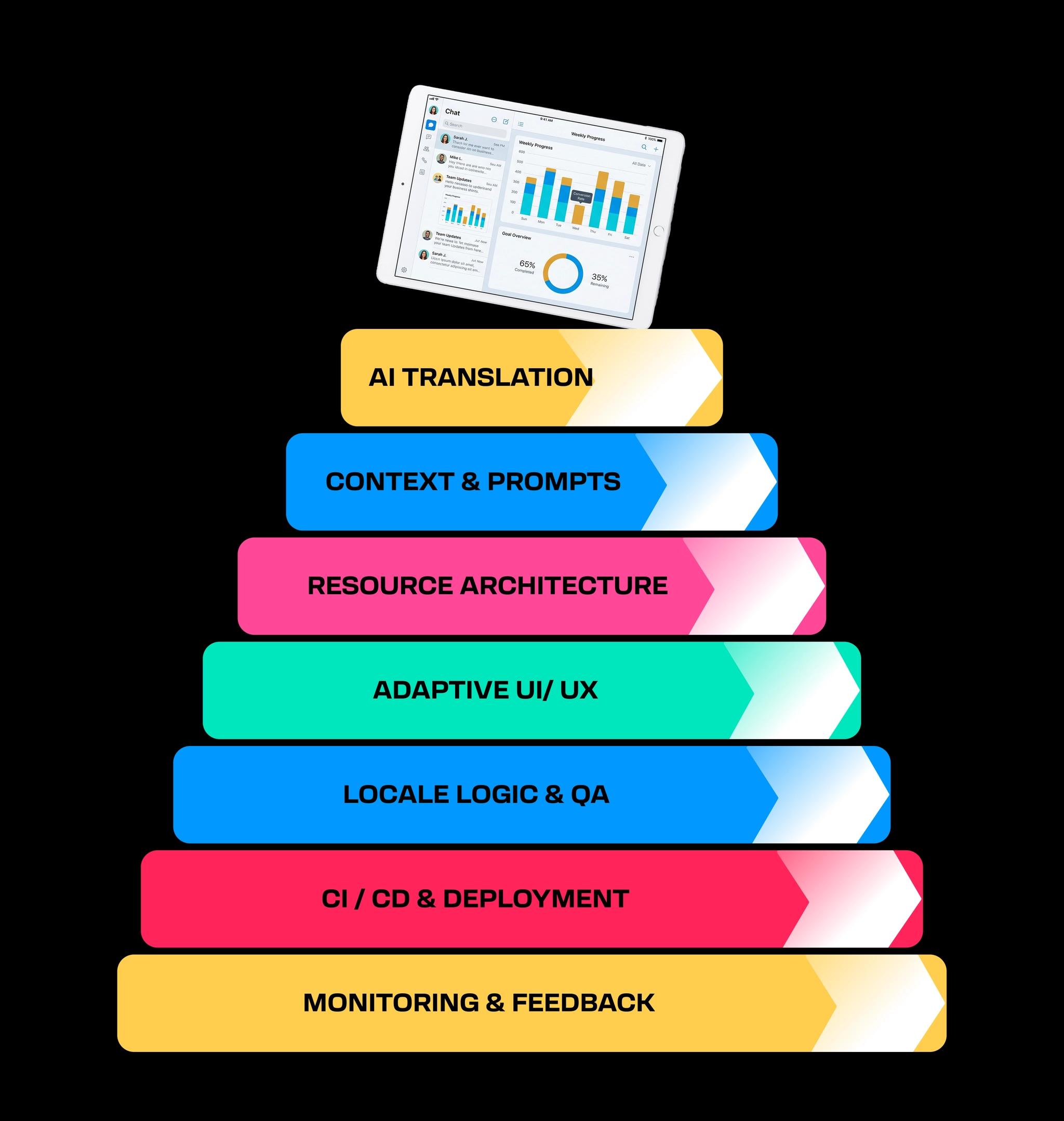
For CTOs and product leaders, this is the key distinction: localization is not a downstream content task; it’s a product architecture decision that affects scalability, release quality, and market readiness.
Why this requires engineering expertise
Localization is often confused with translation or treated as a late-stage task for generalist developers. Neither approach scales. Once products expand across markets, localization introduces system-level concerns: resource handling, UI behavior, feature configuration, automated workflows, testing, and coordinated releases.
The 80/20 rule: Beyond translation
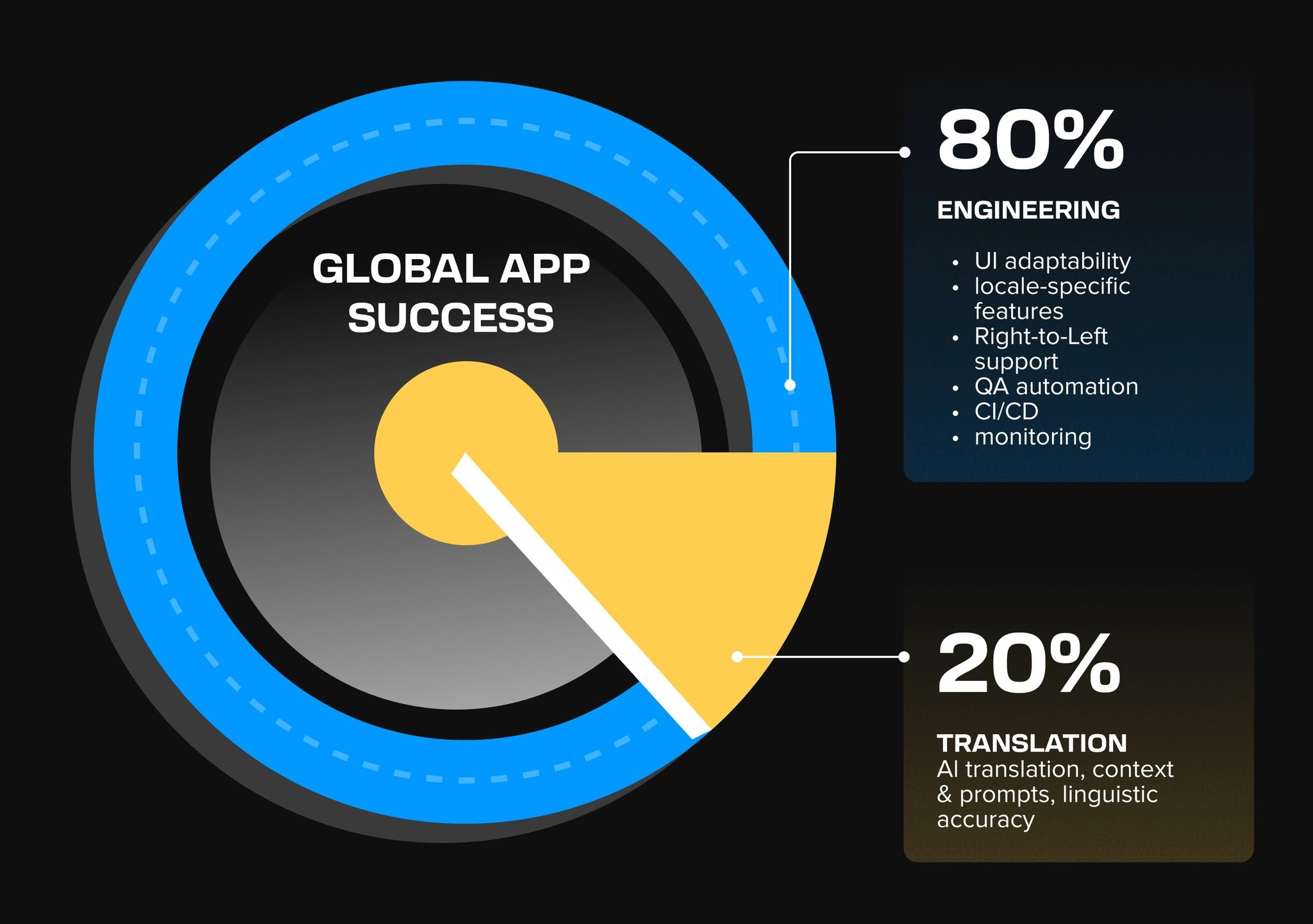
Translation represents only 20% of the effort. Once the appropriate system is established, translation becomes routine. The remaining 80% involves UI adaptability, locale-specific functionality, right-to-left support, cultural adaptation, performance monitoring, app store optimization, and quality assurance. Achieving global mobile app development success requires strong engineering, design, release, and operational discipline, not just language quality.
If you configure everything correctly, the system will do it for you. The bigger challenge is everything else you have to keep supporting around the release.
It is this “everything else” that often undermines global mobile app launches.
Common localization engineering challenges
UI breakage: Layouts built for short English strings often fail under longer translations such as German, Polish, or Finnish. Buttons wrap, cards overflow, and onboarding screens become cramped or unclear. Accurate translation does not guarantee that the interface still works.
Locale-specific functionality: Global apps rarely behave identically across markets. Payment methods, address formats, legal requirements, tax handling, consent flows, and disclosures often differ. At that point, localization becomes part of the product logic, not just content.
Supporting right-to-left languages: Languages like Arabic and Hebrew require more than translated strings. Layout direction, hierarchy, navigation, and component behavior all need to adapt. Without that, the product feels broken from the start.
Cultural adaptation: AI can translate text, but not the meaning of imagery, iconography, metaphors, colors, or interaction expectations. A product may be readable and still feel foreign.
Performance under real-world conditions: Launching in a new market is a usage event, not just a language change. Different devices, networks, and traffic patterns can expose issues that were never visible in the home market.
Monitoring and operational readiness: Release is not the end of localization work. Teams need telemetry, feedback loops, and clear ownership of production issues.
App store execution and QA at scale: Screenshots, descriptions, release notes, and proofing all affect performance. Manual QA across multiple locales and devices does not scale, so automation becomes essential.
In practice, translation is only a small part of the effort. The majority of work involves engineering, design, release, and operational disciplines needed to deliver a reliable product in every market.
The operating model for localization engineering
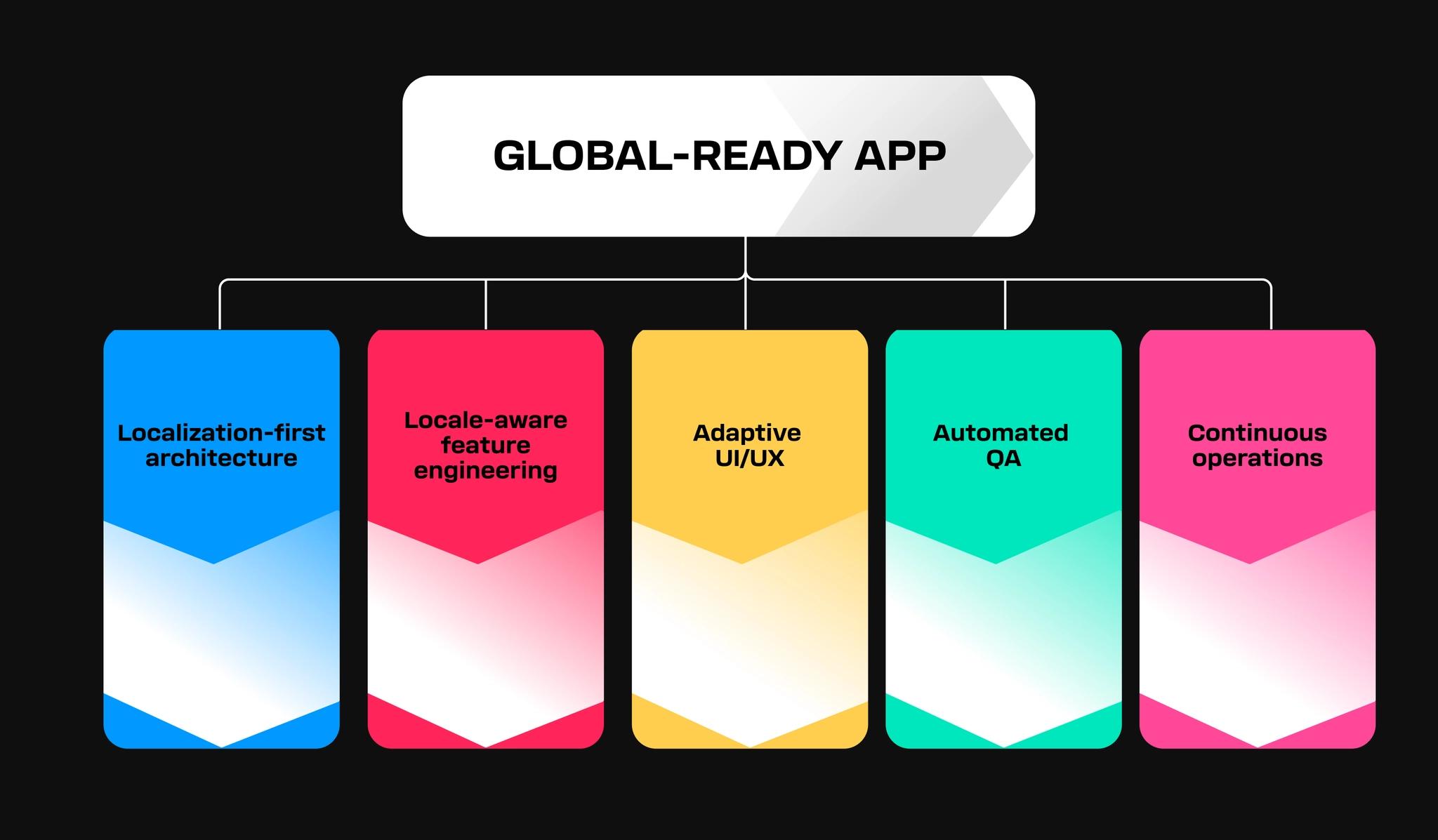
Localization engineering is most effective when approached as a system rather than as isolated tasks. This system is built on five pillars: localization-first architecture, locale-aware feature engineering, adaptive UI/UX, automated QA, and continuous operations. Each pillar has varying importance at different stages. Early architectural and feature decisions eliminate significant risks, while delays increase the cost and complexity of future changes.
Localization-first architecture
Design for multiple languages and markets from the outset. Choices regarding resource structure, language loading, and integrations influence all subsequent development. Retrofitting later introduces more errors.
Locale-aware feature engineering
Not all features are relevant in every region. Feature flagging enables teams to tailor functionality by locale without fragmenting the codebase.
Adaptive UI/UX engineering
Interfaces must adapt to different languages, text lengths, and right-to-left scripts. Layouts and components should expand or contract as needed, maintaining clarity and usability.
Automated localization QA
Automation can identify many structural and visual issues at scale. However, language quality, tone, and context still require human review, especially in complex flows.
You can automate parts of it, but there are still things you will miss. Full automation of localization quality is not something I’ve seen working reliably yet.
Localization engineering is not about managing five separate workstreams. It is about integrating them into a unified system that supports global growth and minimizes rework. All five pillars matter, but sequence matters too. Addressing architecture and feature design early makes localization easier to build, scale, and maintain. Delaying them means even small changes can create broader product disruption.
Common localization engineering anti-patterns
If the challenges of localization engineering are well understood, the next question is why teams still struggle with them. Why do mobile apps fail in global markets? In most cases, the problem traces back to early assumptions that do not survive scale.
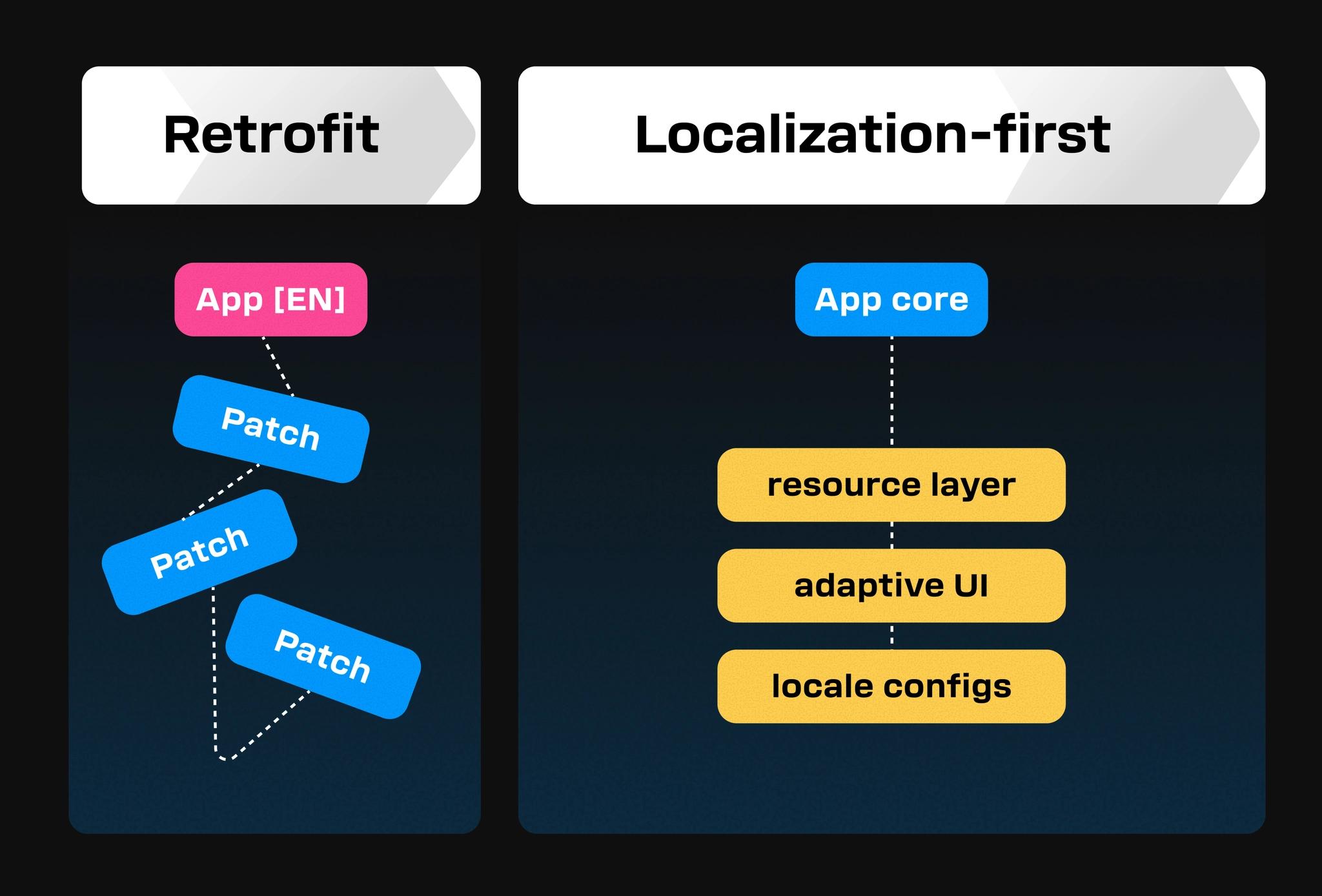
The retrofit disaster: A product built for one market is extended to others through translation and patch fixes. As markets expand, inconsistencies, feature divergence, and regulatory variation create fragmentation.
Translation is the smallest problem you’ll have if you try to take a product into different markets without preparing for it.
The English-sized UI: Interfaces designed around English break under longer strings, forcing text truncation, layout compromises, or unnatural translation.
The translation without context problem: Without descriptions, screenshots, or UI references, translators guess. Output may be linguistically correct but functionally wrong.
You end up putting limitations on translators so they have to fit the original layout, instead of the product adapting to the language.
The manual QA bottleneck: Manual validation across locales, devices, and platforms does not scale. Automation helps, but human review is still needed.
The hardcoded nightmare: Even where hardcoding is avoided, poor key structure, naming, and string composition still increase translation effort and reduce maintainability.
The one-and-done deploy: Localization is treated as a milestone rather than an operational process, leaving teams blind to locale-level performance issues after launch.
You can split your metrics by locale, but it’s hard to isolate translation issues because product performance is more complex than just language.
The pattern is consistent: localization is treated as an added layer instead of a built-in capability. Fixing these problems later is always more expensive than designing for them early. Without monitoring, teams cannot distinguish between translation issues, product-market fit challenges, or technical defects.
Localization engineering patterns and architecture
If anti-patterns show where localization fails, patterns show what mature systems look like.
Well-localized apps are not built on isolated best practices, but on consistent architectural decisions that make localization predictable, scalable, and maintainable over time. When those decisions are in place, localization stops being a source of friction and becomes part of the product's natural evolution:
Resource externalization and abstraction: Mature systems separate localizable content from code and abstract resource handling so UI and business logic are not tied to platform-specific implementations.
You want your UI layer to be agnostic about where resources are coming from.
Dynamic layout systems: Interfaces must flex across languages, content lengths, and writing directions. Constraints should be deliberate, not defaults.
Don’t limit your widgets unnecessarily. Think ahead about how they will behave with different string lengths.
This is where engineering judgment and design systems meet. When handled well, it is invisible. When ignored, it surfaces immediately as UI breakage.
Feature flagging by locale: Feature variation is inevitable in global products. Flagging allows teams to adapt functionality by market without fragmenting the codebase.
Translation memory and pipeline integration: Mature systems connect codebases directly to translation platforms, reducing duplication and keeping content, code, and releases aligned.
Pseudo-localization and automated detection: Many issues can be identified before translation begins through pseudo-localization and automated checks for missing or hardcoded resources.
Incremental rollout and observability: Strong release practices matter even more in localization. Gradual rollout and locale-level observability help catch both visible and silent failures early.
Expose features to a smaller group, gather feedback, monitor crashes and analytics – then expand.
In stronger systems, localization becomes part of the delivery flow rather than a source of friction. That only happens when localization is embedded into the delivery pipeline itself, rather than managed as a parallel process.
The localization engineering pipeline
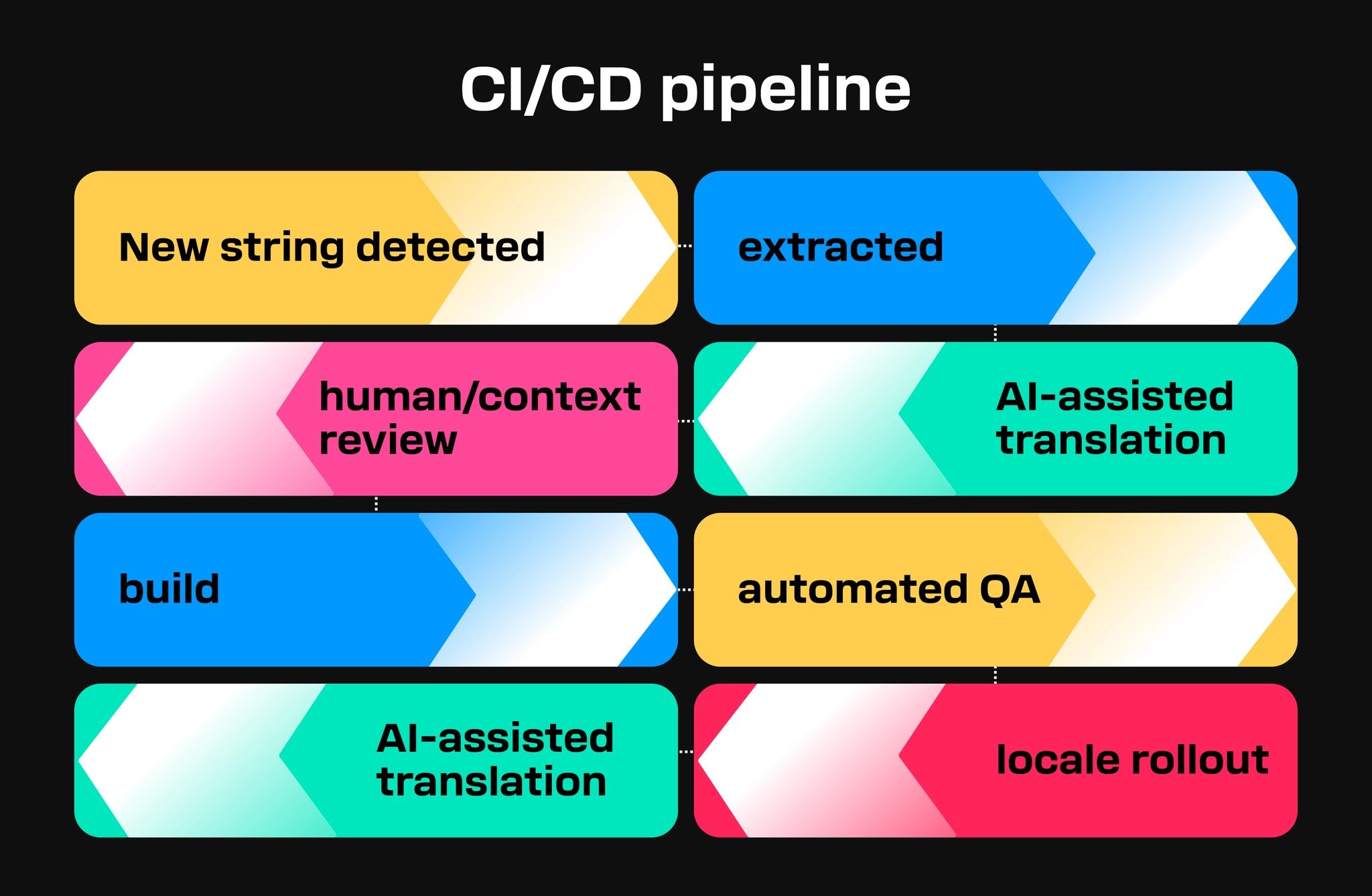
Localization becomes scalable when it is embedded into mobile CI/CD rather than handled as a separate workflow. New strings are extracted automatically, sent to translation platforms, returned to the codebase, and reviewed before release.
In mature systems, this includes string extraction, translation submission, AI-assisted translation where appropriate, pull request creation, and final review. The shift is simple but important: localization stops being a blocking task and becomes part of the normal delivery process.
Where AI helps, and where it doesn’t
AI accelerates translation and reduces manual effort, especially for lower-risk content. But it still depends on context.
If the translations are bad, you can fix them later. But the system still needs the right inputs and configuration.
Without structured inputs and clear context, output may be linguistically correct but functionally wrong.
Testing, deployment, and monitoring
Localization does not end at release. It continues through monitoring, iteration, and optimization. Automation can validate layouts, detect missing strings, and surface structural issues early. But tone, nuance, and context still require human review. Once localized builds are released, performance must be monitored by locale so teams can distinguish translation issues from broader product or market problems.
The most important shift is not tooling, but mindset. Localization is no longer a handoff between teams or a task at the end of delivery. It is part of the system that delivers the product. When embedded into CI/CD, it becomes continuous. Changes flow automatically, and issues surface earlier, so quality improves without increasing manual effort.
The business case: ROI of localization engineering
Localization engineering is often framed as a quality improvement. In practice, it is a growth decision.
- Cost: Retrofitting localization affects layouts, logic, testing, and release processes all at once, often leading to redesigns or rebuilds. Building for localization upfront requires more initial effort, but that effort is controlled and reusable.
- Conversion: Users engage more readily with products they can understand, but the bigger gains come when interfaces behave correctly and the experience feels native, not merely translated.
- Time to market: Without a structured approach, localization slows releases through manual coordination. With localization embedded into the pipeline, expansion becomes a configuration problem rather than a delivery bottleneck.
- Quality at scale: Engineering support makes quality consistent across locales through automation, visibility, and repeatable workflows.
- Technical debt and velocity: Poor localization decisions accumulate silently. A localization-first approach keeps the system flexible and preserves long-term development velocity.
- Competitive advantage: Teams that launch early with products that feel native build trust faster, learn sooner, and iterate ahead of competitors.
Localization engineering turns expansion into a repeatable capability.
Building a localization engineering practice
Localization engineering is as much organizational as it is technical.
In-house vs. partner
The right approach depends on scale. Larger organizations with multiple products and frequent releases often benefit from building in-house capability, while smaller teams may benefit more from partnering. The key is understanding actual demand, not assumed demand.
If you only have one product, it’s often better to work with people who already have the experience, instead of hiring in-house.
The underestimated skill mix
Teams often overestimate how much continuous translation work they will have, and underestimate where the real complexity lies. The challenge is not a new technical capability, but structuring workflows, providing context, and integrating localization without friction.
Cross-functional collaboration
Localization sits across engineering, product, design, and content. Without alignment, gaps appear quickly. Strong systems bring these functions together into a single, coordinated workflow.
What separates successful teams
The difference is clarity. Successful teams understand what expansion into a new market actually means for their product, whether it is primarily language or deeper changes to features and logic. The first step is not tooling. It is readiness. Teams need to assess architecture, UI flexibility, feature variation, pipeline integration, and quality requirements before making decisions.
You need to understand what the new market actually means for your product before you start building, because that understanding shapes everything that follows.
Engineering your global app development future
The companies that succeed internationally do not treat localization as a final translation step. They treat it as part of the product system from the start. AI has improved the translation layer, but it has not solved layout constraints, feature variation, release complexity, QA at scale, or the need for context. AI is a powerful tool, but it is not a substitute for localization engineering. The teams that succeed globally recognize that early. They design for it, build for it, and turn international expansion into an engineered advantage.
Planning to take your mobile app global?
Star helps mobile teams build apps that perform in every market, not just translate into every language. Schedule a localization architecture review to identify the technical, UX, and delivery gaps before they slow down your expansion.
FAQs
Mobile app localization engineering is the process of designing and building apps that function correctly across languages, regions, and cultures. It goes beyond translation to include UI adaptability, feature variation, deployment workflows, and ongoing monitoring.