
Imagine it’s a morning in 2030, you’re having a cup of coffee and your AI agent notices you're low on coffee – it then orders from your favorite brand. You never made any request or opened an app.
By mid‑morning, you casually tell your agent you want “a beach holiday with the family, but with historical sites to explore.” It suggests a handful of destinations and, once you choose one, automatically books flights, hotels and restaurants that match your tastes, calendar and budget.
Later, a new sale from your favorite running shoe brand just came on. Your agent did not inform you on purpose based on the fact that you bought new shoes 3 months ago, and based on your running patterns (tracked via your fitness app), you won't need new ones for 6 more months and that you’re saving for your trip to Australia, saving you an impulse buy that you may regret.
These are many decisions made in a day that you didn’t initiate but are happy with.
Welcome to agent-to-agent (A2A) commerce – the most fundamental transformation to consumer behaviour since the advent of digital media.
What is A2A commerce?
Agent-to-agent commerce, or agentic commerce, refers to shopping and transactions mediated by autonomous AI agents acting on behalf of both buyers and sellers. In this new paradigm, a consumer’s personal AI agent can communicate directly with a brand’s AI agent to discover products, negotiate terms and execute purchases with minimal human intervention. These agents can carry out multistep transactions independently – all while aligning with their human user’s intent.
A2A commerce shifts the traditional shopping flow and brand experience and blurs the boundaries and steps between discovery, decision and purchase.
Critical enabling technologies for A2A commerce
- Autonomous AI agents and LLMs: Advanced LLMs serve as the “brains” of shopping agents, interpreting complex user requests and reasoning through decisions. These agents leverage LLMs to understand broad intents (e.g. “Find me a week’s worth of groceries”) and plan actions across multiple steps. Modern agent frameworks combine LLM-powered reasoning with traditional programming for reliability – yielding systems that are both flexible and precise.
- Real-time data platforms and knowledge graphs: To make intelligent decisions, agents integrate with real-time data feeds and knowledge graphs. This means accessing up-to-the-minute information on prices, inventory, shipping times, reviews, and more. For example, an agent can tap into live e-commerce databases and a user’s personal knowledge graph of preferences to recommend a product and confirm it’s currently on sale and in stock. Graph databases (like Neo4j) enable an agent to maintain context and relationships, making sure that interactions stay relevant, explainable and trustworthy as the agent considers various options.
- APIs and structured product data: Agentic commerce shifts the interface from human-facing websites to machine-facing APIs for services and data. Agents “don’t want open-ended web crawling; they want a structured feed” of product info. Thus, machine-legible catalogs and robust APIs are essential. Having structured data allows an agent to query, filter and compare options instantly, instead of scraping webpages. Going forward, merchants must expose product data in standardized formats (e.g. JSON-LD, schema.org, knowledge graph entries) so that any AI agent can readily consume and understand their offerings. Real-time APIs then let agents perform actions like adding to cart or checking out programmatically.
- Agent communication protocols and platforms: As the ecosystem matures, new platforms and protocols are emerging specifically to support agent-to-agent interactions. A notable example is Google’s A2A protocol, an open standard that allows AI agents to communicate, exchange information securely and coordinate tasks.
- Autonomous payment and trust frameworks: When agents can complete purchases, the payments infrastructure must adapt to non-human actors. Enabling secure, rules-based transactions is critical. One enabler is the development of an Agent Payments Protocol (AP2) – a framework introduced by Google Cloud (with industry partners) to let AI agents initiate and authorize payments on behalf of users. AP2 and similar efforts address challenges like authenticating that an agent is truly authorized by a user to spend money, and conveying the user’s payment credentials without exposing them. These protocols often use cryptographic signatures or digital mandates to verify an agent’s identity and permissions, providing verifiable and auditable transaction trails – a cornerstone for building trust in autonomous commerce.
Taken together, these technologies create the foundation for agent-to-agent commerce. An agentic shopping journey might leverage an LLM-based planner connected to knowledge graphs and real-time APIs, operating within an agent interoperability protocol, and completing a payment via an agent-specific transaction rail – all automatically. With the groundwork laid, we next examine how these technologies change the consumer experience.
How will consumer experience change in an agentic AI era

A2A commerce will significantly change the current consumer choice architecture by moving choice upstream into preferences, constraints and policies rather than downstream into browsing and persuasion. Instead of scanning menus of options shaped by “traditional” marketing activities such as search, advertising, influencer marketing and events, consumers can share their intent, budget, values and other criteria important to them with their AI agents and let them act on their behalf.
Of course AI agents will not “consider” options based on brand storytelling – a key marketing strategy that brands invest in to differentiate from their competitors – they will make choices by filtering structured product data and contextual memory, often backed by knowledge graphs, against their user’s goals and needs.
In practice, however, today’s models are probabilistic rather than deterministic, which means their “buying” behaviour can be noisy or hard to reproduce from one interaction to the next – a major challenge for brands that are used to tuning funnels and campaigns against stable, predictable conversion paths
Even with that uncertainty, the behaviour and interaction paradigm will still shift: shopping shifts from navigating interfaces to delegating outcomes. The classic funnel of search, scroll, compare, cart, checkout compresses into conversation and approvals. For many categories, the experience becomes ambient, meaning the agent handles and repeats all “ purchasing process and actions” and timing in the background, then surfaces only the moments that matter. Consumer effort moves away from clicking and toward guiding, reviewing and occasionally overriding.
The new marketing ecosystem
How will A2A commerce change brands and the larger marketing ecosystem? The answer is everything.
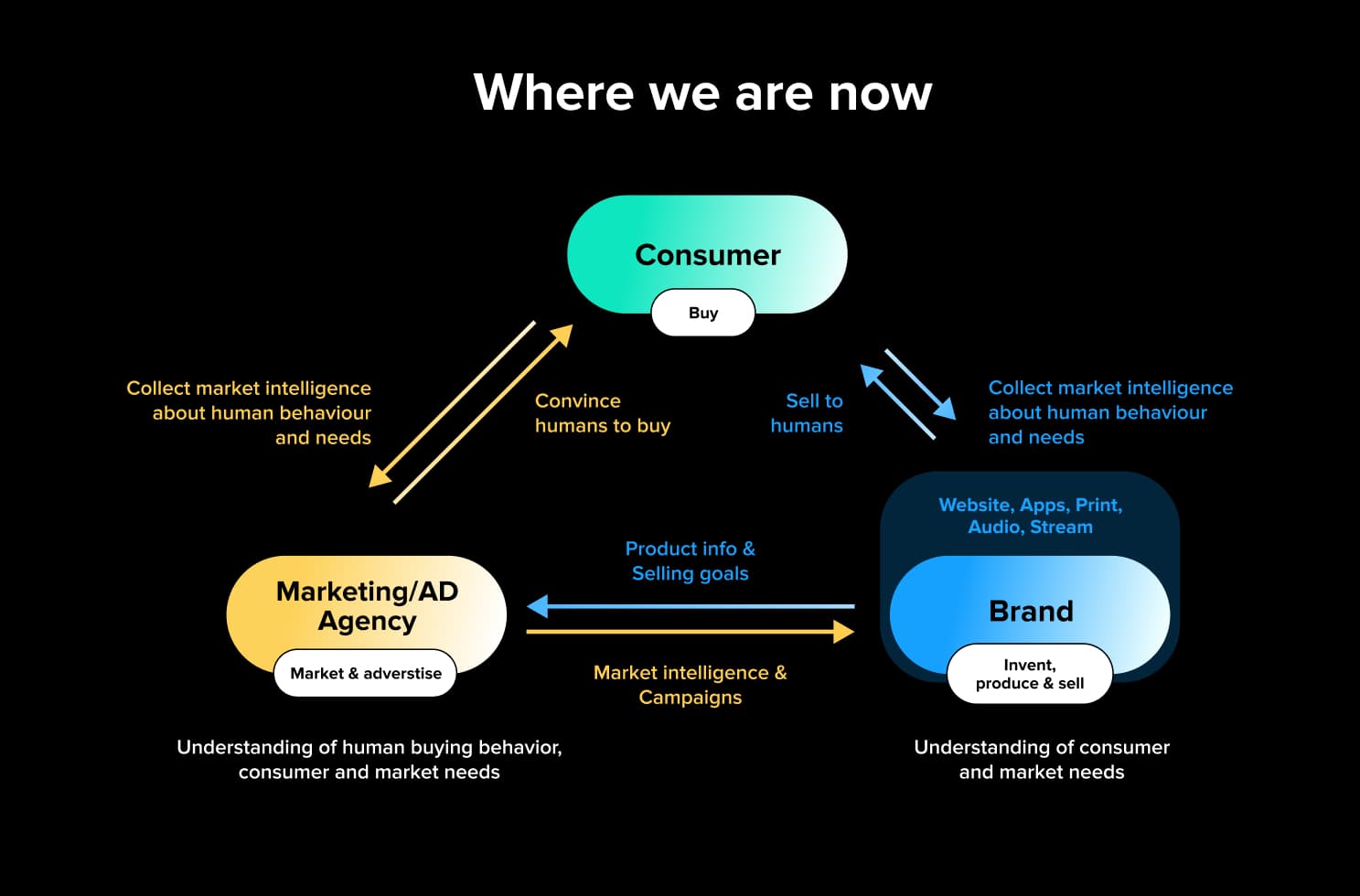
Traditional marketing often aims to persuade or create desire through emotional storytelling and brand messaging. In an agent-mediated purchase, persuasion will take a backseat to relevance and trustworthiness. An AI agent isn’t swayed by emotion; it systematically evaluates options based on the user’s goals and parameters. This means brands have to win on substance, meaning product data, trust signals, performance evidence and alignment with user intent. For example, if a user values sustainability and their agent knows this, a brand that can prove its product is more sustainable (through data) will have an edge over one with a catchy slogan but no environmental info.
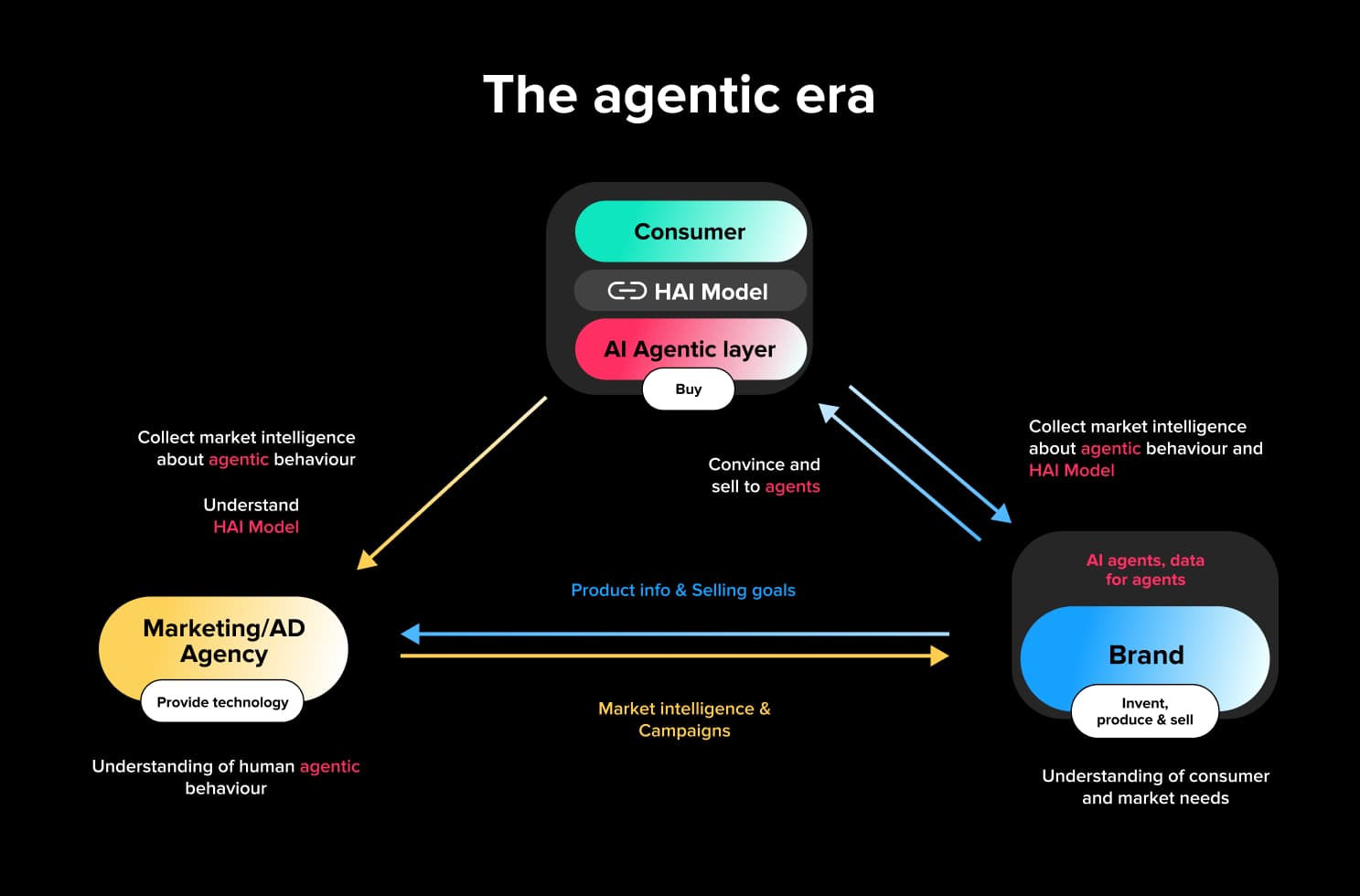
For brands, success moves from being “top of mind” to being top of the agent’s rankings. They need to expose clean, structured product data, real‑time availability, clear prices and policies, and often their own brand agents so other agents can query, evaluate and negotiate efficiently. Brand loyalty will also be tested – will an agent stick to a brand the user historically likes, or switch to a competitor that offers a marginally better fit for the request?
With agents in the mix, the traditional customer touchpoints diminish, but others emerge. Post-purchase and customer service interactions may increasingly occur agent-to-agent. A customer’s agent might directly contact a brand’s customer service bot to resolve an issue or make a return, with minimal user input. This requires brands to have robust AI or agent interfaces for after-sales support. “Marketing” might also shift more to post-purchase engagement: since the initial sale might be automated, brands could focus on delighting customers through packaging, unboxing experiences and all things the agent might not fully handle) to leave an impression on the human.
Instead of crafting campaigns, marketing and advertising agencies could become translators between human intent and algorithmic selection: they study how agents rank and filter options, what data fields and performance signals carry the most weight, and how agent‑to‑agent negotiation unfolds, then redesign product structures, offer logic and content so that brand propositions win under those rules.
Agencies can also start providing agents as a service. They can design and operate dedicated brand agents that are fully optimized for a client’s products, categories and policies. These agents embody the brand’s voice and commercial logic, sit inside the agentic ecosystem as first‑class actors, and act as always‑on specialists that consumer agents can query, compare and negotiate with directly on behalf of the brand.
Media investment will also shift: budget will move away from visual ads into retail media inside agent interfaces, sponsored answers and deep integrations with the major assistant and A2A platforms that now control access to demand. New “media” formats will emerge, such as sponsored answers or AI‑native retail media placements; the monetization model will also as performance will be measured by the share of agentic recommendations and baskets rather than engagement.
How will trust be built in an agentic AI era?
As AI agents take on greater autonomy in making decisions on behalf of people, trust becomes the defining condition for adoption. Delegation only works if individuals remain confident that agents are acting in their best interest, within clearly understood boundaries, and in ways that reflect their values and constraints. This requires intentional design principles that embed transparency, consent, explainability and control into every agentic interaction.
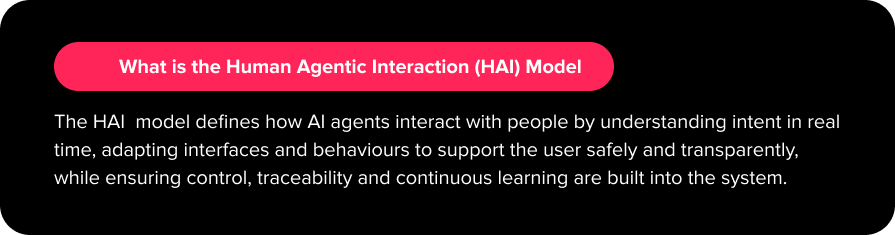
This is the role of the HAI Model. It functions as the ethical and experiential operating system for agentic commerce. It helps to make sure that AI agents remain trusted delegates of the person. By defining how autonomy is granted, how decisions are explained and how humans can intervene at any point, the HAI Model creates the conditions under which consumers can confidently delegate and brands can innovate without eroding trust.
For brands and agencies, the HAI Model is what makes agent-to-agent commerce viable at scale. It translates abstract “human-in-the-loop” principles into concrete interaction rules that determine how autonomy is granted, how decisions are explained and how control can be exercised at any moment. It encodes principles such as supporting and augmenting the human, allowing users to constrain or override agents at any time or demand reasoning and audits behind agent actions.
Operationally, the HAI Model shapes how consumer agents and brand agents interact across the entire A2A flow. On the consumer side, it moves choice upstream into preferences, constraints, and policies: users define what matters to them and the agent acts and optimizes strictly within those boundaries.
On the brand side, it sets expectations for how merchant agents behave in the ecosystem, meaning that they need to go beyond“agent‑ready” and be “agent‑and‑human aligned.” Brands will need to make sure their merchant agents behave in ways that people would recognize as fair, transparent and respectful. That means encoding rules that translate brand values into machine behaviour that are explainable.
As many “interactions” happen without a human in the room in an A2A setting, the HAI Model can be a way for brands to prove to customers and regulators that those invisible decisions still reflect the user’s preferences, rights and values.
It’s worth noting that the HAI Model is not owned by a single platform. Each organization that deploys agents, whether a brand, agency or technology provider, can implement its own parameters based on its own context and needs. Those who treat HAI as a strategic capability will be able to innovate confidently while remaining relevant as decision-making shifts away from humans and into autonomous systems.

What’s next
Agent-to-agent commerce is not a distant theory, we are seeing big tech companies producing standards for agent interoperability, alongside a growing number of pilot programs and technical frameworks that brands can begin testing today. For instance, Google’s Agent2Agent Protocol allows heterogeneous AI agents to communicate, exchange information and coordinate tasks securely. It already has support from 50+ partners (including Atlassian, MongoDB, PayPal, Salesforce, ServiceNow) as a foundation for a multi-agent ecosystem
Likewise, Anthropic introduced a Model Context Protocol (MCP) to help agents share tools and context, and OpenAI – together with Stripe – announced an Agentic Commerce Protocol (ACP) enabling purchases to be completed within ChatGPT’s interface
E-commerce platforms are adapting to be agent-ready. Shopify, for instance, is positioning itself as the “API surface area for agents” with its recent introduction of an embedded commerce widget for LLMs, a headless, agent-optimized product catalog with structured data queries and a universal shopping cart that can span multiple merchants.
McKinsey predicts that by 2030, trillions in commerce could flow through AI agent orchestration. The next few years will determine who captures that value. Standards are being set, consumer expectations are forming, and agent ecosystems are taking shape right now. Decisions made in this window will define which brands are selected by agents, which agencies remain strategically relevant, and which players are disintermediated.
For brands and agencies, the agent era demands a choice: lead the transformation or get led by it. The next 18 months are critical. Brands that act now will architect their products, data and policies so agents naturally prefer them; and in doing so, help define what "trustworthy" and "agent-friendly" actually means in their categories.
Agencies that move fast will become trusted advisors for their clients on how to compete inside agent ecosystems, how to design merchant agents that build loyalty through transparency and fairness, and how to embed HAI principles into experiences so that convenience and human values reinforce each other. The future of commerce is being coded right now, and those who take these steps early will help shape how agent ecosystems operate and where value accrues. Those who delay will find themselves increasingly irrelevant, optimizing experiences for humans who are no longer the primary decision-makers.