

The software-defined vehicle was supposed to change everything. And in many ways it did — OTA updates, connected services, sophisticated ADAS, digital cockpits replacing analog dials. Yet for most drivers, the experience of being in a car has not fundamentally changed. The system still waits to be told what to do. The interface looks identical at 130 km/h on the Autobahn and in city stop-and-go. The car knows more about its own tire pressure than about the person behind the wheel.
The transition now underway is structural rather than incremental. We are moving from the software-defined vehicle to the AI-defined vehicle — the AIDV — and the distinction matters more than most OEM roadmaps currently reflect. Where an SDV uses software to control vehicle behavior, an AIDV uses AI to shape the experience of being inside it. That shift moves the center of gravity from systems engineering to experience design, opening an in-car AI experience space that most OEMs have not yet seriously entered.
What “AI-defined” actually means for in-car experience
AI-defined in-car experiences get described as a smarter voice assistant, a gateway to ChatGPT embedded in the dashboard, or a collection of individual AI features added to an existing HMI stack. None of those descriptions get at what the AIDV actually represents.
At its core, an AI-defined vehicle experience is a fundamental shift in how the vehicle relates to its occupants; from reactive to anticipatory, from static to contextual, from vehicle-centric to human-centric. Each of those three shifts changes the design brief in ways that ripple through HMI AI innovation, system architecture, and commercial strategy simultaneously.
In-car systems in the market today alert the driver after a problem is detected, a fatigue warning when fatigue has already set in, a low-fuel light when the tank is already low. AI personalization in the car enables a shift toward anticipation: recognizing patterns in driver behavior, vehicle data, and environmental context to act before an issue materializes. The system that notices a driver always stops for coffee on Tuesday mornings and pre-conditions the cabin accordingly for that moment of pause, is delivering a qualitatively different product to one that waits to be asked.
When interfaces, audio settings, and cabin configurations remain fixed regardless of situation today. AI can now introduce a continuous contextual adaptation — adjusting the in-car AI experience based on driving scenario, time of day, passenger composition, and individual history. An Adaptive Cockpit that reduces interface density and enlarges critical data at speed represents a different design paradigm, one that requires OEMs to rethink what the HMI is designed to do rather than simply what features it offers.
Most in-car sensors monitor the vehicle. AI enables a redirection toward the human, using biometric data, behavioral analysis, and emotional signals to optimize the cabin for the driver’s physical and mental state. Predictive Wellness, which reads heart rate via steering wheel sensor, detects fatigue early, and responds with fresh air, calmer routing, and adjusted lighting before the driver consciously notices the change, is a different class of product proposition than a warning light. The vehicle stops measuring performance signals and starts reading people.
The seven shifts AI enables
Grounded in years of HMI concept work with OEMs and the use case research that forms the basis of this article’s companion report, we identified seven macro shifts in how AI personalization in automotive HMI changes what in-car experience can be.
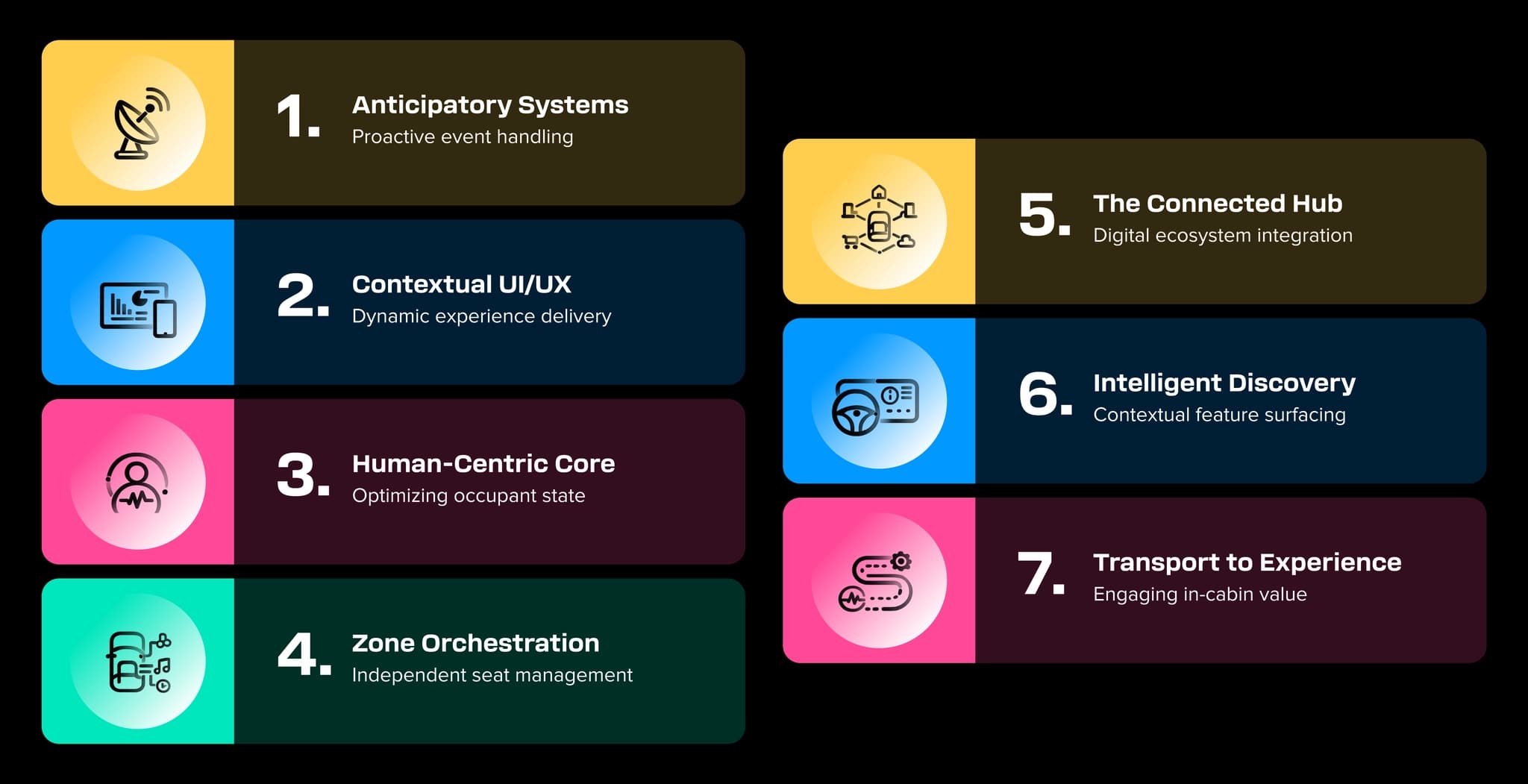
- From reactive to anticipatory. Current systems respond to events. AI-enabled systems prepare for them, acting on patterns in driver behavior and vehicle data before an issue surfaces.
- From static to contextual UI/UX. The same interface for every situation is a product compromise. AI adjusts the in-car AI experience dynamically based on driving scenario, time of day, passenger composition, and individual history.
- From vehicle-centric to human-centric. Sensors that monitor the machine redirect, with AI, toward the human inside it, optimizing for physical and mental state rather than technical performance metrics. This is the foundation of intelligent in-car assistant design that genuinely earns driver trust.
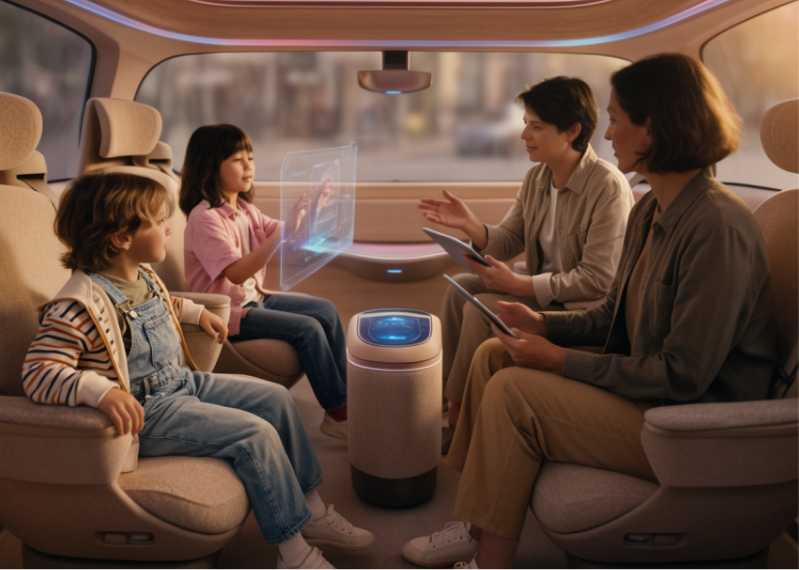
- From one cabin to many zones. AI makes it possible to treat each seat as an independent experience zone, delivering individualized content, climate, and interaction to each occupant while managing coordination between them. A Cabin Experience Orchestrator can give the driver focused navigation, the co-driver browsing at the destination, and children age-appropriate audio via headrest speakers, simultaneously.
- From an isolated system to a connected hub. In-car systems have largely operated independently from the driver’s broader digital ecosystem. AI bridges this gap by linking vehicle context — location, timing, occupancy — with external systems like calendars, smart homes, and communication platforms. The phone-to-car transition becomes invisible rather than a manual friction point.
- From feature overload to intelligent discovery. Modern vehicles contain hundreds of features, most unused. AI shifts the model from static menus to contextual surfacing, presenting the right capability at the moment it becomes relevant and making the vehicle progressively self-explanatory.
- From transport to experience. Drive time is largely passive. AI opens the possibility to transform it into productive, restorative, or emotionally engaging time, creating in-cabin experiences tied to the act of driving that cannot be replicated on a phone or at a desk.
Each of these shifts maps to concrete design concepts that can be prototyped, validated, and built. The gated report accompanying this article contains 20 such in-car AI use cases for OEMs — from Predictive Wellness and Biometric Emotion Engine to In-Car Commerce Hub and AI Road Trip Curator — each with defined end-user value and OEM value articulated separately.
The experience gap most OEMs are not structured to close
The technology required to enable these shifts is largely available. Sensors exist. Connectivity exists. AI models exist. The gap most OEM AI roadmaps fail to resolve is organizational: the capability to translate that technology into something drivers genuinely want, trust, and return to every day.
Most OEM product development processes optimize for feature delivery: define a capability, specify it, engineer it, validate it, ship it. That process works well for deterministic software. Applied to in-car AI experience, it produces systems that are technically correct and experientially flat. The difference between a voice assistant that executes commands and an intelligent in-car assistant that genuinely improves how people move through their day is a design and behavioral problem, resolved in iteration with real users, not in a functional specification document.
Consider what happens when a driver asks “Why is my range lower today?”, a command-execution assistant answers with a generic prompt to check settings. A Conversational Vehicle Brain, an LLM-based assistant with access to the vehicle’s full digital twin, every sensor, parameter, and fault state, returns a contextual answer referencing tire pressure and headwind, and offers an actionable next step in plain language. The underlying technology difference between these two outcomes is small. The product design difference is fundamental, and it is not closed by adding AI to an existing HMI team’s workload.
In-Cabin Productivity illustrates the commercial dimension of the same gap. Level 2+ driving already frees up semi-available time, but the infotainment system offers no productivity tools. Professionals spend 30–60 minutes daily in-car unable to prepare for their first meeting. A productivity mode that activates when conditions allow, voice-first email triage, calendar prep, task capture, features that pause when driving demands full attention, reclaims 20–40 minutes of daily drive time. The OEM opportunity is concrete: a strong differentiator for the business and fleet segment where productivity features directly influence vehicle choice, and an opening for enterprise software partnerships with Microsoft, Google, Anthropic, Salesforce and others.
Closing that gap takes AI-native teams unencumbered by legacy HMI thinking – designers and strategists who can imagine genuinely new modes of interaction beyond the application of AI to existing patterns.
Why the window is shorter than it looks
Asian OEMs, particularly Chinese players, are shipping AI in-car experience at a pace most established OEMs have not matched. NIO’s NOMI, which Star co-designed, established an industry benchmark for in-car AI personality and emotional presence. BYD and Li Auto are building AI-native software-defined vehicle experiences from scratch, competing on digital capability as a primary purchase driver rather than a premium add-on. In Europe, Volvo's ongoing integration with Google signals that the competitive pressure is not confined to Asian markets. These brands are setting consumer expectations for what in-car AI feels like. Once those expectations anchor in a market, they become the reference point against which every incumbent is measured.
The generational dimension compounds this. Younger buyers entering the primary car-purchasing demographic have grown up in hyper-personalized digital environments. They do not register AI personalization as a differentiator — they register its absence as a product deficiency. A car that does not know them, does not adapt to them, and cannot anticipate their needs reads as a legacy product regardless of brand heritage or price point. This shift in buyer expectations is already reshaping how forward-thinking OEMs approach brand relevance across the ownership lifecycle.There is also a compounding data dynamic. AI in-car experience improves with use, each driver interaction generates behavioral data that refines personalization, sharpens anticipation, and deepens model quality. OEMs that begin building genuine AI personalization capability now accumulate the behavioral data, model refinement cycles, and user trust that makes their systems progressively more valuable. Those that delay face a structural disadvantage that grows over time, rooted in the learning curve they have not yet started.
The 19 in-car AI use cases for OEMs
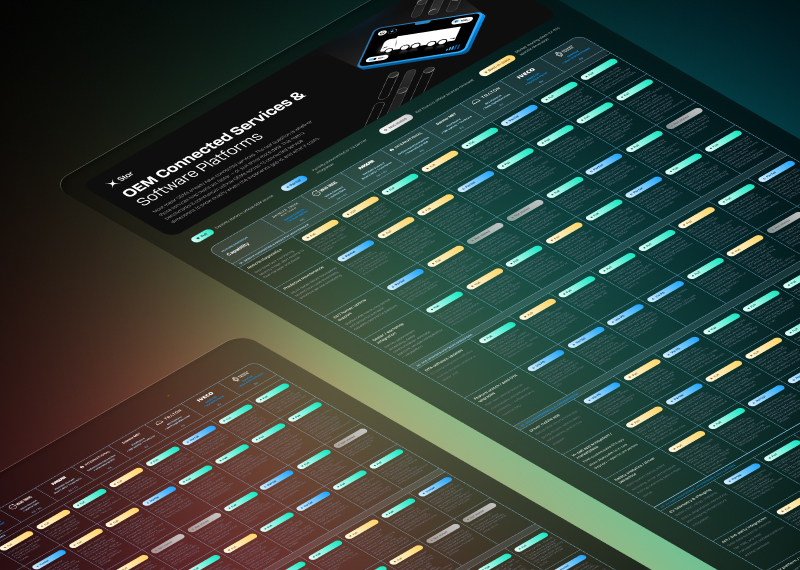
The research behind this article goes further. We cataloged 19 AI-enabled in-cabin concepts — from Adaptive Cockpit and Predictive Wellness to Biometric Emotion Engine and In-Car Commerce Hub — with one question in mind: which ones are your competitors already prototyping?
Each concept is mapped to the challenge it solves, the experience it creates, and the OEM business case: revenue implications, competitive positioning, and partnership opportunities where relevant. A working resource for HMI innovation leads and AI strategy owners — not a finished roadmap prescription.
Access your in-car AI innovation playbook
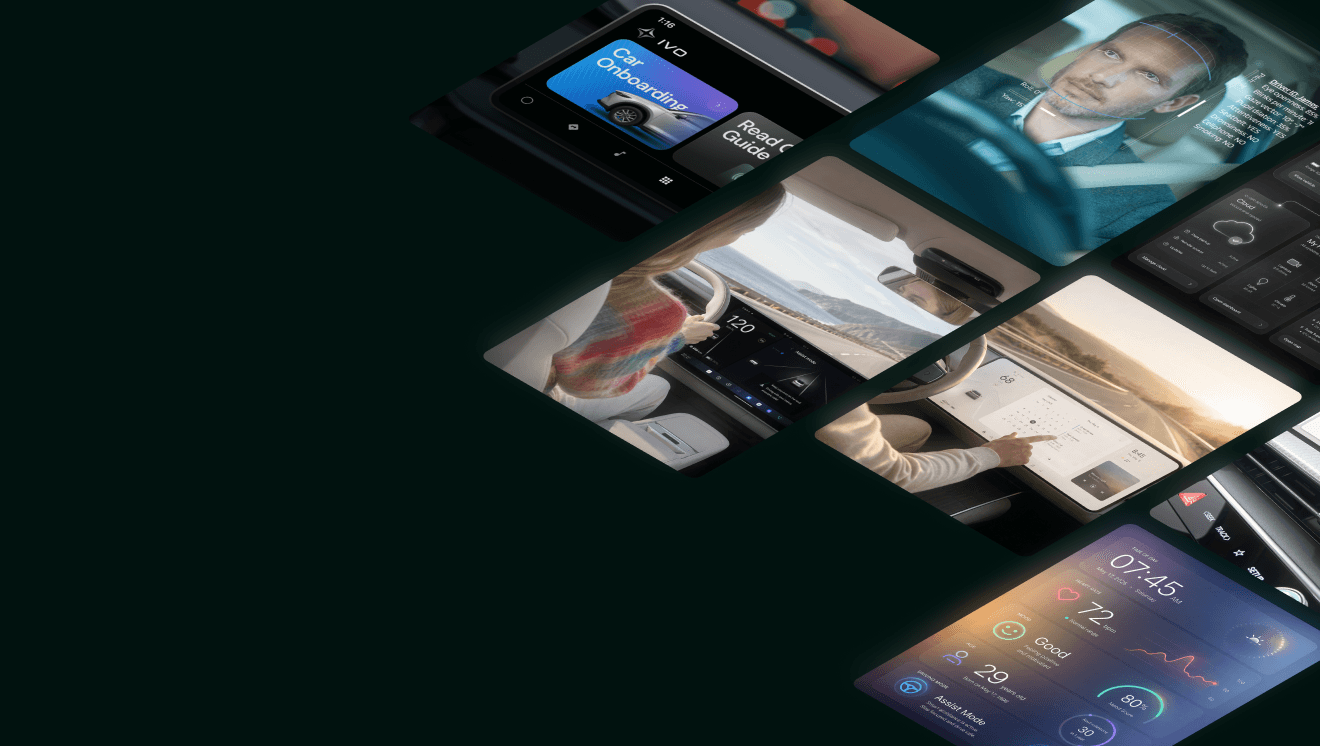
Explore a visual catalog of 10 AI-powered in-car experience concepts, covering everything from Adaptive Cockpit to In-car Commerce. Built as a practical resource for HMI innovation leads and AI strategy teams, each concept outlines the design challenge, the idea, and the value for end-users and OEMs.
How to develop AIDV experiences at speed
Speed matters, but speed applied without product discipline in the in-car context creates a specific kind of damage: an AI experience that overpromises, underdelivers, and erodes driver trust in a space where trust is the prerequisite for everything that follows. Three disciplines separate OEMs that develop credible AIDV capability quickly from those that ship features that users disable.
1. Build from in-car context upward
The most defensible in-car AI use cases are those where the vehicle’s unique context — location, motion state, biometric signals, occupancy data, and time spent in-cabin — creates value a phone cannot replicate. The Commute Companion that learns a driver’s weekly patterns over weeks and anticipates rather than waits is genuinely in-vehicle-native. An AI that mirrors what the phone already does is a feature, not a product. Selecting use cases by this criterion narrows the scope to concepts worth building and worth the engineering investment they require.
2. Prototype and validate before specifying
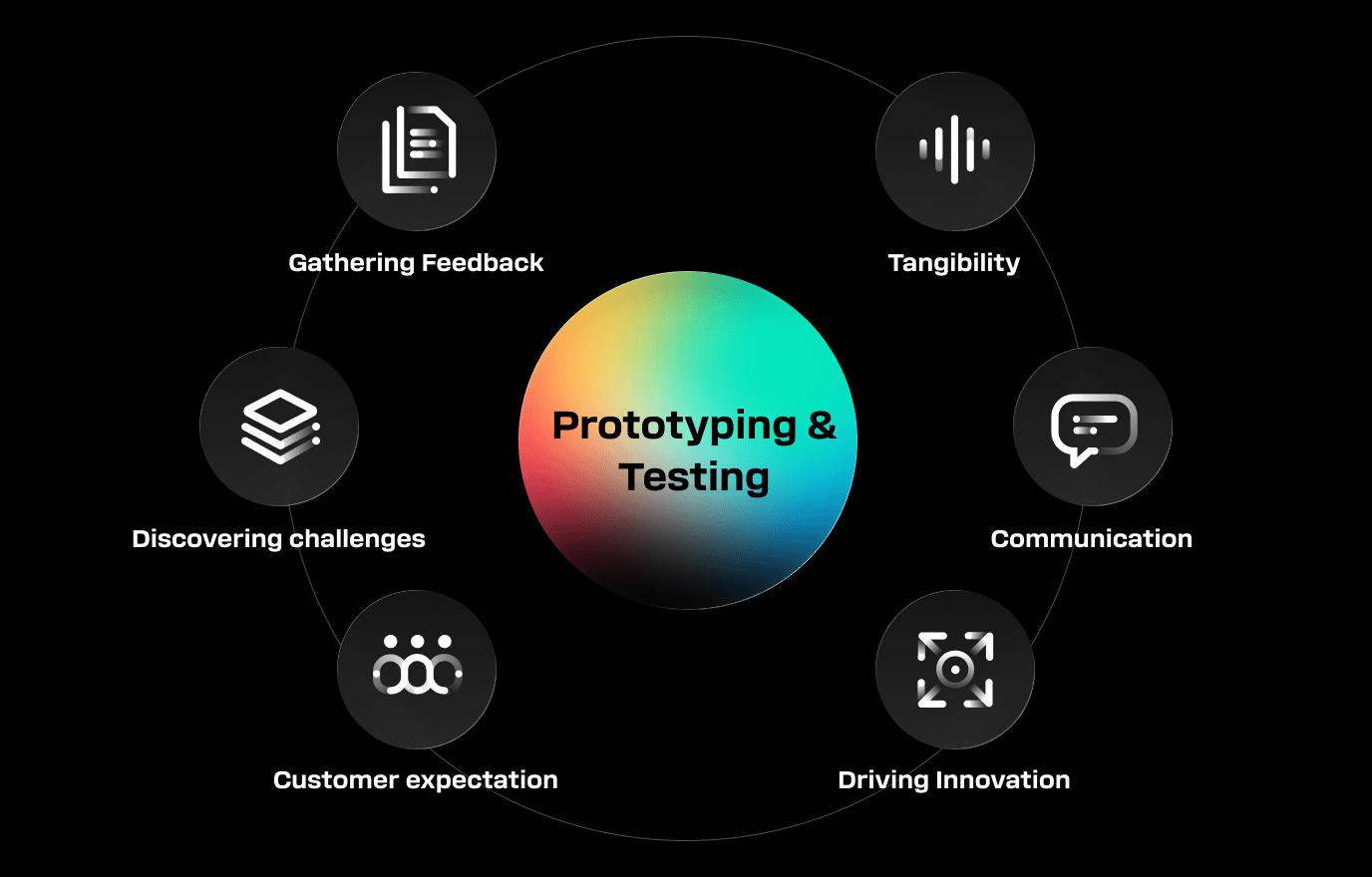
The difference between an AI concept that reads well in a brief and one that changes how people actually experience their vehicle is discovered in use, with real drivers, in realistic conditions. OEMs that move from concept to testable prototype in weeks rather than quarters make sharper product decisions and avoid expensive late-stage corrections. The emerging agentic HMI paradigm, where AI orchestrates multiple in-car capabilities as an active agent rather than a passive responder, makes this kind of early, iterative testing even more important.
3. Design human-in-the-loop moments deliberately
Driver trust in AI in-car experience is earned through interaction. AI that acts without legible intent, surprises at a dangerous moment, or makes decisions the driver cannot easily review or override actively sets back the broader adoption of in-car AI personalization. The question at every design decision is not whether the system can act autonomously, but when it should and when it should ask. Getting that calibration right from the first interaction is the foundation on which everything else is built.
In practice, Star engages with OEM teams across four modes: co-creating AI use case concepts for specific experience domains or full vehicle programs; visualizing and prototyping concepts to make them tangible for leadership and user validation; designing brand-specific AI assistant personalities and tone of voice; and integrating AI experience layers into HMI architecture with production constraints in mind. Across all of these, we embed directly with client design teams, building in-house capability that lives beyond the project.
Star supports your journey to becoming AI-native
We have been designing in-car experiences across the full spectrum of the software-defined vehicle evolution. From early connected services through to current AI-native HMI concepts. Our work spans designing in-car assistants, dynamic HMI frameworks, guardrails and tone of voice for agents, and future AI-native use case ideation for brands including NIO, Nissan, BMW, MG, Toyota, and Hyundai.
The transition from SDV to AIDV is already in progress. The OEMs that define what that transition looks like for their customers are those making product and design investments now, while the experience space is still being shaped. Waiting for a perfect strategy is itself a strategic choice; one that cedes ground to the teams already building.
Interested in exploring how these concepts apply to your vehicle program or AI roadmap? Contact our automotive and mobility team.
FAQs
An AI-defined vehicle places AI at the center of the in-cabin experience and shapes how the vehicle relates to its occupants, moving beyond vehicle system management. Where the software-defined vehicle uses software to control vehicle behavior, the AIDV uses AI to anticipate driver needs, adapt to context, and deliver in-car AI experiences that evolve with each driver over time through behavioral learning and real-time context interpretation.