
Autonomous trucking is a reality, but its adoption remains limited. That is exactly why most people are looking at the wrong problem. Goldman Sachs expects autonomous trucks to reach about 25,000 vehicles in 2030 — still less than 1% of the commercial fleet. The World Economic Forum makes a similar point from a different angle: the technology is moving, but timelines have been too optimistic, large-scale deployment will take time, and mixed traffic conditions will be with us for years.
The present-day scale is already measurable. Aurora has logged 250,000+ driverless miles across 10 Sun Belt routes. Its Fort Worth-to-Phoenix lane is 1,000 miles long, which is more than a single human driver can legally complete under hours-of-service rules, and exactly the kind of operational case for which autonomy is designed. Autonomous trucking and delivery company, Gatik, says it has completed 60,000 fully driverless commercial orders and has more than $600 million in contracted revenue. These are no longer lab demos. They are commercial operations — but still corridor- and use-case-specific.
In the next three to five years, many fleets will run a mixed fleet operations model on selected lanes: conventional trucks, more electric vehicles (EVs), and a small but meaningful number of autonomous assets in specific hub-to-hub corridors.
The challenge comes from coordination, not scale. Even a limited number of autonomous assets introduces new operational dependencies between routes, vehicles, handoff points, and human oversight. The World Economic Forum identifies hub-to-hub trucking as the strongest early use case and projects that autonomous trucks could account for close to 30% of new truck sales on mid-distance hub-to-hub routes in the U.S. by 2035. This is not a full fleet transition. But it is enough to reshape how those lanes are managed day to day.
That is where the commercial vehicle fleet portal changes its role, stops being a reporting tool and starts becoming a control layer.
What the first generation of OEM-connected fleets got right
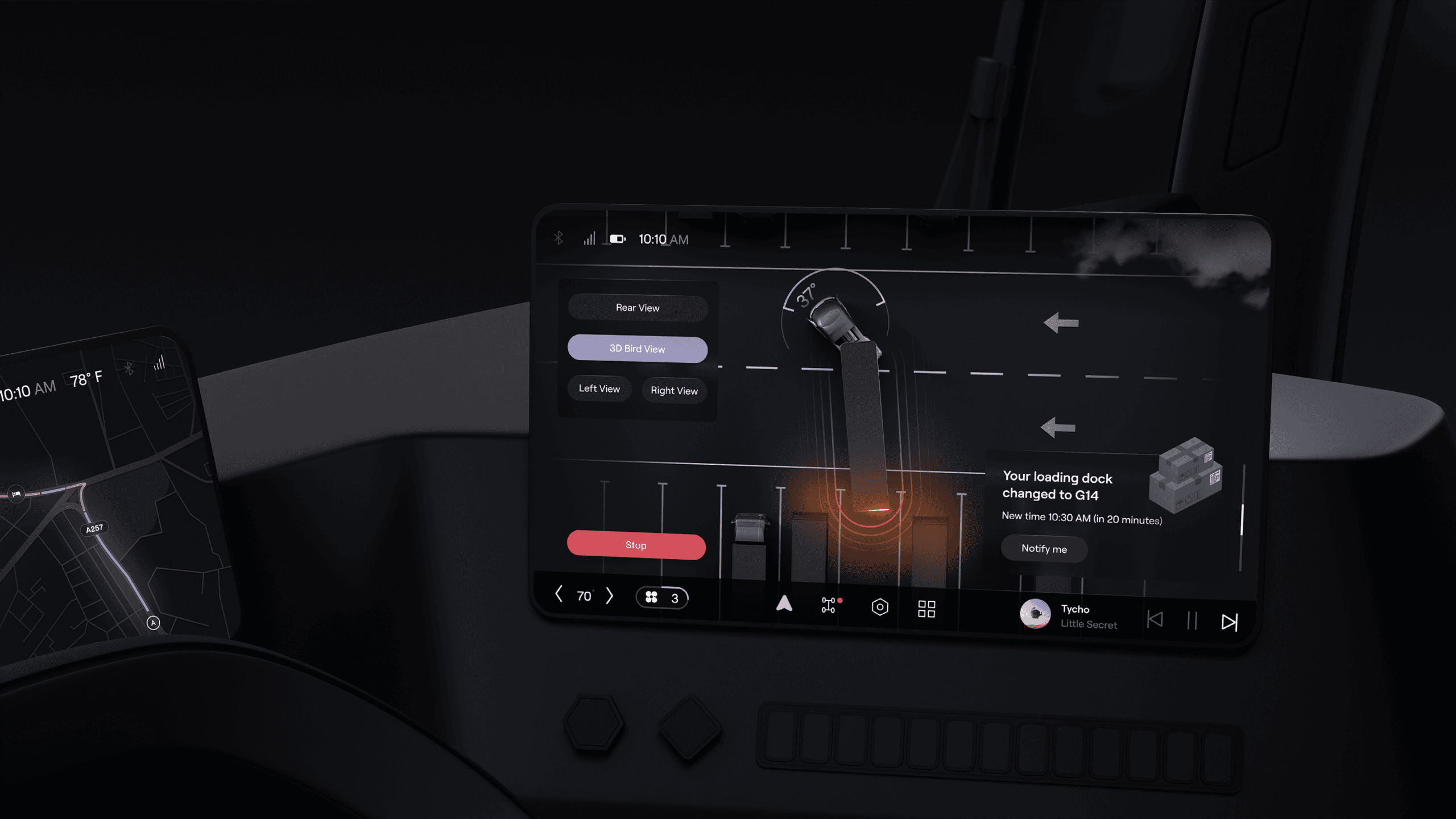
Current OEM portals already do real work. They are not empty dashboards. Volvo's uptime stack combines 24/7 support, remote diagnostics, ASIST service management, and remote programming. International® 360 provides fleets with live service status, online communication with dealers, estimate approval, and preventive maintenance alerts without phone calls. PACCAR's service platform, built with Decisiv, is positioned to streamline the full service lifecycle through digital communication between fleets and providers. DTNA's Detroit Connect, paired with Platform Science's Virtual Vehicle, opens the in-cab layer to a marketplace of third-party apps.
The first wave of connected fleet platforms was built around a clear objective: keeping trucks on the road. These systems addressed the operational friction that takes vehicles out of service and delays resolution - uptime, fault diagnostics, dealer coordination, repair approvals, over-the-air (OTA) updates, service visibility, etc. These were the right problems to solve, but the next set of challenges is different.
How connected fleet UX is moving from diagnostics to decision support
A fleet manager is no longer only asking, “What broke?” They are increasingly asking, “What do I do now?” Can this truck finish the route, or should it divert? Should this load be swapped? Is the EV ready for this dispatch window? Which software issue matters now, and which can wait? Which exception belongs with the dealer, which with internal ops, and which with another system entirely?
This shift fundamentally changes connected fleet UX, moving from passive monitoring to active decision support. These control questions don’t fit into a single clean stack.
Geotab, a global leader in Internet of Things (IoT) and connected transportation, says the average fleet includes vehicles from 13 different manufacturers. That one number explains a lot. Even before autonomy becomes meaningful at fleet scale, most operators already live in a mixed-brand world with multiple systems, service workflows, and data models. Most OEM portals go deep on their own vehicles, but very few help operators make decisions across the fleet.AutoMobility Advisors, a consultancy that works with OEMs and fleets, cleanly put the gap into words: “Access to vehicle data isn’t the problem anymore. Architecture is.”

Fleet portal architecture needs an exception orchestration layer
The next competitive advantage in connected services lies in a focused layer that resolves a high-value operational loop more effectively than broader, all-in-one portals. This is ultimately a question of fleet portal architecture. The goal is improved decision-making and not only increased visibility.
Call the layer exception orchestration. The job is simple to describe, hard to build. Take the inputs that already exist — OEM diagnostics, service availability, route context, load commitments, vehicle readiness, EV charging state, and AV event state — and turn them into one clear operational answer.
This exception orchestration layer, is straightforward to describe but challenging to build. It consolidates inputs such as OEM diagnostics, service availability, route context, load commitments, vehicle readiness, EV charging status, and autonomous vehicle (AV) event state into a single, actionable operational answer: Continue, divert, schedule service, swap asset, escalate, or stop.That is why the cockpit metaphor matters. Not because fleet portals should look like airplanes. Because operators now manage exceptions in real time across increasingly fragmented environments, rather than simply monitoring instruments. Existing tools were not designed for this complexity.
What commercial vehicle fleet portal architecture needs to support
The exception orchestration layer requires a new engineering approach. This is more than a UI redesign. Three critical choices, often overlooked by existing portals, are what matter most:
- Diagnostic state as a state machine, not a log: A fault is not a moment in time. It is a state that can clear, recur, escalate, or correlate with other faults. Orchestration depends on a running diagnostic state per vehicle (open faults, correlated faults, derived severity, suppression rules) exposed as a queryable model. Without it, every downstream system rebuilds the same state on inferior signals, and the “what do I do now?” answer never resolves.
- API-first data model, not a screen-first one: Every entity the portal exposes (vehicles, faults, service events, predictive recommendations, OTA campaigns, AV operational state) must be a stable, versioned API resource before it becomes a screen. When the data model is API-first, integrating with the operator's transportation management system (TMS), telematics overlay, system, and AV provider is inexpensive and reliable. When it is screen-first, every integration becomes a custom export, and every external system runs on stale CSVs. Orchestration cannot survive that.
- AV diagnostic translation as a first-class capability: When an autonomous truck disengages, the portal cannot surface raw perception-stack telemetry. The ops person answering the alert is not a PhD and should not need to be one. The portal needs a translation layer that takes autonomy system state — disengagement reason, confidence, environmental context — and renders it as a decision: resume, dispatch remote support, reroute, or pull for service. This is the difference between AV as a scalable capacity and AV as a permanent escalation queue that is routed back to the autonomy provider's engineering team.
These choices are not visible in a screenshot, yet they determine whether the portal becomes the orchestration backbone of the operator's stack or simply another silo to work around.
Why focused fleet management software architecture beats broad portal ownership
This is where I think a lot of OEM strategy still misses the point. The win does not have to come from owning the whole screen.
The advantage does not come from owning the entire interface, and this is where many OEM strategies still miss the mark. Fleet managers recognize that not all solutions will come from a single brand. They prioritize fewer handoffs, faster decisions, and reduced operational ambiguity over brand consistency. If an OEM or platform provider excels at a critical operational loop, such as service diversion, EV dispatch readiness, predictive maintenance routing, or AV exception handling, this is more valuable than a broad portal refresh.
Aurora Innovation’s commercial integration model reflects this. Instead of building a competing TMS, Aurora integrated directly with McLeod Software’s platform in early 2026. Dispatchers manage autonomous loads from the same interface as other loads, with no additional portals or workflows. Aurora succeeds by providing the best self-driving system through the operator's preferred tools, rather than attempting to control the entire workflow.Additionally, the ongoing debate over vehicle data access suggests that OEMs may find it difficult to build sustainable revenue models based solely on restricted raw data.
Where connected services OEM revenue shifts next
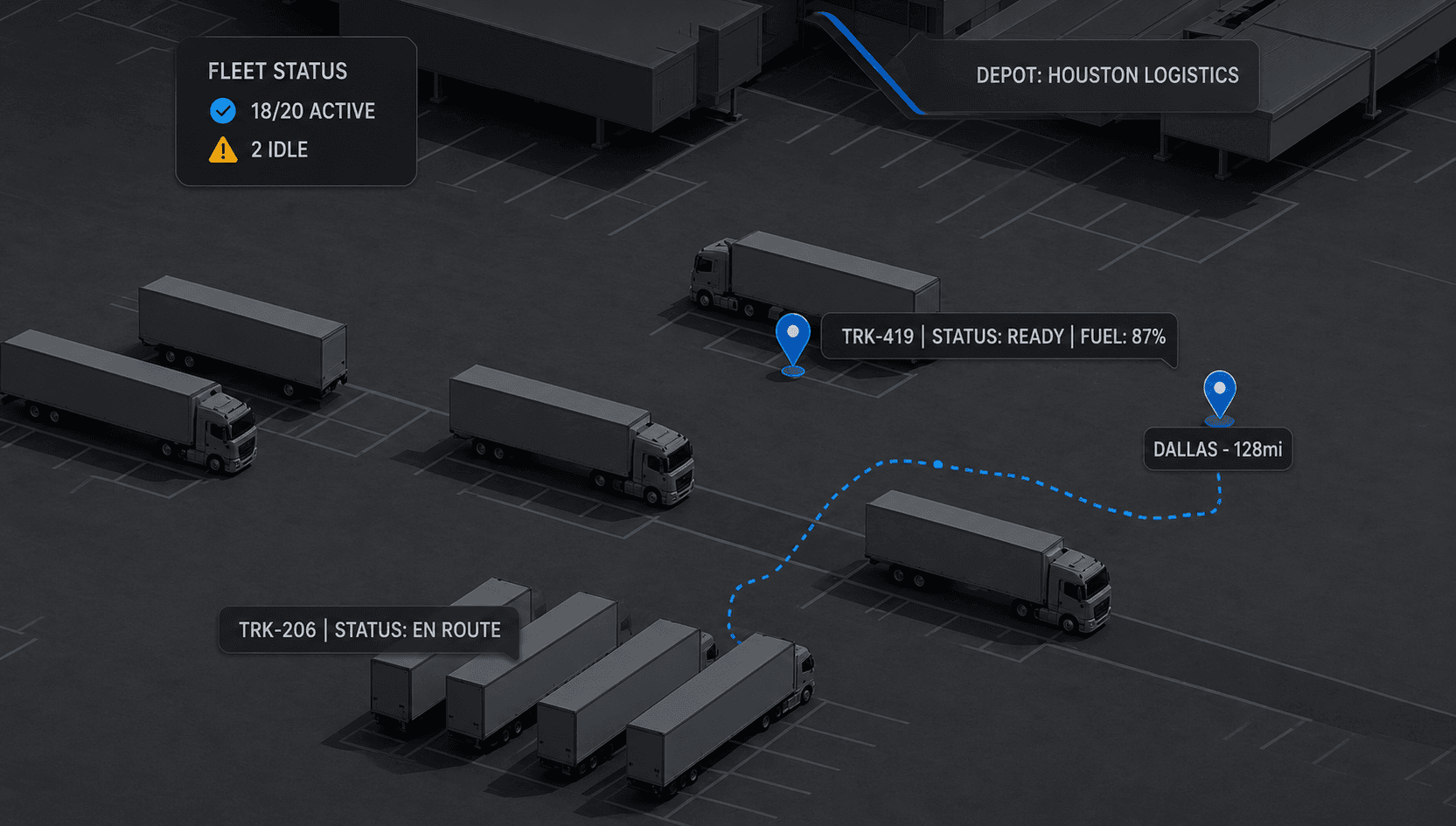
This shift has direct implications for OEM revenue from connected services. The more durable revenue opportunities lie one layer higher in AI systems built on connected-vehicle data, rather than in the data itself. Three categories matter most:
- Predictive maintenance remains the OEM’s structural advantage: proximity to the vehicle, control of the parts ecosystem, and ownership of the dealer network. PACCAR’s Prognostics on the MX engine is one of the clearest examples in North America.
- Usage-based insurance enablement positions the OEM as a data supplier. Clean, normalized, insurer-ready signals can be packaged as recurring data services, without requiring the OEM to move into underwriting.
- Agentic orchestration is more contested. The question is: “Who owns the execution layer on top of fleet data?” Without it, operators may default to third-party systems such as Geotab’s Ace9 or Verizon Connect’s Virtual Fleet Manager.
AI doesn’t change the shape of integration, but it does raise the cost of getting the integration shape wrong.
The fleet portal is becoming the operational cockpit because the complexity of mixed fleets is scaling faster than the systems designed to manage them.
The next five years will be defined by who builds the control layer that manages mixed fleets before complexity forces the issue. The first generation of connected fleet platforms made vehicles visible. The next generation will determine how work gets done.

Alexander Mukomelov
Design Director, US
Next step: the connected fleet experience audit
Star works with commercial vehicle OEMs and connected-services teams to assess and re-engineer the fleet portal as an exception orchestration layer, rather than a comprehensive platform competing with everything else in the operator's stack. Our audit will benchmark your current portal against the engineering posture above, the operational workflow of fleets running mixed-OEM and partly-autonomous operations, and the specific moments when connected service revenue is captured or lost to a third-party tool. The output is a prioritized roadmap of the integrations and capabilities that matter most, in build order.
FAQs
A commercial vehicle fleet portal is a digital platform used by operators to monitor, manage, and coordinate vehicle performance, maintenance, and operations. Traditionally focused on diagnostics and uptime, modern mixed fleet portals are evolving into real-time decision systems that support dispatch, routing, and exception handling.