
The autonomous vehicle industry is standardizing its technical foundation. Recent NVIDIA GTC is the clearest proof. Drive Hyperion — a production-ready reference architecture combining prevalidated sensors, centralized compute and a safety-certified OS — now underpins GM, Toyota, Mercedes-Benz, JLR, Volvo Cars, Rivian, Hyundai Motor Group, BYD, NIO, XPENG, Li Auto, Polestar, Lucid, Nissan, and Geely on passenger vehicles; Pony.ai, Nuro, Wayve, Motional, Uber, Bolt, Grab, and Lyft on robotaxi and MaaS; Aurora, PACCAR, Kodiak, and Isuzu on commercial trucks; Bosch, Magna, Continental, and ZF building Hyperion-based domain controllers on the supply side. NVIDIA projects $5 billion in automotive revenue for fiscal 2026. More than 20 OEM brands are on the same stack simultaneously.
That accelerates deployment and reduces integration friction. It also moves the competitive question upward: when the driving foundation is shared, what makes one vehicle experience meaningfully different from another? Not sensors or compute. The designed relationship between the AI and the person in the seat. That layer is still underdesigned across most of the industry.
The market has moved past the demo phase
Autonomy is no longer judged by whether a vehicle completes a clean route. The next phase is operating a real service — one that people trust, operators can scale, and regulators can inspect. Ride AI 2026 reflects that directly: the agenda is built around rollout, operations, policy, infrastructure, and commercialization.
The question is no longer only "can the vehicle drive?" It is "can the system explain itself, recover well, and keep people confident when something unexpected happens?"
Autonomous vehicle trust UX is not polish. It is operating infrastructure.
Trust UX is not a better voice prompt or a cleaner status screen. It is the service interface between autonomy, remote operations, and people: riders, operators, safety teams, and regulators. It covers state clarity, intent signals, explanations, escalation logic, remote-support flows, and the behavioral cues that tell people what the system knows, what it is doing, and what happens next.
In the demo era, this layer was treated as polish. In the deployment era, it becomes part of the operating model. The real test is not whether a user can read a screen in a calm moment. It is whether the system stays legible when confidence drops.
At scale, weak autonomous vehicle HMI becomes an operations problem
Waymo crossed 14 million total trips in 2025. Aurora entered 2026 with commercial driverless trucking capacity fully committed through Q3, expecting 200+ driverless trucks by year-end.
At that volume, a confusing stop is not a UX flaw. It is support load, utilization drag, and passenger hesitation. Poor trust design does not stay inside the cabin. It spills into operations.
Remote assistance puts autonomous vehicle passenger experience inside compliance
California's CPUC requires driverless passenger services to maintain a live passenger-operator communication link, with records retained for one year. Senator Markey's March 2026 investigation found every major operator — Waymo, Tesla, Aurora, Zoox, Motional — refused to disclose remote intervention frequency. No federal baseline exists for latency thresholds or operator qualifications.
The interface is not downstream from compliance. It sits inside it. A remote-support flow is part of the safety story, part of the compliance surface, and potentially part of the evidentiary record after an incident. How the system escalates, explains, and connects to a human is no longer secondary. It is part of how the service is judged.
In autonomous vehicles brand shows up through behavior
In a manually driven car, brand character comes through physical channels: steering feel, throttle response, chassis tuning, engine note. In an autonomous vehicle, those channels diminish precisely in the moments that define trust. What remains is behavior — and on a shared platform, behavior defaults to generic unless the OEM defines it deliberately.
The four Autonomous Vehicle trust UX questions
Every autonomous vehicle must answer four design questions. How it answers them is where brand either survives or disappears:
1. State legibility — what is the vehicle doing, and does the passenger need to know?
2. Intent signaling — what is it about to do, and how far ahead does it say so?
3. Uncertainty expression — when confidence drops, what does the system reveal?
4. Escalation character — when human intervention is needed, how does the handoff feel?
Generic platforms answer these once, for a generic user. Brand-specific trust architecture answers them differently for each brand's passenger — their expectations, anxiety profile, and what the brand has promised them.
BMW M passengers expect precision. State information is instrument-grade. Intent is early and specific: "merging left in 400 meters — stopped vehicle ahead," not "preparing to change lanes." Uncertainty is stated as fact: "speed reduced — low-visibility conditions." Silence reads as control. The system feels like a co-pilot, not a cautious assistant.
Volvo passengers expect protection. The system speaks before concern arrives: "giving extra space to the cyclist ahead" before the passenger has noticed the cyclist. Uncertainty becomes deliberate caution — "taking this section slowly" — never limitation. Remote assistance feels like an extension of care, not an admission of failure.
Jeep passengers expect capability under pressure. Silence is the confidence signal. Intent is decisive: "taking this steep section at low speed" — not a question, not a request for confirmation. Uncertainty is assessment, not doubt: "checking the approach before proceeding" communicates deliberateness; "I'm not certain about this surface" communicates failure. The same pause, expressed differently, means something completely different.
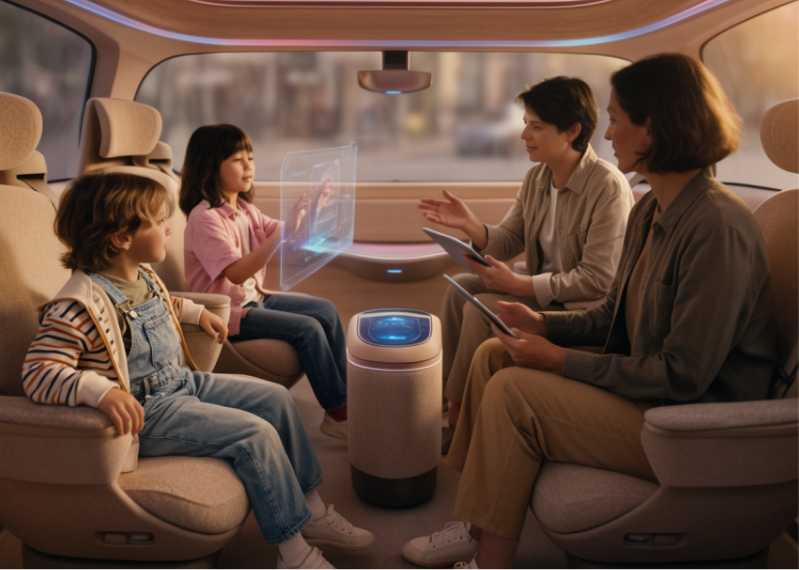
Family vehicles — Toyota, Hyundai, most volume segments — carry passengers for whom autonomy is still unfamiliar. The test: can a ten-year-old in the rear seat understand what the car is doing without asking? State information is visual-first. Intent uses pronouns: "we're slowing down — there's a red light ahead." Escalation is human-forward — the presence of a person at the other end is itself the trust signal.
Waymo is the most instructive benchmark. "The world's most trusted driver" is a brand position, not a safety specification. Waymo publishes independently audited safety data, communicates proactively inside the vehicle, and has built fleet response infrastructure designed to handle edge cases without alarming passengers. That is trust architecture at commercial scale.
But even Waymo has headroom. When the vehicle slows unexpectedly, passengers see a route screen and rarely understand why. Surfacing what the system saw, assessed, and decided — in plain language, at the moment of action — would close the self-driving car trust gap between competent opacity and genuine transparency. At 500,000 trips per week, that compounding trust investment is measurable in repeat use and regulatory confidence. It is the clearest existing proof that autonomous vehicle passenger experience, designed deliberately, compounds into a durable commercial advantage.
NVIDIA does not make these decisions. Wayve does not make them. The OEM makes them — or the platform default makes them instead.
In Autonomous Vehicles, trust and brand are the same design problem
Every significant cabin moment is simultaneously a trust event and a brand event: explaining an unexpected stop, handing off to remote support, recovering from an edge case. Handle those generically and the brand is absent. Handle them with intent and the brand is present in every mile.
We built this from first principles with NIO Nomi. The brief for NOMI was not "add a voice assistant" — it was "make the vehicle feel inhabited." NIO described the result as a pure revenue driver, not a design feature. Buyers in China chose NIO over better-specced competitors specifically because of it. The difference was not hardware — NIO ran on the same platform available to competitors. It was deliberate decisions about character, legibility under uncertainty, and the AI-to-occupant relationship.
The business case is already visible
U.S. automotive brand loyalty stood at 51.1% in 2025 — nearly half of buyers switched brands at purchase. Deloitte's 2026 Global Automotive Consumer Study found 53% of U.S. consumers expect to switch brands on their next vehicle, while 52% said they would keep a vehicle two to three years longer with meaningful OTA updates.
In more automated vehicles, the cabin is where the software relationship is felt. Weak trust UX increases support load, reduces repeat use, and makes substitution easier — on a platform where the underlying technology is already shared with competitors.
The next benchmark in Autonomous Mobility is trust industrialization
Aurora is industrializing autonomy through safety-case discipline. Waabi through verifiable end-to-end AI and simulation-first safety. Wayve through geographic and vehicle-platform generalization at scale. These are real strategic differences.
The next benchmark is who industrializes trust with the same rigor.
The next bottleneck in autonomous mobility is no longer driving intelligence alone. It is the layer between autonomy, remote operations, and people. The winners will make that layer easy to understand, easy to recover with, efficient for operators, credible to regulators, and aligned with the brand promise.
Shared foundations will not erase differentiation. Generic trust UX will.