


Early efforts in enterprise AI were constrained by model capability and strict context limits. Today, those constraints have largely been removed. Systems can now process significantly more information, and access to powerful models is no longer the primary obstacle.
Performance has not improved at the same pace.
In many enterprise environments, AI systems still produce outputs that are inconsistent, difficult to scale, and expensive to run in production. The underlying issue is often not the model itself, but the way information is structured and delivered to it.
Context engineering is proving to be a critical discipline in addressing this challenge. It focuses on how information is selected, organized, and presented to AI systems, and increasingly determines whether these systems perform effectively at scale.
What is context engineering?
Context engineering is the discipline of designing how information flows into and through AI systems. It defines how LLMs access and use information, not just how much information they are given. This includes what the model sees, how that information is structured, where it appears within the context window, and how it changes over time. While prompt engineering focuses on the phrasing of instructions, context engineering addresses the broader system that shapes how the model receives and interprets input.
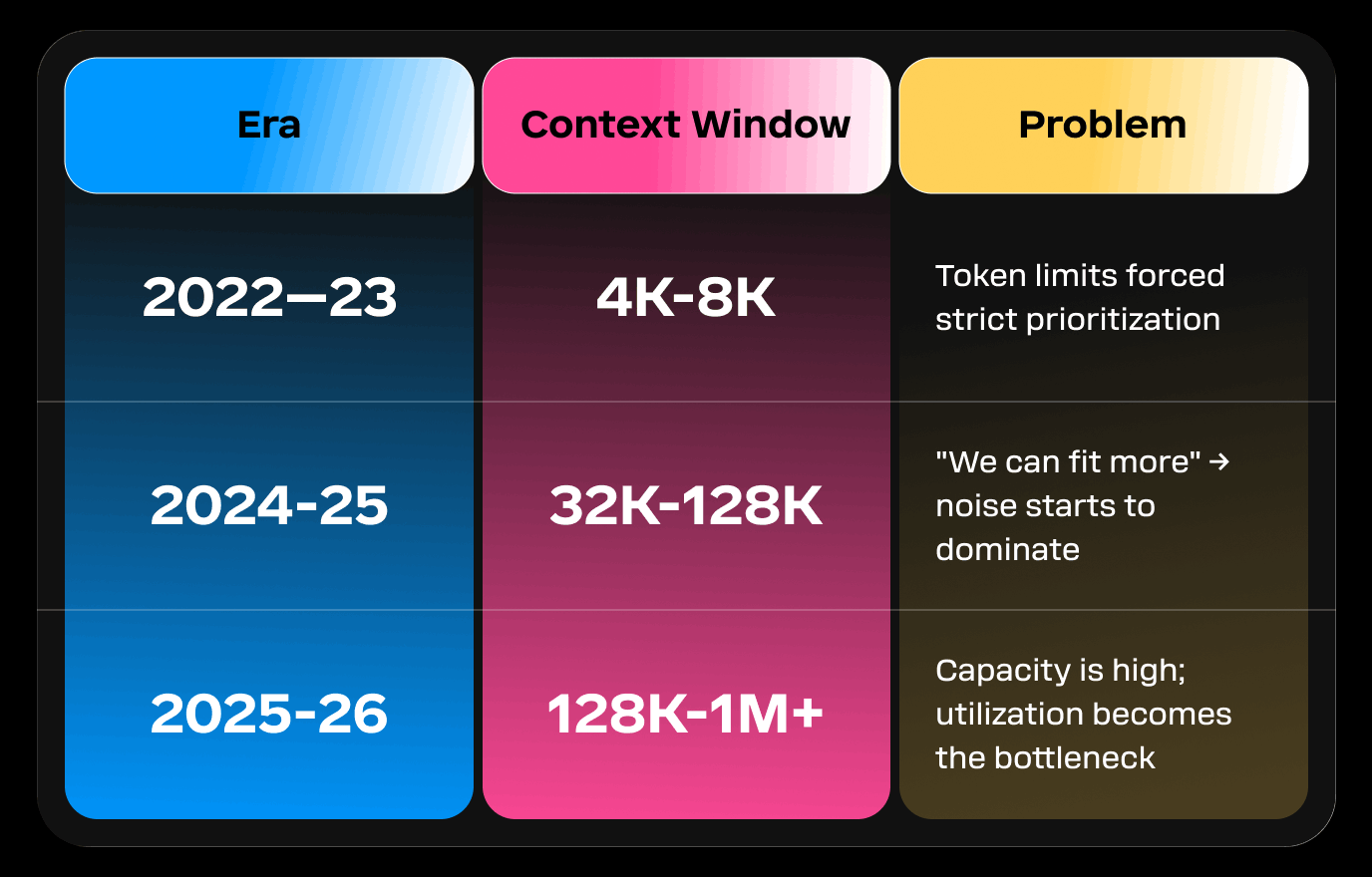
At enterprise scale, this distinction becomes critical. AI performance is not limited by access to data, but by how effectively that data is selected, organized, and presented at the moment of inference. The importance of context engineering has grown as the nature of the constraint has changed.
Context engineering vs. prompt engineering
The two disciplines are often used interchangeably, but they operate at different levels of the system. Prompt engineering is concerned with a single input: how an instruction is worded, what examples are given, and how a task is framed to get a better response from the model. Context engineering operates one level up. It governs everything that surrounds that prompt: what information is retrieved, how it's structured, where it's placed in the window, what's compressed or dropped, and how all of that changes across turns in a conversation or steps in an agent workflow.
A well-crafted prompt can still fail if the context around it is disorganized, redundant, or stale. Conversely, a simple prompt can perform well if the context feeding it is clean, relevant, and ordered with the model's attention patterns in mind. This is why enterprise teams that focus only on prompt wording tend to plateau: they're optimizing the instruction while leaving the much larger surface area, such as the data pipeline, memory layer, and retrieval logic — undesigned. Prompt engineering asks "how do I phrase this?" Context engineering asks "what should the model see at all, and in what form?" Production-grade AI systems need both, but as context windows grow, it's the second question that increasingly determines whether a system holds up at scale.
Why context matters, and why it is still limited
Large language models do not have persistent memory in the way many teams assume. Everything the model can use in a given interaction is derived from the context available to it at that moment. Context, therefore, functions as working memory. It shapes how the model reasons, what it prioritizes, and how reliably it can respond.
That remains true even as context windows expand.
A common misconception is that larger windows reduce the importance of context design. In practice, they do the opposite. Once teams are no longer forced to prioritize aggressively, they often begin passing more information into the model simply because they can. This tends to create a different class of problem; relevant material becomes harder to distinguish from background noise. Important details are buried inside long inputs, and outputs become less reliable.
The constraint has changed, but it has not disappeared. The issue is no longer whether a model can fit enough information into its context window, but whether the information inside that window is structured in a way the model can actually use.
Context engineering matters because it addresses the gap between what is technically possible and what is operationally effective.
Three misunderstandings that continue to hold teams back
Much of the confusion around context engineering stems from a few persistent misunderstandings, each of which becomes more damaging as systems move into production.
Misunderstanding: “More context leads to better performance”
It sounds reasonable, especially when context limits have historically been restrictive. Larger context windows increase potential capacity but do not, by default, produce better reasoning. As more material is added, relevant information must compete with irrelevant, repeated, and poorly structured information. Reasoning quality often degrades if context is not carefully structured. The context window should therefore be treated as a ceiling, not a target.
Misunderstanding: “RAG will fix context limits”
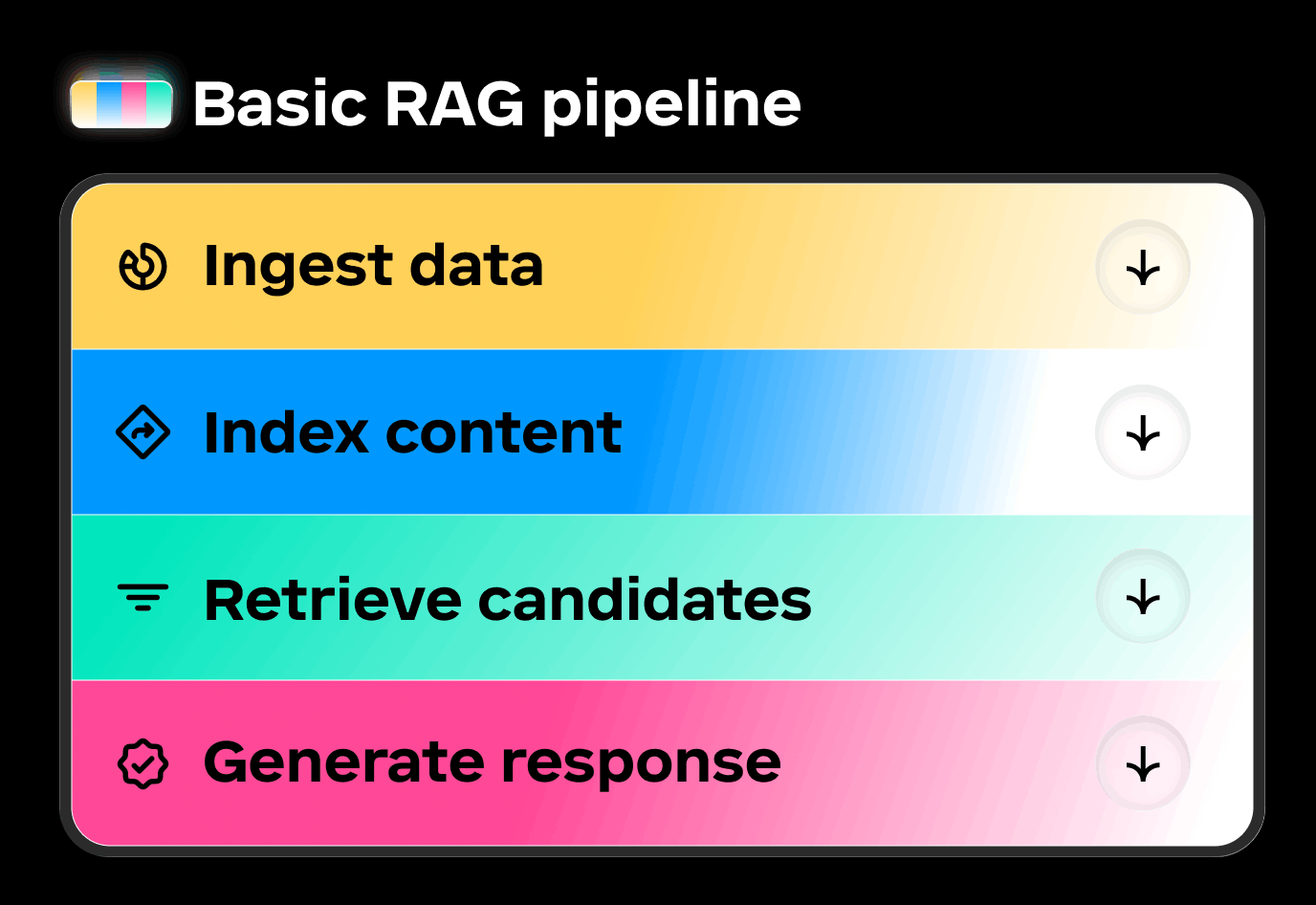
Basic retrieval-augmented generation (RAG) pipelines are useful, but they are often insufficient in production. RAG identifies material that may be relevant. It does not decide what should actually be included, how it should be ranked, or how it should be represented once retrieved.
Without filtering, ranking, and distillation, retrieved content introduces noise. Redundant or conflicting information can degrade output quality, and larger context windows can make that problem worse rather than better. In practice, retrieval alone does not solve context design. It only makes context selection possible.
Misunderstanding: "Our long-context model is production-ready by default"
Larger windows reduce some constraints, but they introduce new tradeoffs. Input costs rise as more tokens are processed per request. Latency increases, particularly in workflows that depend on repeated calls. The system becomes more sensitive to poor structure and unnecessary volume.
As context grows, the likelihood of noise, redundancy, and conflicting information increases, which can degrade reasoning rather than improve it. The challenge shifts from “can we include this?” to “is this worth including at all?”
These misunderstandings matter because they lead teams to treat context as a passive container, something to fill, rather than something that must be deliberately designed.
Real-world failure modes
When context is not deliberately designed, failure modes appear across production systems.
The lost-in-the-middle effect
Relevant information placed in the middle of a long context often has less influence or is ignored, as models tend to prioritize information at the beginning and end. Teams may technically include the right material, yet still get weak outputs because the structure works against the model’s attention patterns.
Context poisoning
Outdated documentation, superseded decisions, or conflicting reference material remain in circulation and continue to shape outputs long after they should have been retired. If not explicitly managed, this leads to incorrect or misleading outputs.
Context overload
Too much information reduces clarity. Large retrieval sets, full documents instead of distilled facts, and excessive chat histories are often passed into the model with minimal filtering. The model is then expected to distinguish signal from noise on its own, which is not always accurate.
Retrieval without judgment
A related issue appears when systems retrieve material that is broadly relevant but fail to filter or prioritize it effectively. Loosely related chunks, duplicate passages, and conflicting sources all make their way into context, weakening the quality of the input before generation even begins.
Context accumulation
Long-running conversations and agent workflows accumulate information over time, including material that was once useful but is no longer necessary. Performance degrades slowly, which makes the issue easy to miss. Teams often blame the model or the prompt when the real problem is that the system has become saturated with low-value context.
These are not isolated defects. They are different expressions of the same underlying issue: context is being treated as something to collect rather than something to design.
Practical context engineering practices
Good context engineering begins with deliberate structure. In production systems, that translates into making a small number of design choices consistently, rather than relying on the model to resolve poor inputs on its own.
Context ordering: work with model biases
Models do not treat all parts of the context equally.
- Place critical instructions and high-priority facts at the beginning and end often carries more weight than information buried in the middle.
- Use explicit section labels such as CORE, TASK, REFERENCE, and HISTORY to make the context easier to interpret.
- Organize inputs by importance rather than chronology to reduce the chance that useful information is diluted by lower-value material.
RAG pipeline optimization that actually works
A retrieval pipeline should not stop at semantic similarity alone.
- Add reranking to improve the quality of top results.
- Use hybrid retrieval approaches, combining keyword and semantic search where appropriate.
- Distill retrieved material before passing it to the model.
- Avoid “kitchen sink” retrieval. More material does not automatically improve results.
Context compression
Compression is not only a way to reduce token use. It is also a way to improve reasoning quality.
- Summarize long conversations into a structured state rather than replaying them in full.
- Remove redundant or low-value content before it reaches the model.
- Extract only the fields or details that matter from documents and tool outputs.
- Focus on increasing the concentration of useful signals, not simply shortening the input.
Memory as a context engineering tool
Memory works best when it is treated as a selection mechanism rather than a storage layer.
- Use memory for durable facts such as decisions, preferences, and persistent workflow state.
- Avoid replaying entire histories by default.
- Carry forward only the information that improves the next interaction.
- Poor memory design creates delayed context pollution that becomes harder to diagnose over time.
Prompt structure and caching
Prompt engineering still matters, but it works best when it supports context stability.
- Place stable instructions in a consistent location, usually at the beginning.
- Keep dynamic inputs, such as user data and tool outputs, clearly separated.
- Avoid unnecessary variation in reusable prompt sections.
- Use prompt caching to reduce cost and latency, but do not treat it as a substitute for good context design.
When long context is the wrong answer
Long context is useful in some scenarios, but it is not always the right solution. In many cases, better performance comes from narrowing the input and improving the quality of what reaches the model.
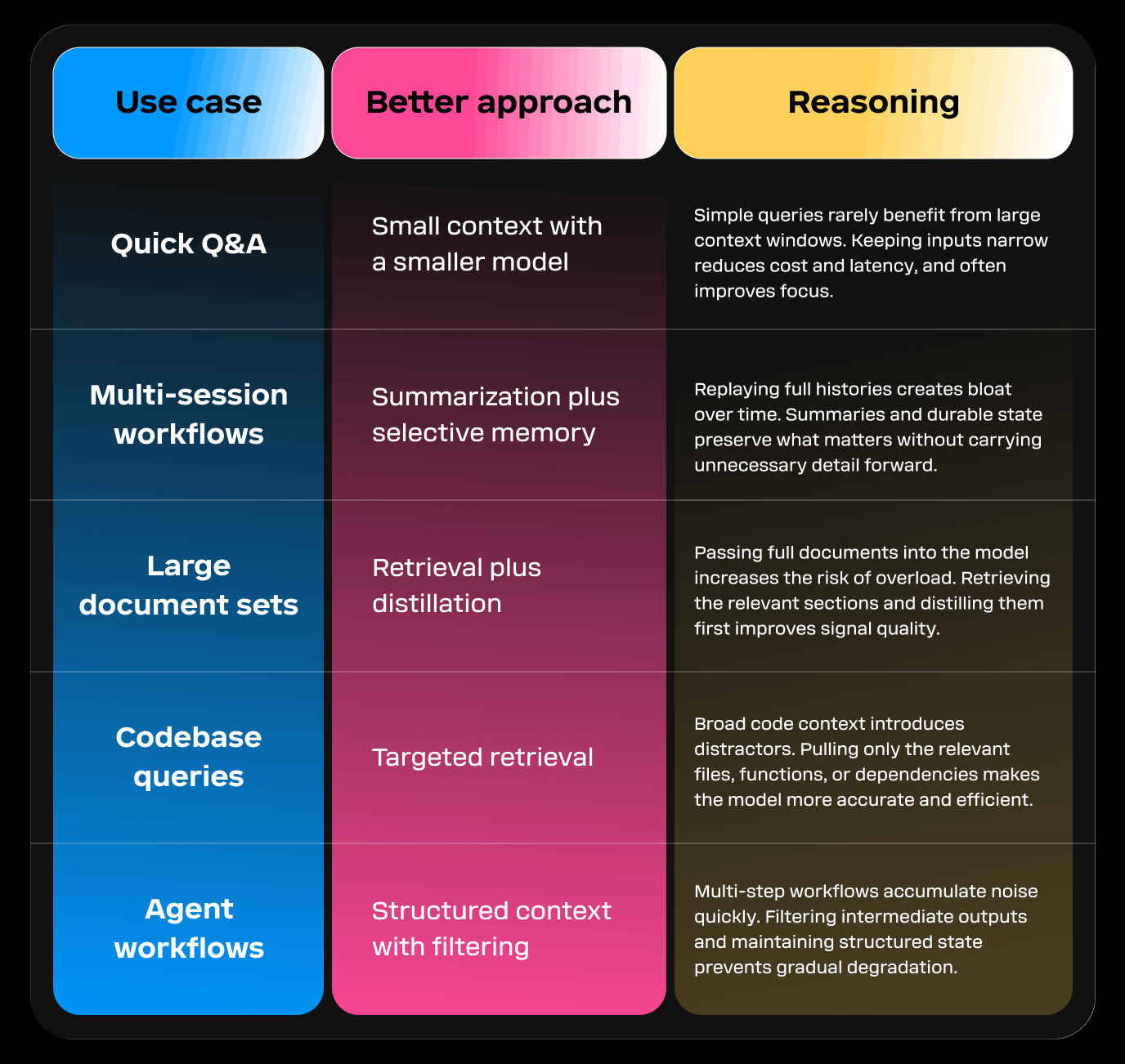
Long context is not inherently the wrong choice. The point is that it should be used deliberately. Capacity does not remove the need for design, and in many cases, restraint produces better results than inclusion.
The cost of poor context design
The financial and operational consequences of poor context design are often underestimated because they do not always appear all at once.
Excessive context increases inference costs with every request. It also adds latency across tools and workflows, making systems slower and less efficient in day-to-day use. Accuracy tends to suffer as well, which leads to more review, more correction, and more rework. Over time, confidence in the system begins to erode. Teams become hesitant to rely on outputs because performance feels inconsistent and difficult to predict.
That is why context engineering matters so much in production. Even relatively small improvements in context quality can have a meaningful effect. Removing redundant material, restructuring inputs, or improving retrieval quality can lower costs while making outputs more reliable.
Few areas of AI implementation offer this kind of return. Better discipline in context design often improves both efficiency and output quality at the same time, rather than forcing a tradeoff between them.
Why context engineering will shape production AI
Context engineering is not a marginal optimization layer; it’s becoming a core part of how reliable AI systems are built.
In practice, this means making deliberate design decisions about how information flows into the model: what the model sees (selection), where it appears (structure and ordering), and how it is represented (distillation and compression).
An effective starting point for quick improvement is often a single system:
- Break the prompt into components
- Remove anything included “just in case”
- Add filtering or reranking before generation
- Separate static instructions from dynamic inputs
Even simple changes at this level often reduce cost and improve output quality immediately. Treat context engineering as a first-class discipline, and you’ll be better positioned to build systems that are more reliable, easier to scale, and more cost-effective to operate.
By focusing less on context size and more on context design, you’ll also get more value from the models they already use, not because those models are inherently better, but because the information reaching them is better designed.
Build AI systems that deliver real business value
If your AI outputs feel inconsistent, expensive, or hard to scale, the model usually isn’t the problem. It’s the system context.
At Star, we help enterprise teams move beyond “bigger context” and toward better context design — so AI systems deliver consistent, scalable performance in the real world. Through Star’s AI Innovation Hub, we work with you to identify high-value GenAI use cases, assess technical readiness, and design AI solutions that reduce noise, improve reliability, and accelerate time to value.
Explore how we help organizations turn AI ambition into production impact.
FAQs
Context engineering is the practice of designing what information an AI system sees at inference time and how it’s organized so the model can reliably use it. Prompt engineering focuses on the wording of instructions, while context engineering includes the broader system that determines whether the right information shows up in the right way.