


Agency leaders do not need another reminder that the industry is entering a new phase of technological change. Automation, optimization engines, and programmatic systems have already reconfigured large parts of media operations. What is emerging now is a more consequential shift: from software that supports execution to coordinated AI agents that can plan, act, adapt, and interact across systems with increasing autonomy.
Agentification is not simply another layer of automation. It introduces operational systems that can interpret context, pursue goals across multi-step workflows, and coordinate decisions across functions that have traditionally been fragmented between people, platforms, and specialist tools. In a media buying environment, this could begin with campaign setup and optimization, but it points toward something much broader: a dynamic ecosystem of specialized agents that negotiate, execute, monitor, and govern spend across an increasingly fragmented media landscape.
The opportunity is significant. Multi-agent systems can reduce operational drag, improve the speed and quality of optimization, and extend intelligence deeper into day-to-day execution. But those outcomes are not automatic. They depend on whether agencies treat agentic AI as a strategic operating layer rather than as a collection of disconnected use cases. Real value comes from redesigning workflows, defining decision boundaries, integrating agents into the underlying data and platform architecture, and establishing governance that is proportionate to the level of autonomy being introduced.
This report is intended to support that process and help agencies translate emerging capability into practical, measurable progress. It explores what multi-agent systems in media operations look like inside an agency environment, how workflows can be redesigned and how accountability evolves. Perhaps most importantly, it looks at how governance and interoperability need to be addressed from the outset. Our endgame is to offer a framework to help leaders identify where agentic systems can create operational lift, strengthen service delivery, and support long-term growth.

Glossary of key terms
Agent (AI Agent): A software system powered by artificial intelligence that can autonomously perform defined tasks within set guardrails. Unlike prompt-based AI assistants, agents can ingest data, interpret context, make decisions, and in some cases all without continuous human instruction.
Multi-Agent System: An orchestrated network of independent but collaborative AI agents, each responsible for a defined sub-function within a broader workflow.
Agentic Workflow: A structured sequence of tasks that is executed or supported by interconnected AI agents. In media operations, these workflows may span planning, buying, optimization, reconciliation, reporting, and finance.
Agentification (in media operations): The transformation of traditional media operations into systems powered by AI agents. Agentification involves redesigning workflows so that semi-autonomous agents handle operational, analytical, or executional tasks across the media lifecycle.
Autonomy: The ability of an AI agent to act independently within predefined rules, constraints, and guardrails. Bounded autonomy ensures agents can make decisions while remaining under strategic human oversight.
Human-in-the-Loop: A governance approach in which AI agents perform tasks or generate recommendations, but final approval or oversight remains with a human decision-maker.
Structured Data: Data organized in predefined formats, such as campaign metrics, ad server logs, or delivery reports, which can be directly processed by AI systems.
Unstructured Data: Non-standardized information such as free-text briefs, audience descriptions, emails, or creative notes that AI agents can interpret and analyze alongside structured inputs.
Media Workflow Modernization: The process of reviewing and redesigning media processes to improve efficiency, connectivity, and intelligence often through AI augmentation.
Modular Deployment: An adoption approach where AI agents are introduced in specific areas (e.g., campaign operations) before expanding across the organization.
End-to-End Automation: The orchestration of AI agents across the full lifecycle of a campaign, from RFP and audience research through optimization, reconciliation, and reporting.
Campaign Monitoring Agent: An AI agent designed to continuously track campaign delivery and performance, flag underperformance, or recommend optimization actions.
Brand Guardrails: Rules and constraints embedded within AI systems to ensure outputs remain aligned with brand guidelines, tone, compliance requirements, and safety standards.
Agent-to-Agent Communication: The exchange of data, signals, or instructions between AI agents, potentially across organizational boundaries, to coordinate tasks and optimize workflows.
Industry Protocols: Shared technical standards that enable interoperability between agents across brands, agencies, ad tech vendors, and media owners.
Agentic Advertising Protocol (e.g. adCP): An emerging framework intended to standardize how AI agents activate, manage, and reconcile advertising transactions across the ecosystem.
Governance Framework: The policies, processes, and oversight mechanisms that ensure AI systems operate safely, ethically, and in compliance with regulation.
Regulatory Fragmentation: The variation in AI-related laws and requirements across different countries or regions, complicating cross-border implementation.
What is multi-agent media operations and how is agentification changing the larger media and advertising industry?
Over the past two decades, advertising has been reshaped by successive waves of automation. From the rise of ad servers to the standardization of programmatic buying. Each technological leap has promised greater efficiency, scalability, and smarter decision-making. Yet despite this progress, much of the daily reality of media operations remains stubbornly manual, fragmented, and prone to error.
Multi-agent media operations represent the next structural evolution of how media workflows are designed, connected, and deployed across agencies, media owners, and the wider industry.
At its core, multi-agent media operations refer to the deployment of multiple AI agents, each one designed to fulfil a specific task or function, while collaborating with others to create one end-to-end solution. Unlike rule-based automation, which executes predefined scenarios, agentic systems operate toward goals. They ingest structured and unstructured data, interpret context, adjust to changing conditions, and act within defined guardrails. Where traditional automation enforced consistency, agentic systems enable adaptability.
The distinction from previous automation waves is critical. Programmatic advertising was built around rule-based systems and standardized formats. It enabled scale by forcing consistency around traditional ad units, standard targeting logic, and routine buying protocols. While enormously powerful, it also constrained flexibility and often layered new complexity on top of existing processes.
The fundamental problem with rule-based systems is that they require every scenario to be anticipated in advance. No matter how comprehensive the ruleset, cases will emerge that the system cannot handle. Attempting to close those gaps by writing more rules compounds the problem: the codebase grows, conflicts multiply, and the system becomes increasingly brittle. Rather than scaling smoothly, rule-based programmatic infrastructure grows through accumulation, creating operational loops and instability that add cost rather than value. This structural ceiling is what creates the conditions for agentic systems to emerge, not as a marginal improvement, but as a fundamentally different logic for handling dynamic environments.
Opportunity for agentic AI
The latest generation of agents are now quickly moving beyond rule-based automation toward adaptive, collaborative systems. By nature, they connect planning, buying, optimization, reconciliation, reporting, and even finance into a continuous workflow. What makes this transformative is the orchestration of agents across roles and functions. For example, an agent monitoring campaign delivery can flag underperformance in real time while another can generate optimization recommendations based on cross-channel signals. No matter the task, these agents operate as a coordinated team, often with human oversight serving as final approval rather than continuous manual execution.
The opportunity for agentic AI is particularly acute in more mundane and administrative tasks. Recent research suggests that roughly a quarter of working hours are spent on routine administrative work such as document management and manual processes. In advertising, that translates into routinely uploading and downloading assets, adjusting pacing parameters, checking delivery discrepancies, and reconciling data across spreadsheets and dashboards. These are not the strategic or creative tasks that attract talent to the industry; they are repetitive, error-prone processes that have accumulated over time.
Multi-agent systems are uniquely suited to absorbing this operational drag. NNot only can they operate 24/7, they can also integrate structured and unstructured data without the cognitive switching costs that burden human teams. In doing so, they promise not just efficiency, but a redistribution of human effort toward higher-value work, such as strategic thinking, relationship management, and creative problem-solving
Crucially, agentification does not inherently eliminate creativity. The early hype cycle around generative AI focused on the idea that machines would replace creative professionals outright. In practice, more powerful use cases have emerged in augmentation and scale. AI can localize campaigns across markets without rebuilding entire productions. It can adapt messaging dynamically for different audience segments. It can assist in post-production, flag compliance issues, or detect stereotypes that undermine brand positioning. Separate AI systems can even audit creative outputs produced by other AI systems, and such guardrails introduce a layered form of automated quality control.

Return on investment reality check
In theory, the shift to agent-driven workflows makes perfect sense for agencies and media owners looking for greater efficiencies, but for many, truly measurable ROI remains difficult to establish in production environments.
Early implementations often require significant experimentation to determine where genuine efficiency gains occur. An agent may generate a campaign brief, produce copy variations, or flag optimization opportunities, but if a human must still interrogate, edit, and verify those outputs, where exactly does the time saving occur?
Working with some of the largest agency clients in the world, we have seen that the first wave of agent adoption has highlighted a real-world gap between theoretical automation and practical confidence. True, systems can generate results, but agencies and media owners hesitate to allow those self-same systems to execute high-impact actions independently. Agents are frequently restricted to recommendation layers rather than execution layers. Budgets are not automatically reallocated. Campaigns are not autonomously amended. Instead, agents propose and humans approve. This creates an important transitional phase for the industry, where we are seeing ‘augmentation without full autonomy’.
At the same time, measurable ROI depends on clarity of use case. Agentic workflows produce tangible gains when deployed against clearly defined, repetitive, high-friction tasks. When applied broadly or without precise workflow mapping, they risk becoming additional layers of complexity rather than sources of efficiency.
There is also an economic dimension often overlooked in strategic discussions. Higher accuracy in agent outputs frequently requires increased computational cycles, validation layers, and guardrails. This improves reliability but increases cost and latency. Agencies must therefore balance precision, speed, and spend, which is a trade-off that mirrors classic operational constraints in any transformation effort.
The ROI challenge is not whether agents can produce value, but whether agencies and media owners are prepared to redesign workflows, define measurable success criteria, and accept evolving models of oversight.
Importantly, this tension should not be mistaken for stagnation. Every major technological shift in advertising, from ad servers to programmatic trading, has passed through a similar phase of skepticism, recalibration, and gradual normalization. Agentification is no different. The gap between potential and realized value is not a contradiction, it is a signal that the industry is moving from experimentation toward disciplined implementation.
How today’s programmatic infrastructure is evolving toward agent-to-agent systems
Programmatic advertising was originally built to remove friction by automating the manual processes that defined early digital media buying, from insertion orders and rate cards to fragmented auction mechanics and siloed reporting. Over time, automation created a rule-based deterministic infrastructure that could bid, target, pace budgets, and generate performance outputs at scale, as long as the scenarios they encountered were already known.
This is why the current evolution of programmatic infrastructure is less about adding “AI features” and more about changing how decision-making is structured. Agentic systems introduce a fundamentally different logic. Instead of treating the world as a list of predefined scenarios, agents work toward goals. They can absorb new inputs, interpret context, and adjust their approach dynamically within defined constraints.
In practice, this shifts automation from static “if-then” execution toward goal-driven autonomy, where systems are designed to operate in changing environments rather than only in predictable ones.
Introducing agents into a business
All agree that agentic systems are the way forward for programmatic advertising. While there is a strong desire to implement ‘agentic transformation’, however, there are barriers which must be overcome before it can become standard across agencies and media owners.
That said, the current landscape is not a clean break from what came before. Most agencies and media owners cannot replace complex, end-to-end workflows overnight. Procurement constraints, compliance obligations, legacy contracts, and entrenched approval structures still require deterministic logic in many places. As a result, the near-term reality is a hybrid model of old and new.
The industry is already seeing agentic components being introduced modularly, integrated into existing stacks via APIs and connectors, and running alongside legacy rule-based systems. This approach creates immediate efficiencies while preserving stability and auditability, but it also means truly end-to-end agent-to-agent operations will arrive over a longer period than initially imagined.
Cataloguing and governing agents in practice
Before any coordination model is chosen, agencies and media owners face a more fundamental challenge, in that they often do not know what agents they already have. In practice, even large, sophisticated agencies find that the first genuine governance exercise is simply trying to answer the question “what agents do we currently have in production?” The answer is rarely straightforward.
The necessary first step is building an agent catalogue, or classifying what exists by asking which agents are client-specific, which are client-agnostic, which could be generalized across accounts, and which meet the quality and compliance standard for inclusion in a shared catalogue. Without this visibility, governance cannot function. It remains reactive rather than structured.
Once agents are catalogued and classified, governance becomes permission oriented. The key questions become: what data does each agent access? Is it client-specific or cross-client? Does it operate at a market level? What documentation and committee sign-off is required before it is deployed or shared? These decisions must be made before deployment, not discovered after.
Once cataloguing is in place, the coordination question, or how agents work together, becomes meaningful. Two dominant models are in use:
- The first is the orchestrator model, where a central agent coordinates subordinate agents across a defined pipeline.
- The second is the swarm model, where agents collaborate peer-to-peer without a central controller.
Each model has distinct implications for control, scalability, and resilience, and choosing between them depends on how predictable the workflow is.
Orchestrator model
The orchestrator model resembles a project manager structure. A single central agent coordinates subordinate agents across a predefined pipeline, assigning tasks, managing flow, and aggregating results. This solution offers a clear chain of command, making it easier to debug, but does also mean there is a single point of potential failure.
- Best suited for high-precision, structured workflows.
- Ideal for predictable, end-to-end processes (e.g., legal contract preparation).
- Operate well in relatively stable environments.

Swarm model
The swarm system resembles improvisational teams where agents collaborate dynamically peer-to-peer, without a central controller. These systems are far more resilient and scalable, but equally also increase the risk of loops or unresolvable task paths if governance is insufficient.
- Best suited to unpredictable, variable environments (e.g., customer support scenarios).
- More flexible, but potentially more chaotic.

Multi-agent implementation considerations
Whether an agency or any other organization opts for a centralized orchestrator or a decentralized swarm, the underlying question is the same: who (or what) is responsible for ensuring the system behaves as intended? Answering that question is the design challenge at the heart of building reliable agentic systems that can be trusted.
APIs sit at the heart of this shift. In traditional software environments, APIs were designed for human developers implementing deterministic workflows. In agentic environments, APIs increasingly become interfaces that autonomous systems can reason with, selecting actions based on intent and context rather than following a rigid script. This reframes integration from “how do we call this endpoint?” to “what outcomes can this system produce, and under what constraints?” The payoff is resilience: agents can route around errors, attempt alternative resolution paths, and escalate only when they cannot self-correct.
None of this removes the need for human governance. If anything, it makes governance more important, not less. As agents transact and delegate among themselves, oversight shifts from approving individual steps to shaping the rules, permissions, objectives, and monitoring frameworks that constrain agent behavior. Humans define intent and boundaries; agents determine the execution path. This demands new operating models: monitoring reasoning trails, defining escalation policies, and intervening in high-risk scenarios. Accountability does not disappear. It moves upward into system design, policy-setting, and continuous supervision.
A further implication is drift. Adaptive systems change over time through model updates, new data environments, and feedback loops. Behavior can gradually diverge from expected performance, sometimes subtly, sometimes with operational impact. In multi-agent environments, small deviations can compound across workflows.
Maintaining reliability therefore becomes an active discipline: golden scenario testing, confidence scoring, meta-agents that validate other agents’ outputs, and monitoring efficiency signals such as step counts over time. The goal is not to prevent evolution, but to distinguish beneficial adaptation from harmful deviation and keep systems aligned with strategic intent.
Finally, adoption is as much a product and organizational challenge as it is a technical one. If operators do not understand how the system reaches decisions, they will not trust it. If interfaces are designed for executives rather than daily users, teams will default back to familiar tools, even if those tools are inefficient. And if the system feels like replacement rather than augmentation, resistance increases. Agent-to-agent infrastructure will only scale when the experience makes oversight intuitive, value tangible, and control visible. In the agentic era, capability matters, but usability and trust are what make capability real.
Taken together, the current landscape is clear. Programmatic infrastructure is moving from rigid rule trees toward networks of collaborating agents, but the transition is constrained by interoperability, regulation, and the practical realities of how agencies and media owners change. Hybrid models will dominate in the near term, with agentic components layered into existing stacks.
The challenge right now from a practical perspective is in connecting multiple agency solutions into one single workflow for the end users. The main goal is having a universal data spine layer, where all the data associated with a client is accessible through one interface by all the agents. All variations of briefs, audience profiles, research, assets, copies, campaign setup, performance data will be one piece of a huge database that can be accessed by all users, only limited by governance and authority levels.
Over time, as governance frameworks mature and coordination models stabilize, agent-to-agent systems will become less experimental and more infrastructural. The likely endpoint is not a fully autonomous market, but a human-governed one: agents coordinating execution at scale, with people remaining responsible for intent, accountability, and trust.
Governance and cataloguing solve the organizational and structural side of agent deployment. But adoption, whether agencies and media owners use these systems in practice, depends on something equally important: whether users can see what agents are doing and whether they feel in control. This is where UX design becomes inseparable from governance. A framework that is technically sound but poorly surfaced to its daily users will not be adopted. The two disciplines must be designed together.

How agent opportunities are identified
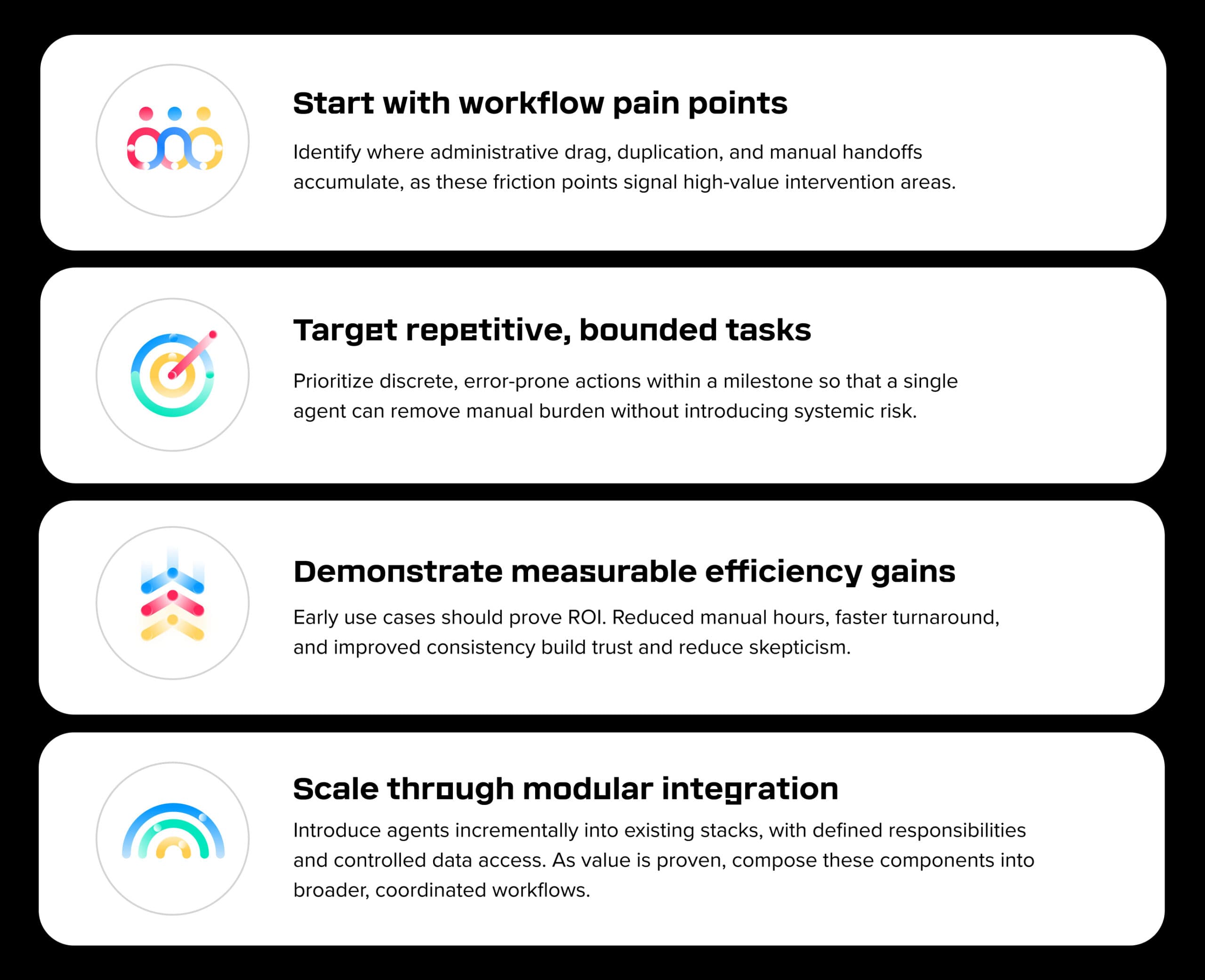
One of the clearest readiness signals is whether an agency has mapped its existing workflows before deploying agents. The temptation is to begin with the technology and to ask where agents can be used, rather than first auditing what work is currently being done, where friction accumulates, and which steps are genuine candidates for automation.
Agencies that skip this workflow redesign phase often find themselves adding agents onto broken or inefficient processes, which amplifies existing problems rather than eliminating them. The starting question is always: what does the workflow look like today, and what should it look like? Moving from experimentation to implementation requires operational focus. In practice, we have found that analysis of real workflows and measurable operational frictions are key to the most effective solutions. As such, agencies and media owners need to consider the following:
Diagnosing ecosystem readiness and identifying the biggest blockers to end-to-end agentic workflows
There is no denying how quickly the acceleration in the capabilities of agentic AI underpinning multi-agent systems is happening. However, the most significant barriers to industry readiness are not intricately linked to the technology itself. Rather barriers to success will come in different forms, typically cultural, structural, and collaborative.
Resistance to change is nothing new and is as old as work itself. Within agencies and media owners it has been seen time after time how teams willingly default to familiar workflows even when those self-same workflows are proven to be inefficient. There is anxiety around job security, skepticism about automation, and legitimate concern about losing the human elements that differentiate agencies and brands.
Compounding this is the temptation to deploy AI superficially. In some cases, agencies and media owners have attempted to “stick AI onto everything” without clearly defining the business need it is meant to address. This approach often leads to wasted investment and underutilized systems. When AI becomes another tool layered onto an already fragmented stack, it increases complexity rather than reducing it.
True readiness requires disciplined use-case definition. It requires starting from workflow pain points and asking whether agentic systems can genuinely remove friction or unlock new value. It also requires sustained change management. Initial training sessions should be seen only as a starting point, as teams need ongoing support and proof that new systems are removing work rather than adding to it.
In this sense, cultural readiness is inseparable from design quality. If agents demonstrably reduce repetitive tasks and enhance performance, users will readily use the tools and adoption will increase. However, if they feel like additional oversight tools or opaque black boxes, resistance hardens.
Fragmentation across the ecosystem
Beyond internal culture, the broader ecosystem presents structural challenges. Advertising involves a complex chain of stakeholders: brands, agencies, ad tech vendors, media owners, data providers, regulators, and ultimately end users. Each operating with different incentives and levels of technological maturity.
As a result, different teams and departments will find ways to adopt new technologies, while others will adopt at a slower rate. For example, agencies and ad tech providers often move first. They are under margin pressure and operational strain and therefore have strong incentives to pursue efficiency and differentiation. Media owners, whose core value lies in content and audience, may feel less immediate urgency to transform unless buy-side demand compels it.
This fragmentation limits the effectiveness of siloed automation. An agency may deploy sophisticated agentic workflows internally, but if those systems cannot interact seamlessly with media owners’ environments or shared buying protocols, the benefits plateau.
The protocol and collaboration gap
For multi-agent media operations to reach full potential, cross-industry interoperability is essential. As such, standardized protocols are needed to enable agent-to-agent communication across company boundaries.
AdCP (Agentic Decisioning & Commerce Protocol) is an open, standardized protocol that enables autonomous agents, whether representing advertisers, agencies, publishers, or platforms, to communicate, negotiate, and transact with one another in real time. As a shared technical language for agentic advertising, it allows agents to interoperate across platforms rather than remaining siloed within proprietary systems and fragmented integrations.
Developed by the Agentic Advertising initiative, AdCP establishes a common foundation for how intelligent agents express intent, evaluate opportunities, and execute media transactions. The protocol transitions media workflows away from manual, platform-bound processes toward interoperable, programmatic coordination between intelligent agents, while preserving human strategic oversight.
On the buy side, this means that advertiser agents can readily translate campaign objectives into machine-readable intent, solicit inventory proposals across multiple publishers, as well as evaluate offers against performance, brand safety, and budget constraints and even automatically negotiate pricing and placement terms.
On the sell side, publisher agents can use AdCP to package inventory dynamically based on demand signals, optimize yield in real time, and even set up counter-negotiations based on availability, audience composition, or strategic priorities. This transforms media buying from static deal-making to continuous, adaptive market interaction.
For the media industry to evolve into an AI-centric ecosystem, open standards like AdCP and Agentic Advertising Management Protocol (AAMP) must become a fundamental part of the AI-mediated media infrastructure. Standardization enables interoperability without eliminating competition and standardizing how autonomous agents communicate and transact will lead not only to faster negotiations, but ever more dynamic optimization, delivering greater efficient alignment between both supply and demand.
Governance, guardrails, and regulatory complexity
Another element of readiness concerns governance. The risks of moving too quickly are tangible, as autonomous systems with high degrees of control can cause brand damage, misallocate budget, or create regulatory exposure if not properly constrained. After all, data leakage, bias, and compliance violations remain serious concerns and should be a priority for any company looking to grow quickly but safely.
The “move fast and break things” ethos, once celebrated in technology culture, is ill-suited to highly automated systems. Instead, agentic adoption requires layered guardrails in the form of human-in-the-loop oversight, brand safety controls, AI systems auditing other AI systems, and clearly defined accountability structures.
At an operational level, each agent must be scoped with clear data access parameters: whether it operates on client-specific or client-agnostic data, what market-level access requirements apply, and what defined data dependencies or restrictions govern its use.
From an operational level, access control mechanisms are technically straightforward to implement but the greater complexity lies in agreeing the rules, especially in multi-agency or multi-client environments.
Before an agent is deployed or shared more broadly, its purpose, data access, and scope should be documented, configured, and reviewed, often through committee-based structures. Governance, in this sense, is as much organizational alignment as it is system design.
Finally, governance requires traceability, which means that outputs, violations, and execution decisions should be logged within audit systems, creating versioning, and oversight over time. As autonomy increases, auditability becomes foundational rather than optional.
In practice, there is a growing demand from agencies for full reasoning trace transparency. By this we mean not just audit logs for compliance purposes, but visible, navigable records of what each agent did, which tools it called, in what sequence, and why a particular output was produced or an error occurred. This is less about regulatory obligation and more about operational trust. When a campaign recommendation goes wrong, account teams need to understand what happened. When an agent produces an unexpected output, engineers need to drill into the execution path. The expectation is shifting from “did the agent do the task?” to “can I understand exactly how it did it?”
On a wider, global scale, regulatory fragmentation adds further complexity to agent deployment. Different jurisdictions are introducing AI regulations at different speeds and with varying levels of strictness. Multinational agencies must navigate this patchwork carefully, often defaulting to the most stringent applicable standard to ensure cross-border compliance.
Governance readiness, therefore, is both a technical and organizational challenge, one that requires clarity on what autonomy levels are appropriate and where human oversight remains essential.
The regulatory dimension
As agentic systems take on greater operational autonomy, the question of legal accountability becomes increasingly important for agencies to address. Under current frameworks, responsibility does not rest with the agents themselves. It sits with the agencies that deploy them. Who specifically is accountable within that structure depends on the roles different parties play across the system lifecycle, and on how governance responsibilities have been defined and documented. The EU AI Act offers one model for assigning those responsibilities clearly, but agencies operating across multiple markets will encounter a patchwork of different regulatory requirements, each with its own logic.
Transparency and auditability are the key areas likely to attract regulatory scrutiny. In practice, this means maintaining decision logs, documenting data provenance, managing model lifecycles, and being able to explain how a system reached a particular output. For example, the type of data to track will depend on the specific AI use and the data itself, which in turn maps to existing regulatory requirements, such as Article 12 of EU AI Act.
Regulators are also paying close attention to bias and fairness, and the concern extends well beyond training data. It runs through every stage of system development and use. Human-AI team performance, or how effectively people and systems work together toward defined goals, is becoming the more relevant measure, rather than AI system performance in isolation.
For agencies deploying agents across multiple markets, regulatory complexity increases quickly. For example, agencies will need to deal with a patchwork of different regulations across different markets. These regulations may include data privacy, cybersecurity, AI, or any other domain-specific regulations.
Agentic commerce also raises specific questions around brand control. When autonomous agents interpret, summarize, or prioritize brand information independently, the risk of inaccurate representation increases. This carries potential exposure under consumer protection, competition, and advertising standards frameworks. Strong governance and monitoring mechanisms are becoming an operational requirement for any organization using AI-mediated interactions at scale, and the legal risks of treating them as optional are growing accordingly.
Perhaps the clearest message from regulators is one that mirrors what effective operators are already learning: governance built in from the start is meaningfully different from governance retrofitted after deployment. The agencies that treat compliance as a design principle, rather than a final checkpoint, are the ones building systems that can withstand scrutiny over time.
Overall readiness assessment
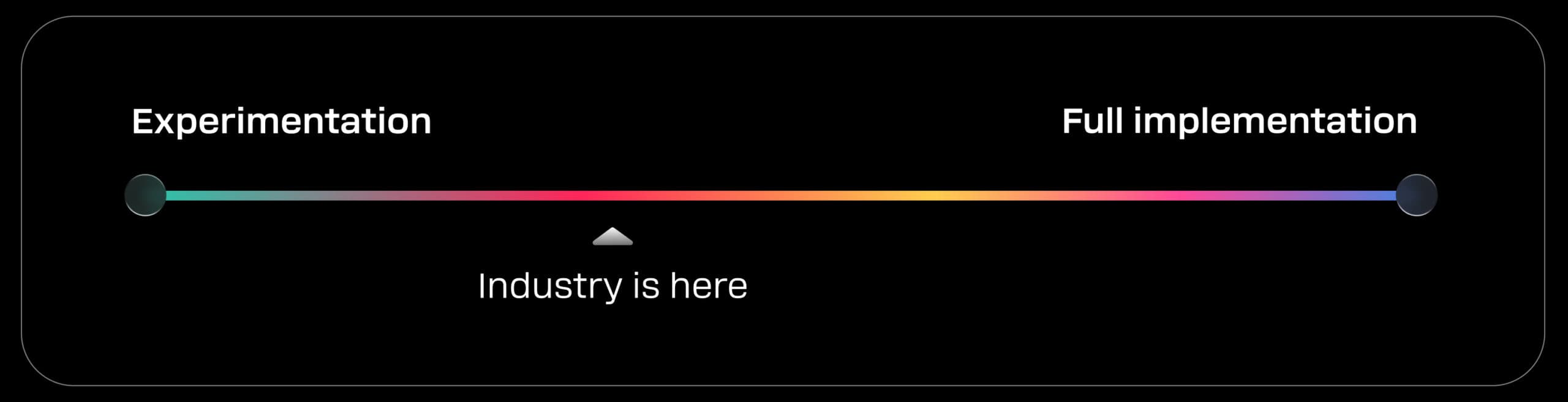
Technologically, the building blocks are largely in place. Agents can already perform more tasks than most agencies and media owners are currently asking of them. The limiting factors lie elsewhere, within business culture, interoperability, governance, and collaboration.
The industry appears to be transitioning from experimentation to structured implementation. The early hype cycle around generative spectacle is giving way to deeper questions about workflow redesign and ecosystem alignment.
It is also worth naming something the industry tends to talk around: trust in fully autonomous systems remains low. This is not primarily a technical problem, as the capability already exists. Rather, the hesitation is organizational. In production environments, agentic workflows are frequently scoped to discrete, bounded outputs rather than end-to-end execution, specifically to avoid scenarios where an agent takes a consequential action without a human in the sign-off chain. The real work of readiness, therefore, is less in building more capable agents and more in the classification, permissions, approval processes, feedback loops, and guardrails that allow agencies and media owners to extend trust incrementally.
The industry is coming to the realization that end-to-end agentic media operations will not emerge overnight. They will be built incrementally, through modular adoption, cross-industry protocol development, and sustained cultural adaptation. The readiness gap is not a deficit of capability, but a deficit of coordinated execution. As a result, the future of multi-agent media operations will be determined less by what AI can do and more by what the industry is prepared to redesign.
Practitioners working in production environments consistently point to the same entry point: task-specific agents. Rather than beginning with multi-agent orchestration, the most reliable starting position is a single agent assigned to one action within an existing workflow, such as generating copy variants from a brief, extracting structured data from unstructured inputs, or flagging delivery discrepancies. The value is demonstrable, the risk is contained, and the learning is immediate. Expanding into broader, coordinated workflows comes later, once individual agent reliability is established, and user trust is built.
For agencies and media owners moving into structured implementation, two broad transformation models are emerging. The first is modular adoption: identifying one high-friction workflow, often ad operations, and deploying agents to reduce manual effort and increase efficiency within that specific area before expanding to adjacent workflows. This approach is lower risk, delivers faster proof points, and builds institutional confidence gradually. The second is the platform approach: building an agentic operating system from the ground up and expanding functionality over time. This is more ambitious, better suited to larger agencies with the resources to absorb a longer time-to-value curve.
Neither model is categorically better. The right choice depends on the size of the business, the maturity of existing workflows, and the degree of executive sponsorship behind the transformation effort.
Guardrails: A three-layer control model
If governance defines who can build and deploy agents, guardrails define how those agents behave.
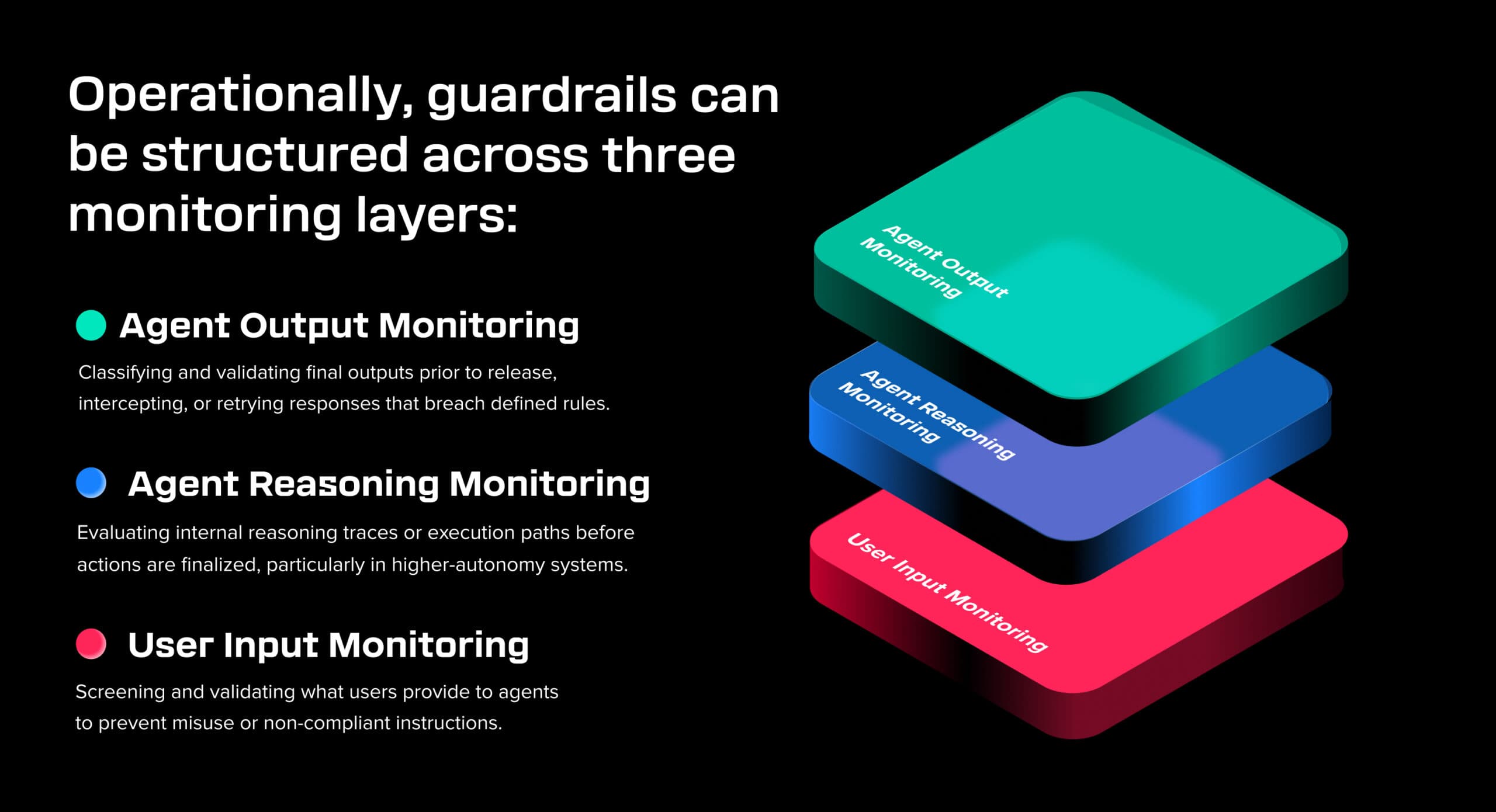
In practice, many agencies and media owners prioritize output-level guardrails, as these are the most direct and cost-efficient to implement. Expanding monitoring into reasoning and input layers increases accuracy but also computational cost and complexity.
As agents gain greater autonomy, the number and sophistication of guardrail rules scale accordingly. The underlying mechanism may remain consistent, but the structural oversight surrounding it must evolve.
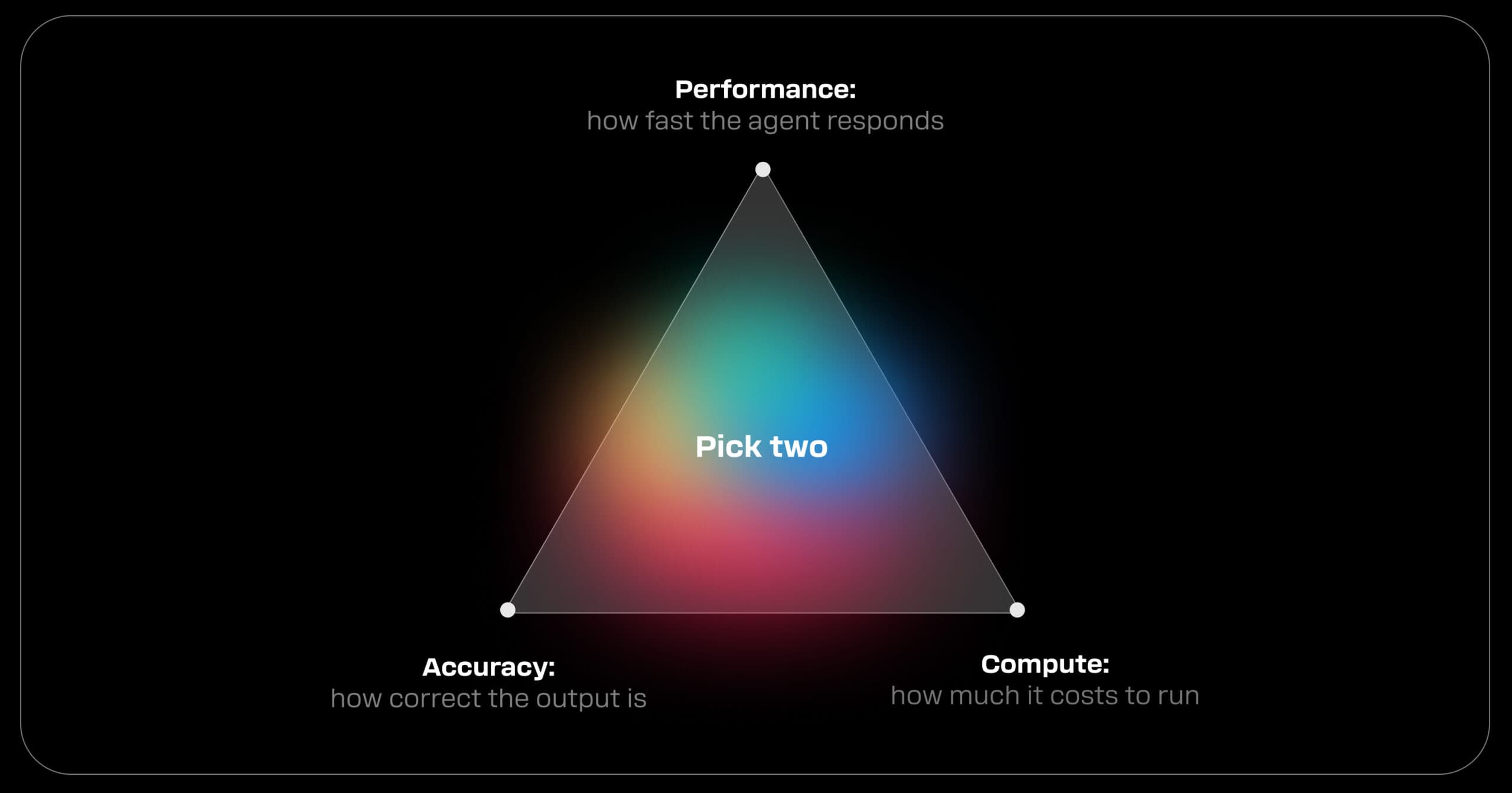
Compute. Performance. Accuracy.
At the core of every agent workflow sits three competing factors: performance, compute, and accuracy. These are not design challenges but basically economic ones. This is the classic triangle, and agencies and media owners need to select two for the best efficiency, while the third is going to be sacrificed.
In practical terms, this means that every agent decision, whether that is extracting information from a brief, generating copy variations, or validating campaign parameters sits on this trade-off curve. Faster responses reduce cost but may reduce precision. Greater accuracy increases reliability but increases latency and compute spend.
When thinking about implementing agents, they must be designed with use-case value in mind. Not every milestone in a workflow requires maximum accuracy. Not every decision justifies maximum compute. And not every latency increase is acceptable in production environments.
The question, therefore, is not simply how intelligent an agent can be. It is how much compute an organization is willing to spend, how long it is willing to wait, and what level of accuracy is good enough for each specific step in the workflow.
Buy vs Build vs Integrate: Understanding the roles of technology ownership in the modern agency
Technology and AI are already reshaping marketing services, enabling agencies to shift their core value proposition from pure creative storytelling to an integrated offering combining creative + technology + data solutions. Rather than pitching bold ideas in isolation, agencies now position themselves as partners delivering data-driven creativity that results in measurable business outcomes.
Inside agencies, AI and automation are reshaping how work gets done. Content production, media buying, and even strategic planning are increasingly supported by intelligent tools and AI, making workflows more technology-first. Campaigns are evolving into continuous, always-on cycles of analytics and optimization. The modern agency model blends human creativity with machine execution, demanding seamless integration among people, data, and technology.
As a result, CMOs are increasingly viewing agency technology as a critical factor in partner selection, yet many see agency platforms as interchangeable and expect improvements in AI automation, analytics, and compliance. This creates pressure on agencies to rethink not just whether to invest in technology, but how much to own versus how much to leverage.
This tension between building and buying technology emerges from a more fundamental strategic question: how should agencies allocate resources between deepening existing capabilities and expanding into new ones? This distinction provides a coherent framework for understanding when agencies should own technology (build) versus when they should leverage external platforms (buy).
Building: Owning differentiation
Building technology in-house gives an agency full control over intellectual property, data, and workflows. An in-house solution can be custom fit to processes and client requirements, potentially making it more effective in specific use cases.
However, building requires substantial upfront investment which is costly for agencies not historically structured as software firms. Also, technology evolves fast, and an agency might sink millions into a tool that becomes outdated if done solely in-house. It also demands ongoing maintenance and upgrades, creating a new organizational competency and cost that agencies must sustain. For most agencies, building only makes sense when the technology directly underpins strategic differentiation.
Buying: Speed and scale
Buying technology, typically through a SaaS platform, cloud infrastructure, or licensed AI models, offers speed, reliability, and access to best-in-class capabilities. It allows agencies to deploy proven tools quickly, spread costs over time, and focus resources on creative and strategic work rather than core infrastructure.
By buying, an agency can deploy a solution quickly, often immediately getting world-class functionality (since the vendor specializes in that tech). It avoids reinventing the wheel – for example, rather than building a cloud infrastructure, agencies use Google Cloud or AWS; rather than developing a generative AI from scratch, agencies license OpenAI or Google’s models.
The trade-off is reduced differentiation and control. If everyone uses the same tools, competitive advantage erodes. Vendor dependence, data constraints, and limited customization can also restrict how agencies evolve their offerings.

Integrating: Orchestrating value
The future of agency tech strategy is rarely “build” or “buy” alone. It is integration.
In marketing services, integration means acting as the orchestrator of tools and data to create client value. Rather than owning every component, agencies master how to blend the best tools and apply them to real workflows. APIs and cloud platforms make this practical at speed and scale.
For example, an agency could license a third-party AI tool via API and layer a proprietary interface on top, tuned to its workflows and brand data — delivering client benefits like faster turnaround and consistent brand expression without owning the underlying model.
Integration benefits agency employees as well. It removes friction and manual overhead by embedding tools directly into their workflow, so instead of toggling between platforms or reworking generic outputs, teams work inside a system designed for how they think and deliver.
In practice, an integration strategy blends best-in-class external platforms for generic capabilities, such as cloud hosting, AI algorithms, or CRM systems, with targeted custom layers or connectors that adapt these platforms to an agency’s unique processes. The result is a cohesive toolchain that automates and executes work end-to-end, with human expertise guiding and quality-checking the final output.
Choosing the right ownership model
When technology and data become ubiquitous, an agency can either strive for scale advantages with efficient, high-volume, cost-competitive services, or for scope advantages with specialized, highly differentiated expertise, or some combination of focus. The worst place for an agency to be is straddling both and trying to be everything for every client.
The most urgent question agency leaders should ask isn’t whether to invest in technology, it’s what purpose that investment serves. Is the goal to drive operational efficiency in client delivery or to create a strategic differentiator that defines the agency’s unique position in the market? The answer shapes everything downstream, from hiring plans to platform architecture to how an agency communicates its services.
This requires deliberate clarity on three areas that should guide its technology decisions and investment:
- What services the agency chooses to deliver and not deliver.
- Where ownership creates true differentiation versus unnecessary cost.
- Which clients and CMO needs is the agency designed to serve.
In the next evolution of agency models, we could see a fundamental shift towards platform modularity and Platform-as-a-Service (PaaS) offerings where they deliver value with technology, but humans are still the differentiator. A blueprint for this shift is Palantir’s FDSE model, where software is embedded via specialists who deploy and operationalize it based on each client's unique demands.
Ultimately, technology investment must serve a clear strategic purpose, either operational efficiency or market differentiation. Agencies must deliberately choose what services they offer, how they deliver them uniquely, and which clients they serve.
The future agency model will likely be modular and platform-based, where technology enables outcomes, but human specialists remain the key differentiator. Agencies that treat technology as an outcome engine and not just infrastructure will be best positioned to deliver growth, speed, and relevance for clients.
Summary and checklist

Multi-agent media operations are no longer theoretical as the technological building blocks are largely in place. Agents can already interpret context, optimize toward goals, coordinate across workflows, and operate within defined guardrails. It’s no longer a question of capability. The challenge now is coordinated execution, which will require a deliberate redesign of the underlying infrastructure.
Agencies and media owners must shift from asking where AI can be used to how decision-making itself should be structured. That means rethinking workflow architecture, redefining accountability, clarifying autonomy boundaries, and aligning coordination models with business risk. It requires hybrid operating environments that integrate legacy systems while incrementally introducing multi-agent components. It demands governance frameworks robust enough to manage drift, regulatory complexity, and reputational exposure.
Equally, progress depends on interoperability beyond organizational walls. Without shared protocols and cross-industry collaboration, agentic systems will remain siloed and value creation will plateau. Standardization is not about limiting competition; it is about enabling scalable, intelligent coordination across the ecosystem.
At Star, we believe that the next phase of agentification will not be defined by experimentation, but by operational discipline. To prepare the way, we have created the following checklist. With it agencies and media owners like yours can start the conversation of how best to prepare and structure for a multi-agent environment.
Approach agentification as an operating model shift
Multi-agent media operations should be treated as a structural redesign rather than a feature upgrade. This requires rethinking workflows, coordination logic, and accountability frameworks. The strategic question is not “Where can we use AI?” but “What operating model are we intentionally shaping?”
Prioritize workflow friction over novelty
Agentic systems deliver the most value when they remove administrative drag and enable continuous optimization. By defining workflow pain points and looking to create solutions that solve admin problems, agencies and media owners can look to create meaningful change.
Design governance at foundational level
As autonomy increases, oversight must evolve. Clear intent, guardrails, and monitoring frameworks are essential and should be defined early in the development phase to have the most impact.
Plan for hybrid evolution
Legacy rule-based systems and agentic components are set to coexist for the foreseeable future. Therefore, plan for incremental implementation that allows for steady returns on investment and efficiency while preserving operational continuity.
Make coordination a deliberate strategic choice
Selecting the appropriate coordination structure, swarm versus orchestrator, for example, should be aligned with task complexity, risk tolerance, and organizational maturity.
Embed interoperability into the roadmap
Internal gains will plateau without cross-platform and cross-industry connectivity. As a result, interoperability should be considered early, not retrofitted later.
Align technology decisions with strategic purpose
Be clear whether investment is driving efficiency, differentiation, or both. Build where it creates advantage, buy where it’s commoditized, and integrate to unlock value.