
Holding companies aren't buying more tools, they're building systems clients can't leave. Independent marketing agencies have the speed to outmanoeuvre them, but speed without infrastructure isn't a strategy. This report benchmarks nine leading independents on AI maturity, data infrastructure, and workflow automation.
The infrastructure strategy shift in agency competition
Agency competition has changed. For years, the industry operated on familiar trade-offs: scale vs agility, and global reach vs specialist expertise. With AI workflow automation, that model no longer holds. The new defining factor is infrastructure.
Agencies that unify data, AI, workflows, and client operations into a single operating layer are pulling ahead. Those that don’t are positioned as execution partners in a market that now values integrated intelligence.
This shift is already visible in how marketing leaders operate. In a recent Forrester Consulting study commissioned by Star, 76% of CMOs and senior marketing leaders identified revenue growth as their top priority, while over half now directly lead martech strategy and collaborate with CTOs.
Holding companies are reorganizing around unified, AI-enabled platforms. More than a mere inconvenience, disconnected systems are a barrier to measurable ROI.
The direction is clear: platform-led delivery is becoming the competitive baseline.
For independent agencies, this creates both pressure and opportunity. Without legacy complexity, independents have the architectural freedom to move faster: connecting systems, operationalizing AI, and designing platforms tailored to client needs.
The question is no longer whether to act, but how quickly and, more importantly, how to become an AI-native marketing agency in a way that creates lasting competitive advantage.
See how leading independent marketing agencies compare
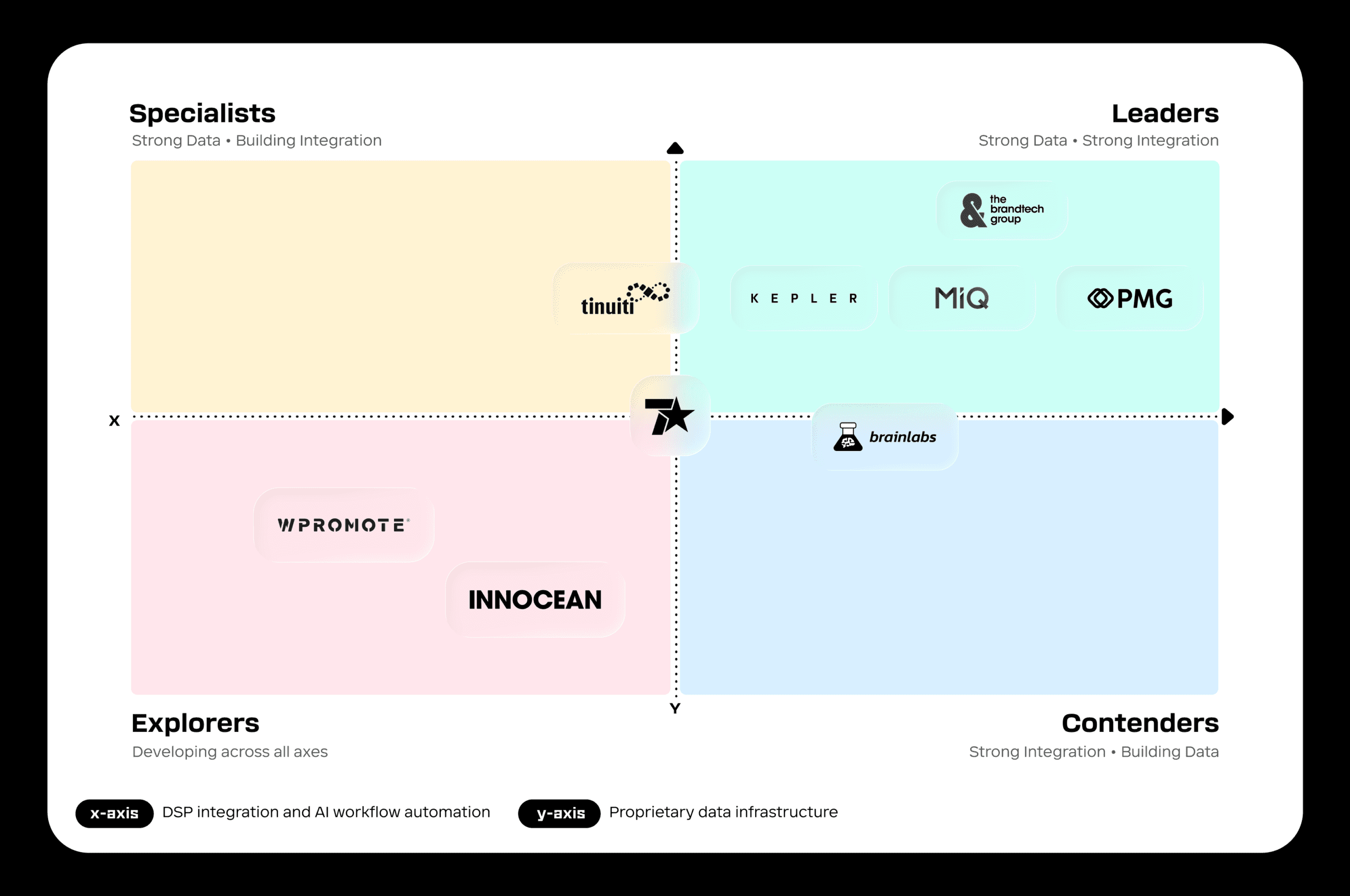
To understand how the market is evolving, this benchmark assessed nine independent agencies with a focus on media buying — Brandtech Group, PMG, Kepler, MiQ, Tinuiti, Brainlabs, The7Stars, Wpromote, and Innocean.
What the independent agency landscape reveals
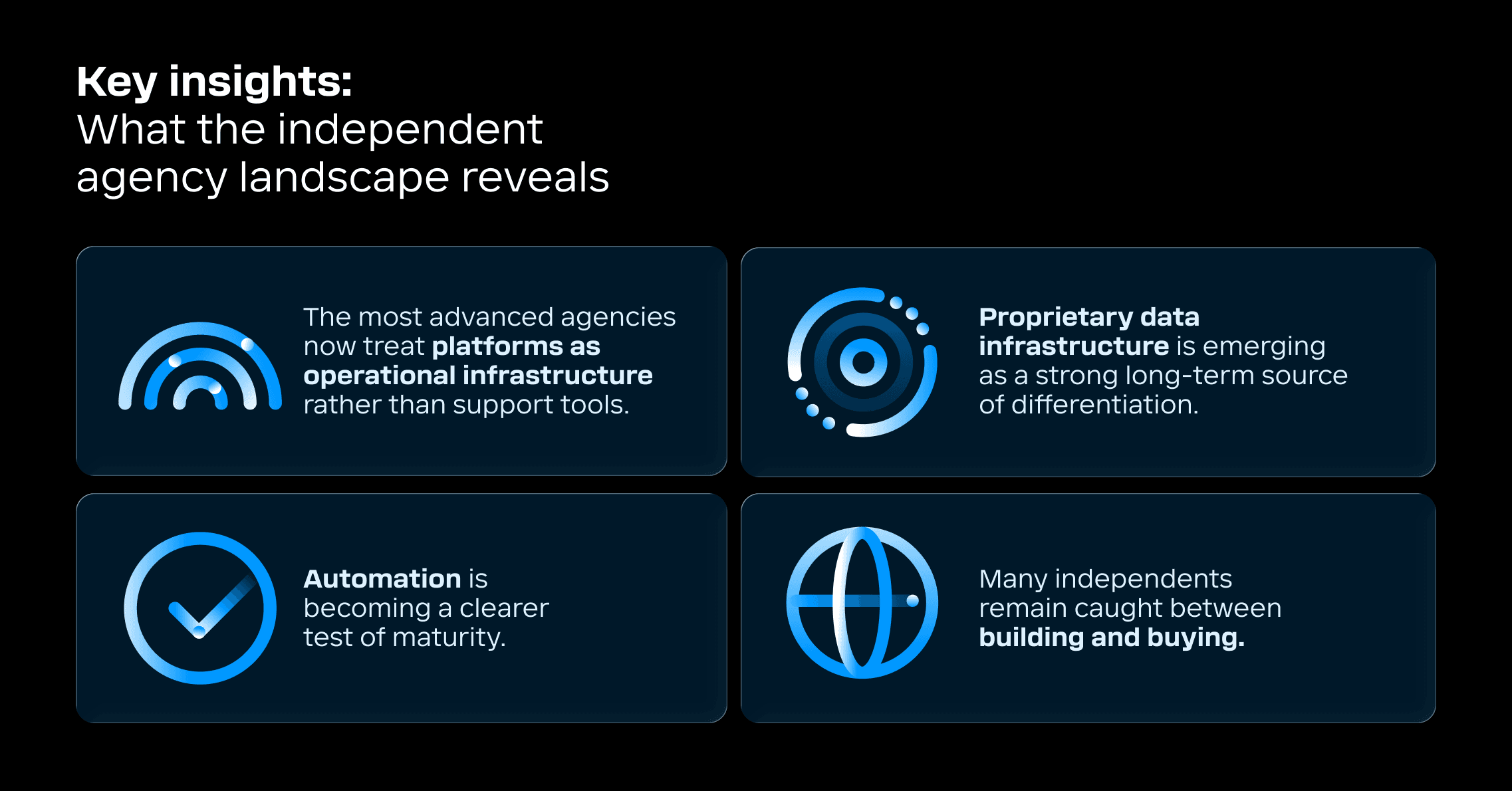
Most agencies believe they are progressing toward AI-native operations. This report shows how that progress actually compares across the market, and the patterns already beginning to define competitive advantage:
- Technology maturity is uneven. A small group of marketing agencies have built integrated platforms, while many are still operating across fragmented systems.
- Proprietary data is becoming the strongest source of differentiation. Agencies that own their intelligence layer are better positioned to scale and retain clients.
- AI maturity is still developing. Adoption is widespread, but far fewer agencies have embedded AI into core workflows in a way that changes how they operate.
These shifts are already shaping how agencies compete.
Strategic implications for the next five years
Those who continue to build in silos will struggle to retain the clients that Boards now fight over. The benchmark makes it clear that integration and AI-native operating logic unlock durable competitive advantage — when data, workflows, and intelligence function as a connected system, agencies become structurally difficult to replace.
To pull ahead, independent agencies should invest in the layers they own: proprietary data environments, unified reporting, and orchestration logic that compounds in value over time. Now is the moment to reimagine the agency model as an infrastructure play, not just a service one.
Most importantly, technology must be a means, not a destination. Agency leaders should start by defining where they need to be irreplaceable — and work backwards to identify the capabilities, integrations, and platforms that get them there. By building around strategic retention rather than chasing tools, independent agencies can create the connective tissue needed for real growth, stronger margins, and a competitive moat that holds.
Independent agencies will not differentiate through more talent or more tools. They will differentiate by building connected systems of data, workflows, and intelligence that clients depend on every day. – Lolly Mason, Head of Strategic Accounts, Media & Advertising, Star