


Around 25% of agency work hours are spent on administrative tasks. Things like re-entering briefs, following up on requests for proposals (RFPs), manually checking campaign builds, creating reports, and matching ad spending are still part of the daily media buying workflow.
At first, this might seem like a staffing issue, especially when teams are busy and deadlines are close. But the real problem is how the work is set up, since much of today’s agency process depends on people manually managing tasks across separate systems, partner platforms, spreadsheets, emails, and reporting tools.
Agentic AI has significantly changed that structure, reshaping the workflow around AI agents that understand context, manage tasks, run checks, raise issues, and keep work moving through the media buying lifecycle. Much of the current online rhetoric would have you believe that equates to replacing staff, but actually, people become more important because they can provide context, judgment, guardrails, and final accountability, allowing agentic media operations to be safe and useful.
So what changes when agentic AI is introduced into the end-to-end media buying workflow in advertising agencies? What does the ‘before and after’ picture look like when the media buy is no longer a process but a living system? Read on to find out.
9 stages of the media buying workflow, before and after agentic AI
A traditional media buying workflow is linear: brief, plan, buy, launch, optimize, report, and reconcile. In reality, it is much messier. Information moves between teams, systems, partners, and clients. Decisions are made in one place but executed elsewhere. As work moves from strategy to activation, reporting, and finance, context can get lost.
Agentic AI changes this by adding a coordination layer across the workflow. Agents don’t replace the media team, but they do help structure information, manage handoffs, check work against rules and exceptions, preventing delays or errors.
The important shift is agentification over automation. Humans provide context and approval, while agents coordinate the operational work around them.
1. Brief intake and goal definition
Without agents: Briefs arrive through emails, decks, calls, and messages. Requirements are re-entered across systems, and missing details often surface later during planning or launch.
With agents: The team provides the client context: goal, budget, audience, timing, markets, success metrics, and known constraints. An intake agent turns this into a structured brief and flags missing inputs, such as unclear attribution windows, missing creative specs, or undefined compliance requirements.
Escalation and governance: Anything that could affect strategy, spend, measurement, or risk is escalated to a human. The agent can structure and validate the brief, but a strategy or account lead approves it before planning begins.
2. Audience research and insights
Without agents: Planners gather insights from first-party data, platform tools, past campaigns, market research, and third-party sources. The work is slow, inconsistent, and difficult to reuse.
With agents: The team defines the strategic question: who the campaign needs to reach, what behavior it needs to influence, and which assumptions need testing. Research agents look across different data sources, spot patterns, identify potential audience groups, indicate where the evidence is weak, and explain how confident they are in each suggestion.
Escalation and governance: Low-confidence recommendations, conflicting data, sensitive targeting categories, and major shifts from the previous strategy are sent for human review. Agencies need clear rules for data access, validation, and handling sensitive audiences.
3. Media planning
Without agents: Plans are built manually in spreadsheets and decks. Scenario modeling is slow, so budget shifts, channel mix options, and measurement trade-offs may not be fully explored.
With agents: The team sets the strategic direction, including growth priorities, budget constraints, channel appetite, and risk tolerance. Planning agents draft channel scenarios, forecast ranges, budget options, and measurement assumptions. They can also standardize taxonomy, KPI definitions, naming conventions, and UTM rules early.
Escalation and governance: Channel mix, budget weighting, measurement compromises, and client-facing recommendations remain human decisions. Agents can support planning, but strategists own the trade-offs.
4. Discovery, RFP, and inventory selection
Without agents: Partner discovery, RFPs, and inventory comparison are manual and relationship-driven. Teams spend time formatting, chasing, and comparing responses instead of evaluating fit.
With agents: The team provides the buying strategy, client constraints, and inventory preferences. Agents prepare RFP inputs, generate consistent questions, manage follow-ups, and normalize responses into comparable deal cards.
Escalation and governance: Brand suitability concerns, unusual pricing, measurement gaps, and partner exceptions are escalated. Humans still make final partner and inventory decisions where client trust, commercial relationships, or reputational risk are involved.
5. Deal negotiation and buying strategy
Without agents: Negotiation details live across emails, spreadsheets, and notes. Terms, verification requirements, and approval constraints can be captured inconsistently, creating gaps between strategy and setup.
With agents: The team sets priorities such as target pricing, acceptable trade-offs, preferred partners, and risk thresholds. Agents track terms, compare changes, draft negotiation checklists, and check proposed deals against client guardrails.
Escalation and governance: Pricing exceptions, nonstandard terms, measurement limitations, and any deviation from approved guardrails go to the buying lead. Agents can track and flag, but humans approve final terms and commercial commitments.
6. Campaign setup and trafficking

Without agents: Campaign setup is repetitive, high-volume, and error-prone. Teams manually configure settings, upload creative, implement tracking, build UTMs, and QA the platform setup.
With agents: The team provides the approved plan, creative assets, platform requirements, and launch criteria. Set up agents translate the plan into platform-ready build sheets and run pre-flight checks across tracking, URLs, naming conventions, conversion events, budget settings, creative specs, brand safety, and compliance rules.
Escalation and governance: Missing assets, tracking mismatches, budget discrepancies, compliance issues, and platform conflicts are escalated before launch. Agents can prepare and validate the setup, but launch approval stays human-led.
7. Live optimization
Without agents: Optimization often depends on scheduled checks, dashboard reviews, and ad hoc troubleshooting. Teams are limited by reporting delays, bandwidth, and inconsistent alerting.
With agents: The team defines optimization goals, budget flexibility, approval rules, and risk thresholds. Optimization agents monitor pacing, performance, frequency, conversion quality, and anomaly signals. They recommend bounded changes, such as bid adjustments, exclusions, audience refinements, or budget shifts within approved limits.
Escalation and governance: Budget reallocations, major bid changes, CPA spikes, brand safety flags, and recommendations outside approved thresholds are escalated. Agencies need clear guardrails on what agents can recommend, execute, pause, or escalate.
8. Reporting and insights
Without agents: Reporting requires teams to pull data from multiple platforms, standardize definitions, troubleshoot mismatches, and draft client narratives. This slows learning and leaves less time for interpretation.
With agents: The team defines the reporting narrative, stakeholder needs, and business context. Reporting agents extract and normalize data, identify exceptions, update dashboards, and draft first-pass commentary against agreed KPI definitions.
Escalation and governance: Data discrepancies, unexplained performance shifts, missing source data, and recommendations that imply budget or strategy changes are escalated. Agents can draft, but humans own the final story and client-facing recommendations.
9. Finance reconciliation
Without agents: Spend and delivery are reconciled manually against invoices, platform records, and partner reports. Discrepancies can take time to detect, creating margin and billing risk.
With agents: The team defines billing rules, dispute thresholds, and approval requirements. Reconciliation agents match platform spend to invoices, flag anomalies, compile dispute evidence, and track unresolved issues.
Escalation and governance: Spend discrepancies, billing anomalies, margin risk, partner disputes, and client-impacting finance decisions are escalated. Agents improve visibility, but commercial accountability remains with the agency team.
What changes overall: Across the media buying workflow, agentic AI shifts the agency operating model from manual coordination to governed orchestration. Humans provide context, strategy, creative judgment, client understanding, risk appetite, and final approval. Agents structure the work, maintain context across systems, monitor for issues, recommend next actions, and escalate exceptions. Automation completes isolated tasks. Agentification changes how work moves across the entire media buying workflow.
For an extensive review of media agency AI workflow ideas and how you can optimize planning for your own implementations, read ‘AI automation for media agencies: 4 high-ROI workflows to prioritize’
What changes for your team in an agentic media operations workflow
Agentic media operations do not mean the removal or replacement of headcount; when designed properly, they eliminate repetitive overhead, allowing media buying teams to deliver higher-value work.
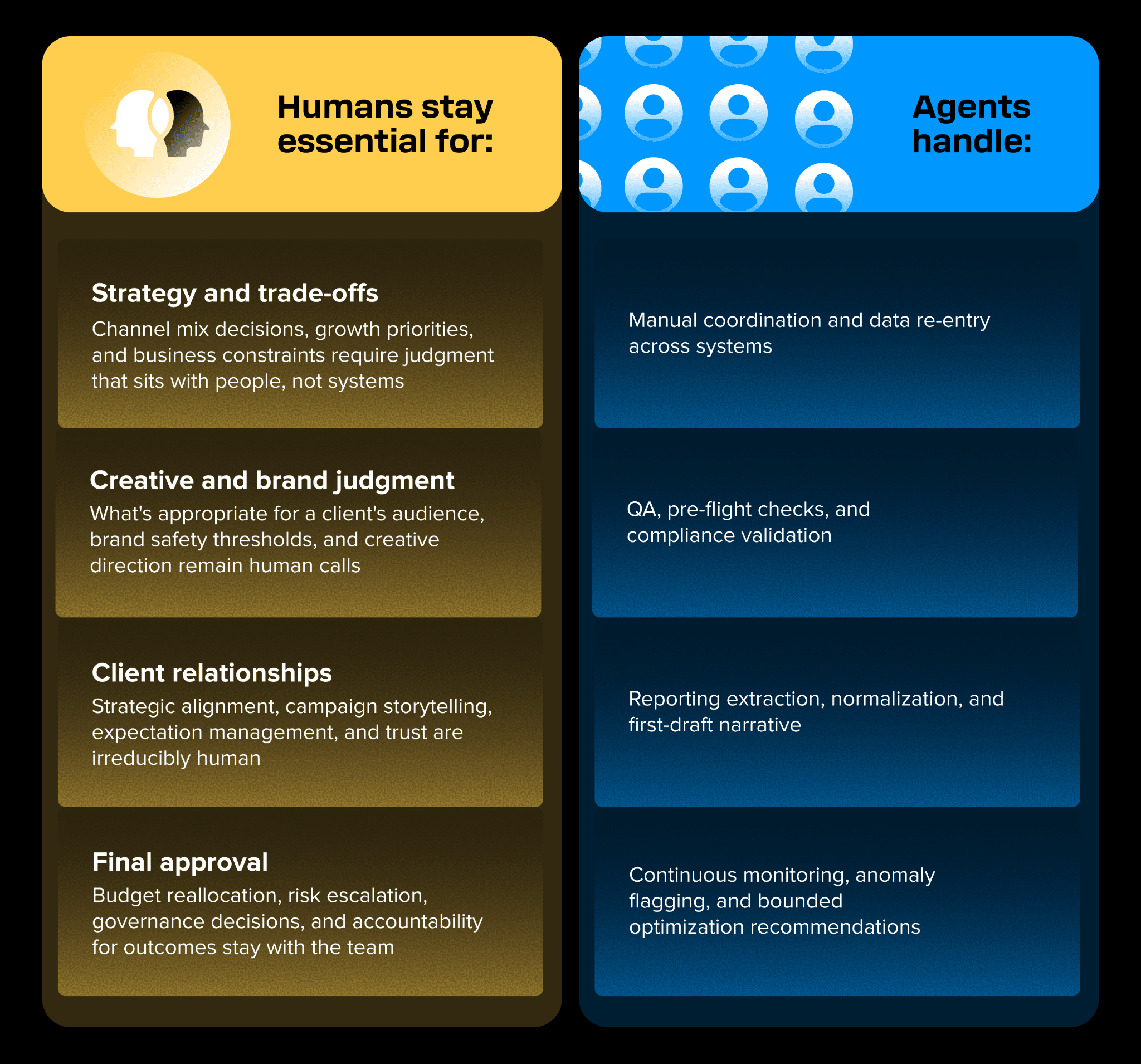
Within an AI-enabled process, humans remain essential for strategy setting and trade-offs, such as channel mix, business constraints, and priority alignment. Creatively, the humans interacting with the client day to day will have the brand judgment that agents cannot replicate. Humans know what falls within the client's approval appetite, what an audience fit looks like in the context of prior performance learnings, and when the risk tolerance is open to stretching.
AI agents handle manual coordination, QA, and reporting, while people maintain final approval on creative direction, ad spend, risk management, and accountability for budget decisions, governance, and escalation thresholds, while AI agents manage automated execution work. Ultimately, client trust and confidence are still reliant on human relationships, strategic alignment, campaign presentation, storytelling in reporting, and expectation management. AI is designed to reduce administrative burden, increase campaign efficiency, and quickly highlight inconsistencies or anomalies.
What agencies have already proven with AI agents in media buying
Measurable gains are being felt across a range of agencies using agentic AI and programmatic workflow automation in media buying. Here are just a few examples:
- Jellyfish reported 65% faster campaign launches, a 22% average reduction in infrastructure expenses, and a 30% average boost in campaign performance by automating media research, evaluation, content strategy, and activation.
- LG Ads compressed reporting cycles from 2 days to just 5 hours by introducing a media effectiveness agent for its platform, Agentiv.
- Equativ helped media planners reduce planning time by up to 40% by implementing AI planning support within the ‘Maestro by Equativ’ platform.
Agencies that approach agentification as task automation may see efficiency gains in faster planning, launch, reporting, and less operational drag. But agencies that treat it as agentification can redesign the operating model behind the media buy for a consistent, governable, and scalable AI layer for campaign workflows across the agency.
For more examples of Agentic AI in action across media buying workflows, see'How AI is Transforming Media Operations: From Programmatic Rules to Agentic Workflows'.
What agencies need to have in place before scaling campaign workflow AI
AI media buying workflow transformation is primed for success when this is treated as an operating-model shift rather than a tool rollout. Before an agency can rely on agents across the workflow, it needs the right foundations.
- Sensible, usable data: Agents can’t reliably automate what they can’t reliably read. Campaign, audience, performance, creative, and finance data must all be accessible and queryable. Raw data isn’t enough; it must be accurate, structured, and relevant to decision-making. Standardized definitions across areas such as KPI taxonomy, naming conventions, and UTM rules are critical to avoid mistakes.
- Workflow definition: Agentification requires agencies to define how work actually moves. That includes inputs, outputs, owners, approval points, handoffs, and dependencies across each stage of the media buying workflow. If the workflow itself has become inconsistent across teams, clients, and platforms, the process must be defined before agents can orchestrate it.
- Governance and controls: It is important to define what agents can do autonomously and what requires approval. If boundaries aren’t clearly defined from the outset, you risk introducing speed without control. You will need to set escalation thresholds or ‘stop conditions’ for things like CPA spikes, and risk categories for every client/channel, as well as maintaining logging and audit trails for decisions, changes, and exceptions.
- A human-in-the-loop operating structure: To maintain control and operational efficiency, you must assign ownership. Decide who approves builds, budget changes, and reporting narratives. Clear handoffs between human team members and AI agents will keep the process working smoothly, so define what constitutes ‘ready’ at each stage. Finally, determine accountability. In a hybrid AI media buying workflow, humans remain responsible for outcomes.
A three-layer control model
A practical governance model should operate across three layers:
- Task control: what the agent is allowed to do at a specific stage of the workflow.
- Workflow control: how work moves between agents, systems, and humans, including handoffs, approval gates, and escalation points.
- Business control: how the agency manages risk, accountability, auditability, client-specific rules, and regulatory considerations.
Agentic AI risk does not stay neatly contained in a single stage of the workflow. Decisions made early can shape everything that follows. If an agent works from an incomplete brief, the media plan may be built on the wrong assumptions. If the plan is inconsistent, setup may be misconfigured. If the setup is wrong, reporting, optimization, and billing may all be affected. Governance needs to follow the workflow end to end.
Before and after AI in a media agency workflow
The real shift is not from manual to automated. It is from fragmented execution to governed coordination. Before agents, the media buying workflow depended heavily on people manually carrying context from one stage to the next. After agents, the workflow can become more structured, traceable, and responsive, with humans making the decisions that matter and agents managing much of the operational movement around those decisions.
That is how agentic AI changes media planning and buying. It gives agencies a way to reduce administrative drag without removing human judgment. It gives teams a way to move faster without losing control. And it gives agency leaders a clearer path to modernize operations in a market where speed, transparency, and accountability are increasingly hard to separate.
Ready to modernize your media operations?
Star helps agencies design and build agentic workflows — without losing control. From workflow mapping to AI agent design, integration, and governance. Let's find your starting point.
FAQs
A media buying workflow is the end-to-end process agencies use to plan, buy, launch, optimize, report on, and reconcile advertising campaigns. It typically includes brief intake, audience research, media planning, RFP and inventory selection, deal negotiation, campaign setup, live optimization, reporting, and finance reconciliation.