

For the past two years, agentic AI tools have been proliferating across the advertising industry. Agencies have built buying agents, optimization agents, and planning agents. What most of them could not do was talk to each other across platforms. A buy-side agent and a sell-side agent, built by different companies on different architectures, had no shared language. That gap is what AdCP and AAMP IAB Tech Lab exist to close.
The urgency is real. According to our independent Forrester study, only 8% of CMOs say they have seamless data integration with their agencies. Half report that fragmented marketing systems make it difficult to track campaign ROI. Programmatic automation improved speed but never fixed the structural fragmentation underneath. Agentic AI media buying is the next serious attempt to address this, and it requires shared infrastructure to work. That infrastructure is now being built.
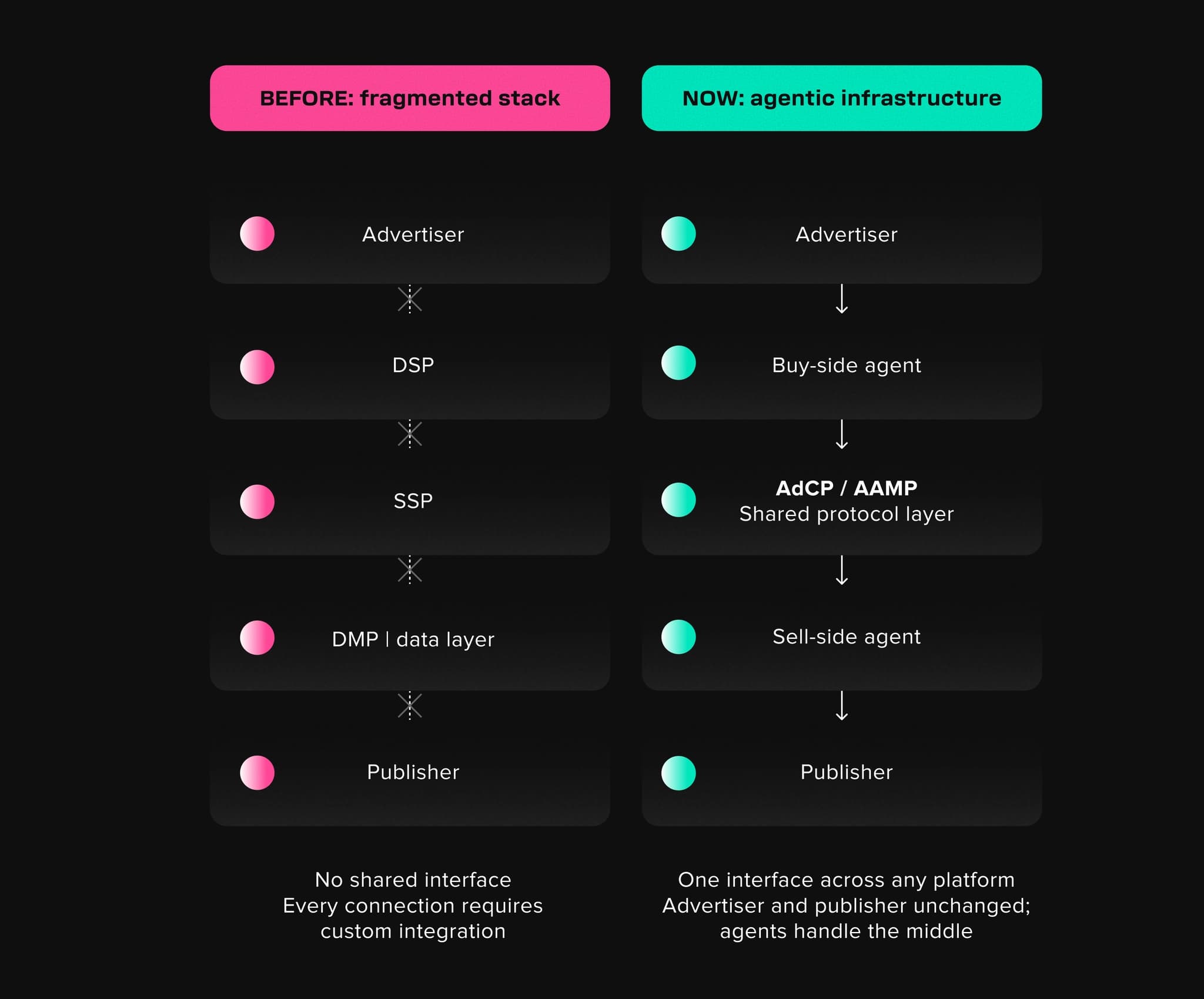
What "agentic" actually means for media buying
Most automation in media buying today is rule-based. It executes predefined logic: pause when CPM exceeds a threshold, rotate creative when frequency hits a cap. The system does exactly what it was programmed to do, in scenarios that were anticipated in advance.
How do AI agents buy media? They work differently. An agent pursues a goal rather than executes a rule. It can interpret a natural language brief, assess available inventory across platforms, form a media strategy, set up a campaign, monitor pacing, and optimize, all without a human managing each step. It reasons toward an outcome, which means it can handle situations it was not explicitly programmed for.
For that to scale across an industry built on hundreds of disconnected platforms, agents need a common language. Agencies have been running agentic experiments for two years. The problem has been that each deployment was an island: a buy-side agent built on one architecture could not talk to a sell-side agent built on another, which meant every agentic workflow required custom integration and couldn't scale across the ecosystem. Two emerging agentic advertising standards are now attempting to fix that at the infrastructure level.
For a broader view of how agentification is restructuring media operations end to end, our agentic AI media hub covers the full picture.
Ad Context Protocol explained: the protocol layer for agent communication
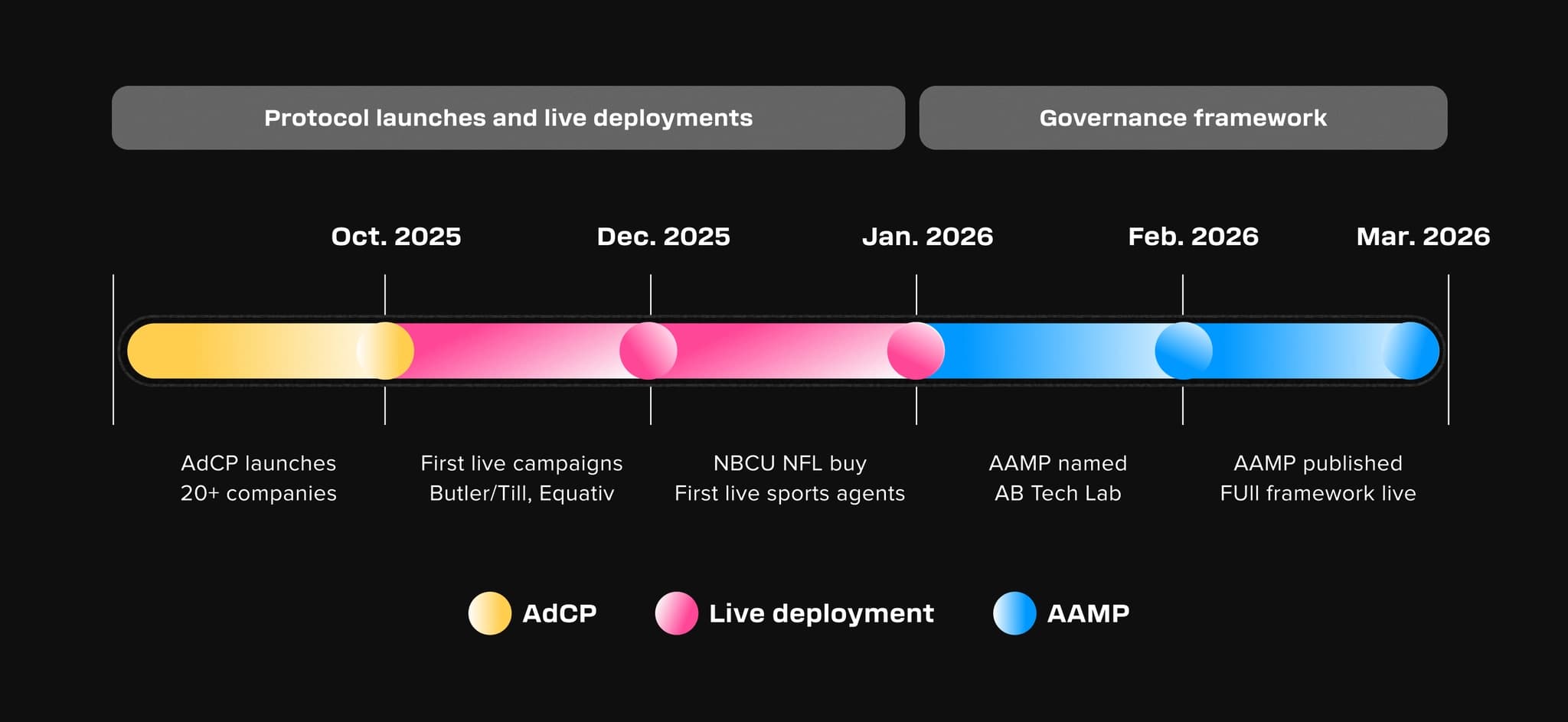
The Ad Context Protocol (AdCP) is an open standard that enables AI agents to communicate with advertising platforms and, as the standard matures, directly with each other across the ecosystem. It launched Oct. 15, 2025, backed by a founding consortium including Yahoo, PubMatic, Scope3, Swivel, Triton Digital, and Optable, with more than 20 companies participating at launch.
AdCP advertising is built on MCP (Model Context Protocol), an open standard that lets AI agents connect to and communicate with external tools, data sources, and other agents. MCP was originated by Anthropic and donated to the Linux Foundation in late 2025, making it the open, vendor-neutral foundation that both AdCP and AAMP build on. AdCP takes that foundation and applies it specifically to advertising: how a buying agent discovers inventory, how a selling agent responds, and how campaign intent gets transmitted in a structured, machine-readable way across platforms that previously had no shared interface.
The analogy that has become standard in industry discussions is apt: if OpenRTB standardized real-time bidding for programmatic advertising, AdCP is doing the same for the agentic era. It creates shared infrastructure that lets agents operate across platforms without requiring custom integration work for every new connection.
In practice, a buyer issues a brief in plain language, an agent translates it into a standardized request, and platform agents on the sell side interpret and respond. The spec is public, the working group has open membership, and the GitHub repository launched alongside the October 2025 announcement. This is a working protocol, not a concept paper.
AAMP explained: IAB Tech Lab's coordinated framework
AAMP stands for Agentic Advertising Management Protocols. Formally named on Feb. 26, 2026, it is the umbrella initiative under which IAB Tech Lab is organizing all of its agentic standards work. Where AdCP is a focused, open-consortium protocol for the agent communication layer, AAMP is a broader governance framework designed to provide the full infrastructure stack required for agentic advertising at industry scale.
AAMP builds on existing IAB Tech Lab standards, specifically OpenRTB, AdCOM, and OpenDirect, rather than replacing them. IAB Tech Lab's position is that those standards represent decades of industry knowledge refined through billions of transactions, and the agentic future should run on that foundation rather than starting from scratch.
The framework has three pillars:
- Execution (ARTF): The Agentic Real-Time Framework defines how AI agents operate safely inside real-time bidding and delivery systems. Released for public comment in November 2025, ARTF is the technical execution layer of the AAMP stack. IAB Tech Lab says it is designed to significantly reduce real-time bidding latency by providing a high-performance, MCP-based control infrastructure for agent operations.
- Agentic Protocols: Standardized schemas that enable buyer agents and seller agents to discover each other, whether through a centralized orchestrator model or a decentralized swarm (see our guide on coordination models for the distinction), understand inventory, negotiate deals, and exchange performance signals, automating the coordination work that currently sits with human planners and traders.
- Agent Registry: Launched March 1, 2026, the Agent Registry is the trust layer. It allows companies to register and verify their AI agents, providing identity and accountability as agents begin transacting directly across buy-side and sell-side systems.
IAB Tech Lab published the full AAMP framework on March 16, 2026. Kochava's StationOne became the first publicly available, AAMP-compliant environment for testing agentic ad workflows shortly after.
The difference between AdCP and AAMP
Understanding the difference between AdCP and AAMP is the question the industry has struggled with most since both entered the market. The short answer: they operate at different levels of the stack and are designed to work alongside each other, not compete. Both are agentic advertising standards, but they address different parts of the infrastructure problem.
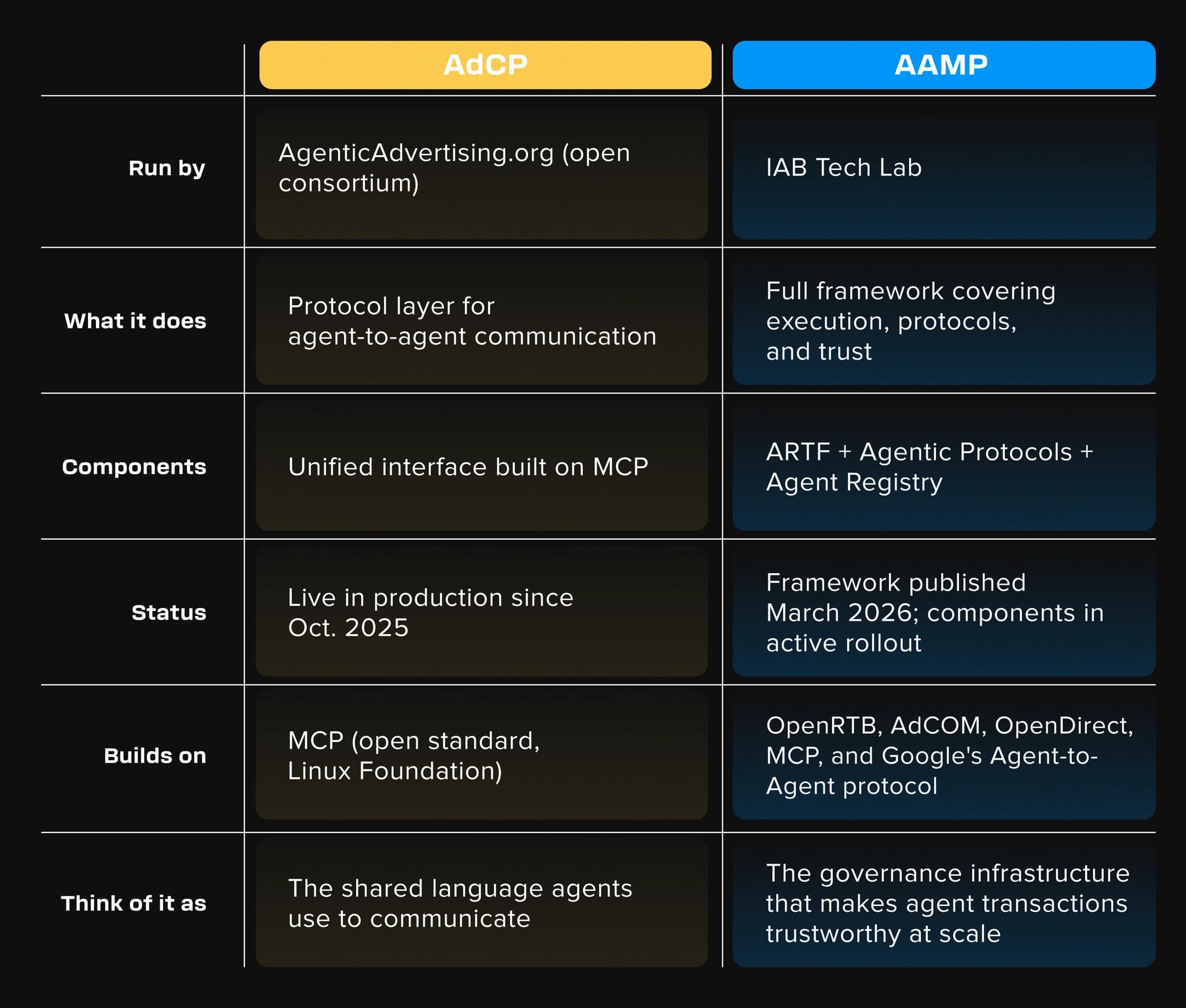
Agencies currently running agentic pilots are predominantly doing so through AdCP. AAMP provides the governance layer that scaled, multi-platform operations will require. For most agencies, the practical framing is: AdCP is where early implementation is happening now; AAMP is what the ecosystem will align around over the next 18 to 24 months. Building on AdCP today does not put you at odds with AAMP later.
What early deployments actually look like
AI agent programmatic buying is not a 2027 scenario. Three deployments from the past six months show where the industry already is.
Butler/Till and PubMatic: the first fully agentic CTV campaign
In December 2025, independent agency Butler/Till and PubMatic ran what is widely regarded as the first fully autonomous, end-to-end agentic advertising campaign, for Clubtails on CTV. Butler/Till submitted a natural language brief through Claude. PubMatic's agents interpreted the brief, generated the media strategy, set up the campaign, and began optimizing pacing and targeting in real time, all over AdCP. An optimal media plan was delivered in seconds. The workflow bypassed the traditional DSP layer, with PubMatic's sell-side agents handling discovery, planning, and activation directly.
NBCUniversal, FreeWheel, and RPA: live sports inventory, bought by agents
In January 2026, NBCUniversal, FreeWheel, Newton Research, and independent agency RPA announced the first AI-driven cross-platform premium video buy, including the first use of AI agents to automate live sports inventory on linear TV, specifically NFL playoff games. Buy-side and sell-side agents coordinated inventory, negotiated terms, and set up the campaign via MCP, with human approval retained at either end. Discovery, packaging, and proposal work that previously took days was completed in seconds.
Equativ and Omnicom: from planning agent to live buys
In December 2025, Equativ launched its Media Planning Agent inside the Maestro platform, designed to transform media briefs into actionable deal strategies. The system analyzes more than 400,000 sites and apps and automatically bundles deals into prioritized packages, claiming to cut planning time by up to 40%. Omnicom Media Group was among the early users, with its deputy director of investment and accountability describing it as unlocking "an entirely new way of structuring programmatic buys." By Q1 2026, Omnicom had moved further: CTO Paolo Yuvienco confirmed on the company's earnings call that it has executed live media buys for multiple clients using an agent-to-agent framework built on AdCP, negotiating directly with publishers. CEO John Wren framed the objective plainly: shorten the supply chain and redirect more of every client's budget into working media. These buys are live and operational.
Three infrastructure prerequisites
The agencies making progress on agentic AI media buying share one characteristic: they treated infrastructure as a precondition rather than something to sort out after the first deployment.
Three requirements are becoming clear from early implementations.
- A unified data layer. Agents are only as effective as the data they can access. Fragmented campaign data across disconnected platforms prevents agents from operating with the context they need. Omnicom's approach is instructive: its agentic buying capability runs alongside Acxiom's identity infrastructure, because clean first-party data is what makes direct publisher relationships worth pursuing. Without it, a shorter supply chain is just a cheaper pipe.
- API connectivity and protocol alignment. Agentic workflows require clean API access to inventory and platform systems. Agencies need to know which platform partners are building toward AdCP or AAMP compliance, since that determines where agentic workflows can be deployed first.
- Governance designed in from the start. As agent autonomy increases, oversight has to evolve alongside it. The practical question is which decisions agents can make autonomously, within what guardrails, and with what escalation paths when something falls outside those boundaries. Agencies that define this framework before deployment build organizational confidence in the system progressively. Our implementation guide maps out the governance prerequisites alongside the data and API readiness steps. Those that leave it for later tend to keep agents in recommendation-only mode indefinitely.
What agencies should do now
The standards will not converge on a timeline that matches the pace of competitive movement. Internal readiness, specifically data, governance, and protocol alignment, is the work that can be done right now, independent of which standards win. The agencies that are ahead are not waiting for a definitive winner before they act.
The right entry point is a specific, bounded, high-friction task: pacing checks, deal discovery, brief translation, delivery reconciliation. These are the workflows where agents deliver immediate, measurable efficiency and where the consequences of a mistake are recoverable. Start there, demonstrate value, then expand.
Our step-by-step implementation guide maps the phased approach agencies are using to build internal readiness now, starting with bounded, low-risk workflows and building toward coordinated agentic operations.
Star helps agencies map their data, workflow, API, and governance readiness, identify the right first use cases, and design agentic media operations that are practical, auditable, and built for adoption. Our step-by-step implementation guide maps the phased approach agencies are using to build internal readiness now, starting with bounded, low-risk workflows and building toward coordinated agentic operations.
Are ready to move from pilot to operational advantage?
Contact Star to define your agentic advertising roadmap.
FAQs
No. They operate at different layers of the stack. AdCP provides the communication protocol; AAMP provides the governance and execution framework. The more useful question is: which platforms in your current stack support either, and what does your roadmap need to account for?