

Marketing agencies can already deploy AI agents to interpret briefs, work with different forms of data, monitor campaign performance, and complete defined tasks within guardrails. Access to those capabilities, however, does not mean an agency is ready to use them well.
In many agencies, the operating environment lags behind the capabilities of AI agents. Data remains fragmented, AI pilots are isolated from core workflows, and approval processes are designed for human-driven tasks. Teams may lack clarity on which agents are running, what data they access, or who is accountable for their outputs. For end users, this can add complexity rather than reduce workload.
Agentic AI readiness depends on whether an agency can put these capabilities into practice safely and effectively. Agencies need a clear grasp of which workflows are changing, control over the information agents use, defined boundaries for agent authority, and explicit criteria for when human oversight is required. Use this checklist for implementing AI agents in media agency operations to assess your readiness across five dimensions: workflow, data, governance, people, and interoperability.
The five dimensions of agentic AI readiness, explained
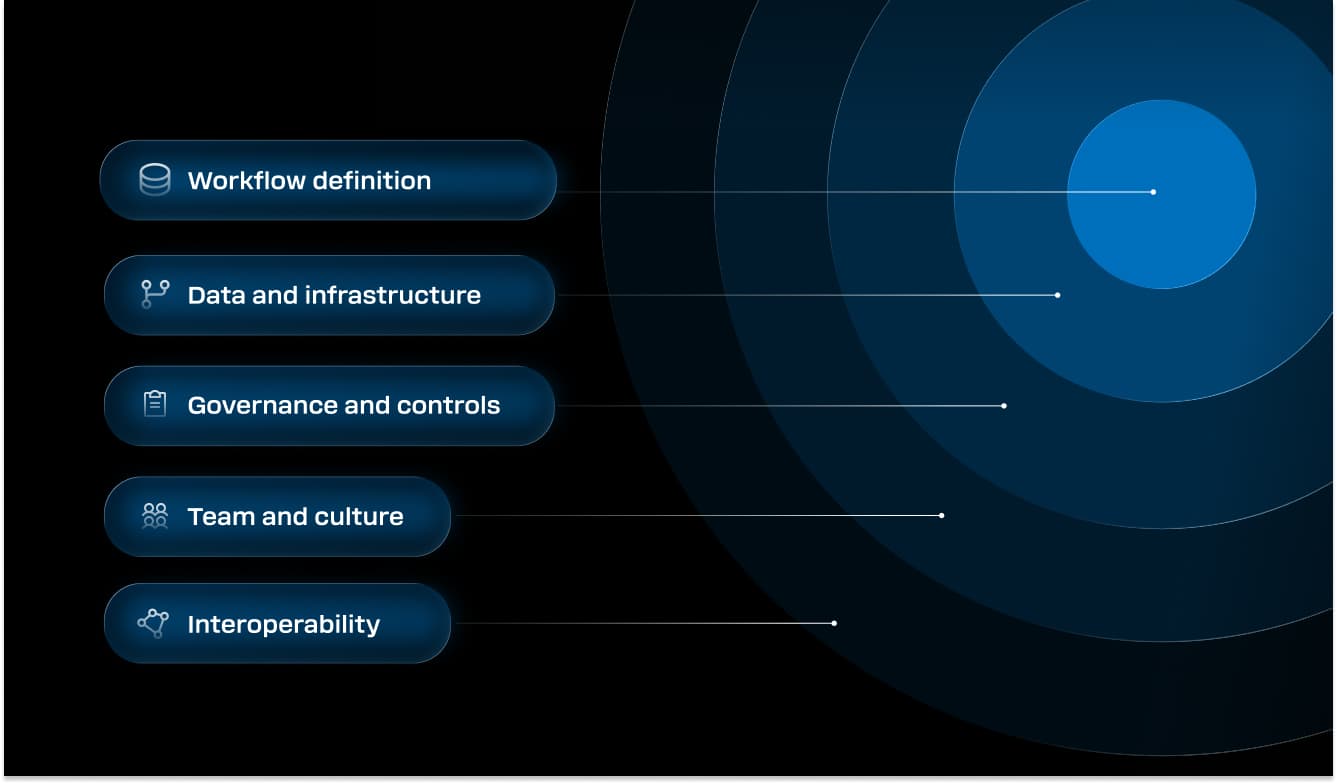
Readiness is not one universal standard. An agency may have strong data infrastructure but unclear governance, or a well-defined use case that does not yet fit its technology stack. The following five connected dimensions determine whether an agent can move from pilot to production.
1. Workflow definition
Workflow definition establishes where an agent fits and what problem it is expected to solve. A task-level view makes the triggers, handoffs, delays, and decision points visible, including the stages where human judgment remains essential. Without that clarity, agencies risk automating the wrong part of the process or introducing an agent without a measurable purpose. Prioritize a first use case that targets a specific, well-defined problem and delivers a measurable outcome.
2. Data and infrastructure
Agents require consistent access to the right context for each task. While campaign, audience, and performance data can remain in separate systems, they must be accessible through a governed shared layer or approved APIs. It is critical to establish clear data sources, definitions, ownership, and permissions to avoid ambiguity and ensure reliable performance.
3. Governance and controls
Governance and controls determine how much authority an agent has and how the agency remains accountable for its actions. This includes what the agent may observe, recommend, prepare, or execute, where human approval is required, and how exceptions are handled. Establish clear processes for handling exceptions and ensure that all actions are recorded for accountability and auditability.
4. Team and culture
Leadership endorsement alone is not enough. Daily users must understand the reasons behind workflow changes, what responsibilities they retain, and how to review or correct agent outputs. If the system introduces unnecessary complexity or hidden tasks, adoption will falter. Successful implementation depends on clear communication and practical support for those closest to the work.
5. Interoperability
Agents must integrate with the broader operating environment rather than operate as isolated pilots. This requires connecting to existing platforms via APIs, ensuring context moves smoothly between systems, and planning for integration failures. Agencies should also track the adoption of AdCP and AAMP standards among technology partners, as agent-to-agent communication develops across the advertising ecosystem.
Complete your agentic AI readiness assessment
This assessment takes about 5 minutes and gives you a clear starting point for agentic AI adoption. For each of the five dimensions below – workflow definition, data and infrastructure, governance, team and culture, and interoperability – select the description that most closely matches your agency's current position. Your results will point to whether you're ready to pilot, need to shore up foundations first, or should start with a workflow-mapping exercise.
Six essentials for agentic workflow preparation
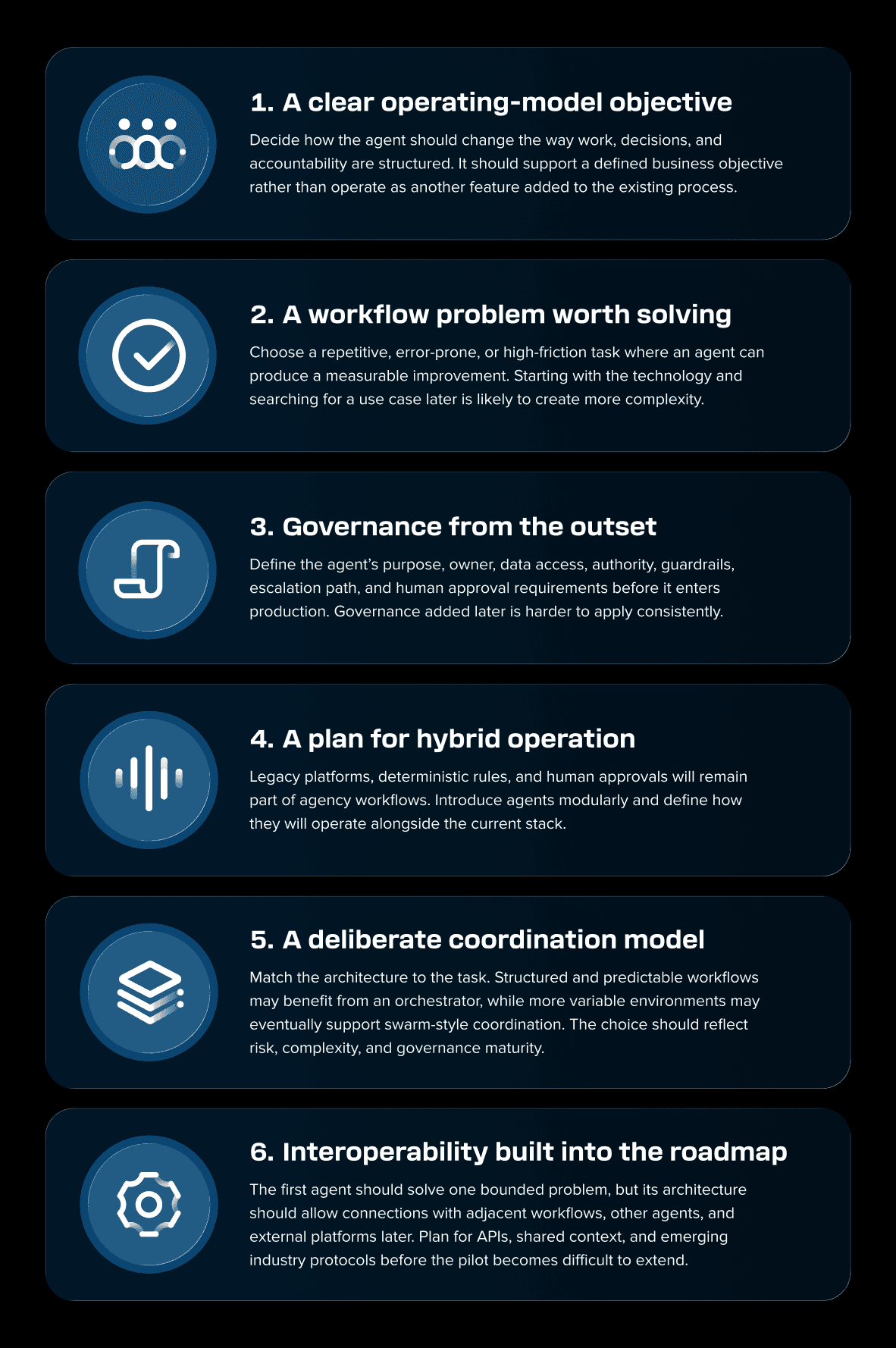
Readiness means having enough control to begin
Agencies do not need to transform every workflow at once, but they do need the right foundations before testing agentic AI. That includes a well-defined workflow, a clear data strategy, reliable access to the right context, clear accountability, and the ability to pause, review, and learn from each step. With these conditions in place, agencies can begin testing agentic AI in a controlled, measurable way.
The goal is not to automate everything at once. Instead, start by demonstrating that an agent can improve a specific part of the workflow without adding risk or complexity, then expand based on evidence.
How Star can help
Star helps agencies turn the findings from this AI agent implementation checklist into a practical roadmap. Using Endgame Thinking, we start with the outcome you want agentic AI to achieve, assess your agent-readiness across workflows, data, governance, people, and interoperability, and identify a bounded first deployment to safely prove value.
Contact our Star experts to strengthen the foundations you need to progress toward connected, multi-agent media operations.
Turn your agentic AI endgame into a practical plan
Identify the readiness gaps that matter most and map a clear path from your first agent deployment to scalable, governed workflows.
FAQ
Your agency is ready to begin when it has a clearly defined workflow, a bounded use case, reliable data access and an accountable owner. Guardrails, human approval points, and a way to trace the agent’s actions should also be in place before production deployment.