

Most SaMD products meet regulatory requirements, but many still fail in real-world use, often due to gaps in SaMD UX design.
Direct-to-consumer Software as a Medical Device (SaMD) places regulated health technology directly in patients’ hands — without a clinician in the room. That means the app itself must do the motivational, trust-building, and guidance work that a doctor would otherwise do. When the experience creates confusion or friction, even a clinically strong product struggles to sustain the engagement and adherence it needs to prove efficacy — and justify its market position.
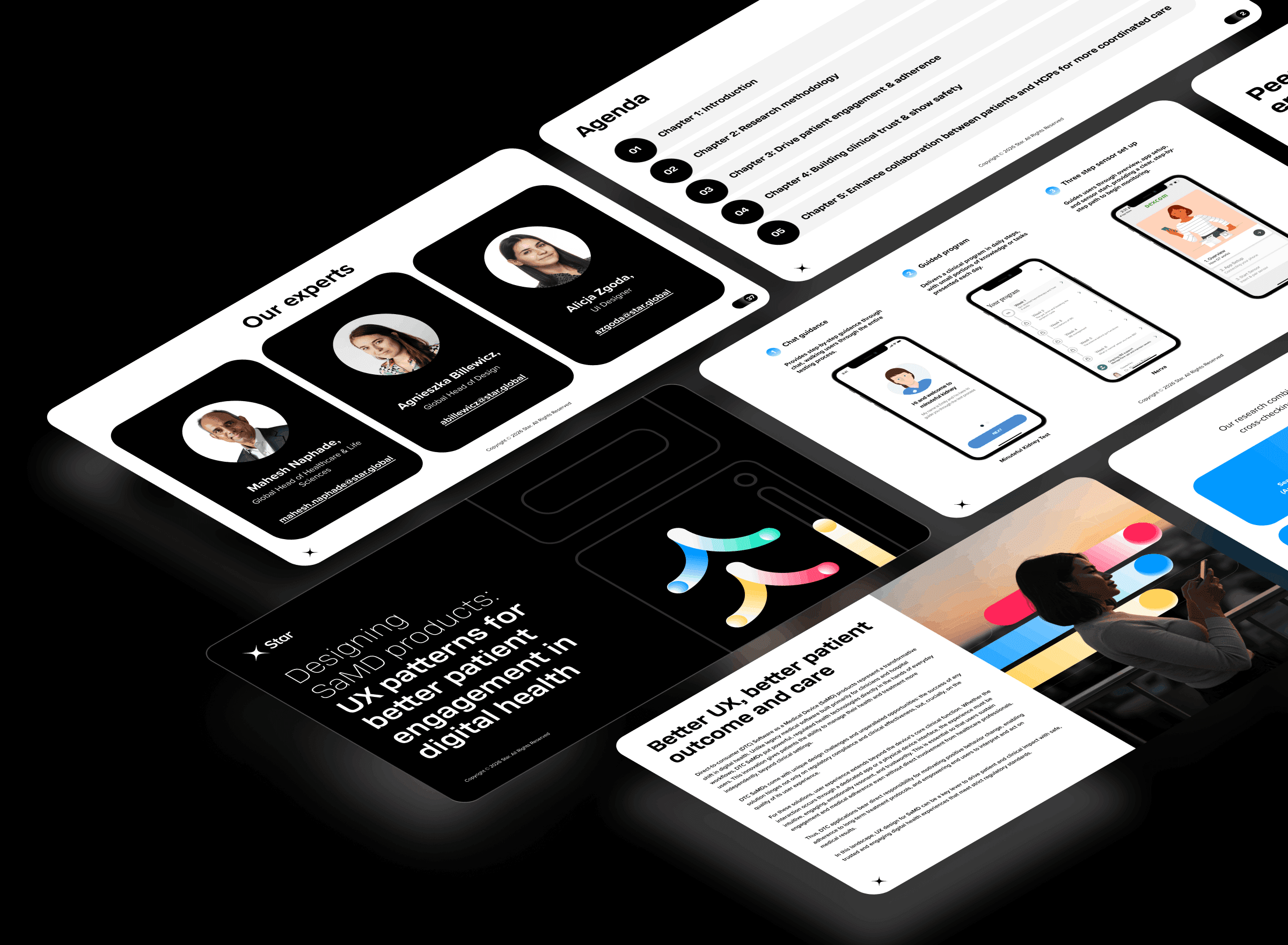
Star analyzed 17 leading regulated health apps across oncology, cardiology, neurology, diabetes, diagnostics, respiratory, and ostomy care — and distilled the 9 recurring digital health UX patterns behind the highest-performing products. This report gives SaMD teams an evidence-based design playbook, so you don’t have to build from zero.
How to improve patient engagement in regulated digital health apps — and why it starts with design, not features.
SaMD teams are caught between two pressures: the rigor of FDA/CE clearance requirements and the speed the market demands. Most are designing without a structured, evidence-based framework for what healthcare app UX actually needs to do in a regulated context.
The consequences are real. Products launch successfully, then lose momentum after onboarding. Patient adherence drops not because the clinical program fails, but because the experience creates friction, uncertainty, or fatigue at the wrong moment. Data is available, but not actionable. Care journeys are technically complete, yet difficult to sustain when patients are anxious or managing a condition alone.
Regulatory clearance gets you to market. Patient engagement in digital health keeps you there.
What higher-performing SaMD products do differently in UX design
Star analyzed leading regulated health apps to identify the digital health UX patterns that consistently support better real-world product performance.
Inside the report, you’ll find:
- Nine recurring UX patterns used across high-performing SaMD products
- Examples from apps in seven disease areas, illustrating how these patterns are applied in practice
- Three outcome areas that matter most in patient-facing digital health: engagement and adherence, clinical trust and safety, and stronger patient-HCP collaboration
- Practical insights on how leading products reduce friction, improve clarity, and support confident long-term use
It also shows how stronger products reduce patient isolation by design, enabling better information sharing with clinicians, easier caregiver involvement, and more connected, continuous care experiences.
Why good UX design helps SaMD de-risk and accelerate adoption
In regulated digital health, strong healthcare app UX goes beyond improving satisfaction. It supports safer use, stronger engagement, better patient adherence, and clearer communication between patients and care teams.
This has strategic value. Regulators, providers, and payers increasingly look beyond features to real-world evidence and patient outcomes. Products that are easier to understand, trust, and sustain in daily life are better positioned to reduce adoption risk and demonstrate value over time.
The opportunity is not in copying consumer app conventions or adding features. It lies in understanding which interaction patterns help people manage health more confidently, consistently, and with less effort.
UX design in healthcare is a key lever for reducing adoption risk and accelerating value in SaMD. These patterns already exist. The challenge is identifying which ones matter most, and how to apply them with enough rigor to make a meaningful difference.
For SaMD teams, the question is no longer whether UX matters, but where to focus first and which design decisions are most likely to improve adoption, safety, and long-term patient engagement.
How Star can help improve patient engagement, trust, and adoption
Star is a global technology consultancy with deep expertise in MedTech and regulated digital health. We combine product strategy, UX, and engineering to help teams create experiences that are clinically credible, operationally viable, and easier for patients to use confidently.
This research is based on structured analysis of regulated health apps and the recurring UX design patterns that shape better patient experiences across disease areas, to help teams shift from assumption-led design to a more evidence-based approach.
Ready to apply these patterns to your product?
Star conducts structured audits of the patient journey — mapping where your current experience creates friction, uncertainty, or drop-off, and identifying the highest-impact UX improvements available to your team.
FAQs
Star's research identified three engagement-focused patterns that consistently appear in high-performing SaMD products: guided and adaptive care journeys that break treatment into manageable steps; motivation design that reinforces progress without triggering shame; and patient activation features that simplify complex medical processes into intuitive daily actions.