The commercial vehicle industry is facing a structural problem that product alone cannot fix: fleets have more freight than people to move it. In the US alone, the trucking industry is currently short around 80,000 drivers, and forecasts suggest the gap could reach 160,000 by 2030 if nothing changes.
At the same time, truck drivers are aging out of the workforce. In the US, the median truck driver is about 46 years old, several years older than the average worker. In Europe, the situation is even more acute: the average HGV driver is roughly 47, about one‑third are over 55 and less than 5% are under 25. This is more than just a demographic shift; it also exposes a widening gap in commercial vehicle innovation that will determine which OEMs stay relevant over the next decade.
The driver shortage: why OEMs need to attract more Gen Z talent
Against this backdrop, Gen Z will become a sustainable source of new driving talent. Internal demographic modelling for commercial transport suggests that 47% of commercial vehicle drivers could be Gen Z by 2030 – this digital-native cohort will bring very different expectations around technology, work‑life balance and what a “good job” feels like day to day.
At the same time, industry analysis shows that annual truck driver turnover commonly sits in the 35% to 40% range in the first three months of employment and around 50% in the first six months. And the estimated cost of replacing a single driver can reach up to 15,000 USD once recruitment, training, lost productivity and idle equipment are included.
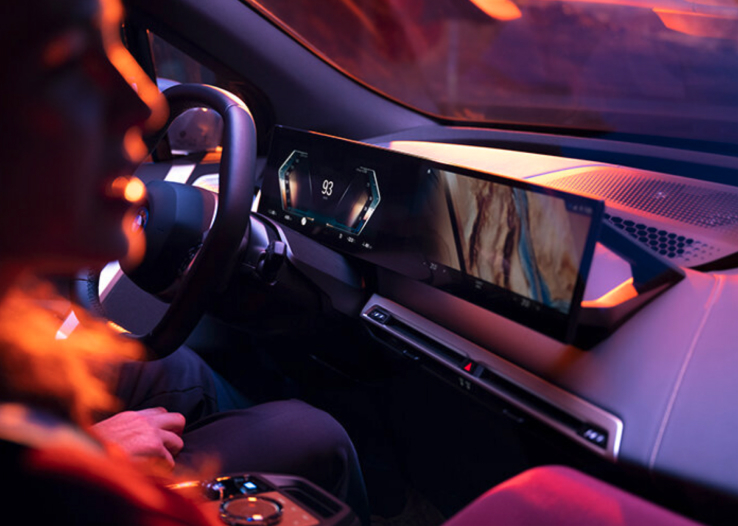
For forward‑thinking OEMs, reimagining the in‑cabin digital experience for the next generation of commercial vehicle drivers can be a critical economic lever for securing future workforce capacity and strengthening total cost of ownership for fleets.
Some fleets have already started experimenting with this reality. One US trucking company, for example, is running recruitment ads directly inside a popular truck‑driving simulator, betting that Gen Z gamers who invest hours mastering virtual rigs may be more open to considering a CDL and a driving career in real life.
It is an early signal that the race for Gen Z talent is shifting into the digital spaces where they already spend time, and that tomorrow’s drivers expect their work environment to feel as modern and connected as the games and apps they use every day.
How can truck driving become an attractive career for Gen Z
Gen Z is usually defined as those born between 1997 and 2012, making their age range approximately 13 to 28 years old. That means more than half of Gen Z doesn't even know how to drive yet.
We are fascinated by Gen Z at Star and we know that we cannot generalize this generation. To move beyond opinion, we take a deeply contextual approach to understanding this demographic.
We combined industry data with a study of 300 truck drivers coupled with 24 in‑depth qualitative interviews with Gen Z truck drivers in North America to help our commercial vehicle OEM clients attract and retain this vital talent pool.
Some of the key data points worth highlighting:
- 9 in 10 Gen Z workers say purpose is critical to job satisfaction; they want to see that their work matters.
- 50% of Gen Z demand work‑life balance, compared to 36% of the broader workforce.
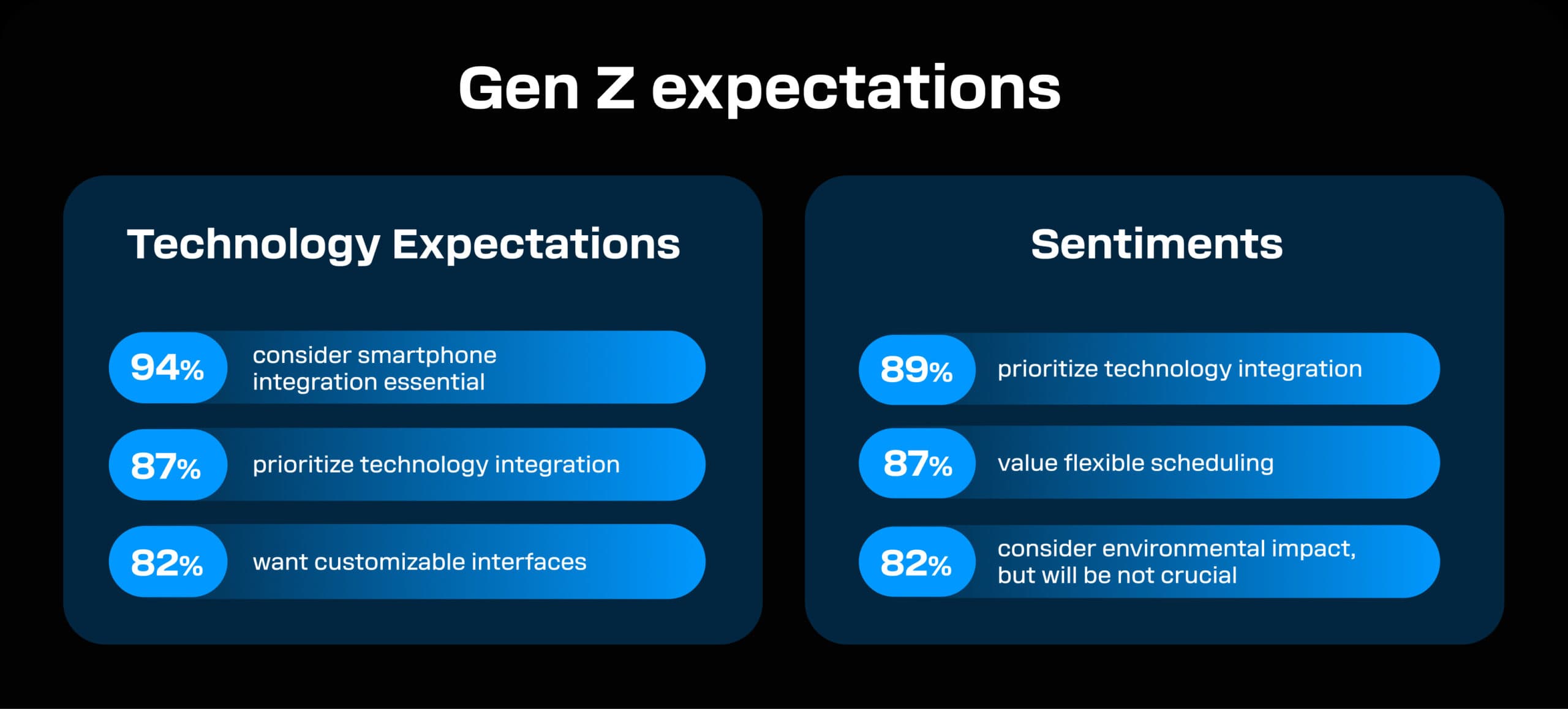
- When asked specifically about in‑vehicle UX, 94% consider smartphone integration essential, 91% expect sub‑0.5 second response times, and 87% want customizable interfaces.
Our thematic analysis of these insights reveals a critical conclusion: Not only does this generation bring a very different set of expectations into commercial vehicles, but the primary deterrent from becoming a truck driver isn't the hard work; it is the analog experiences sitting in the truck cabin for long periods.
We found that Gen Z brings a distinctly digital-native perspective to their expectations of work trucks, benchmarking commercial cabins not against previous-generation trucks, but against their F-150s, Model 3/Ys, and even the intuitive, connected experiences that define their broader digital lives. A modern car infotainment system that connects instantly and seamlessly to their phone has become the norm; a sluggish, dated head unit in a six‑figure truck reads as a signal that the employer is behind the times.
In fleets where most churn happens within the first 90 days, an engaging in-cabin experience and digital connectivity can have a direct correlation with Gen Z driver attraction and retention.
Passing the smartphone test: bringing consumer tech to fleet
Gen Z are far more pragmatic than many assume. Their cost‑to‑value perception looks a lot like Millennials: they care about safety, parking assist, and practical features, but they are also digital‑native, so in‑car connectivity now sits alongside anti-lock braking and airbags as a basic expectation, not a bonus. Yet the teams driving commercial vehicle innovation are often segmented by traditional age bands and miss how strongly Gen Z wants a “car everything” experience - an in‑car digital ecosystem where the truck feels as capable as their personal car and phone.
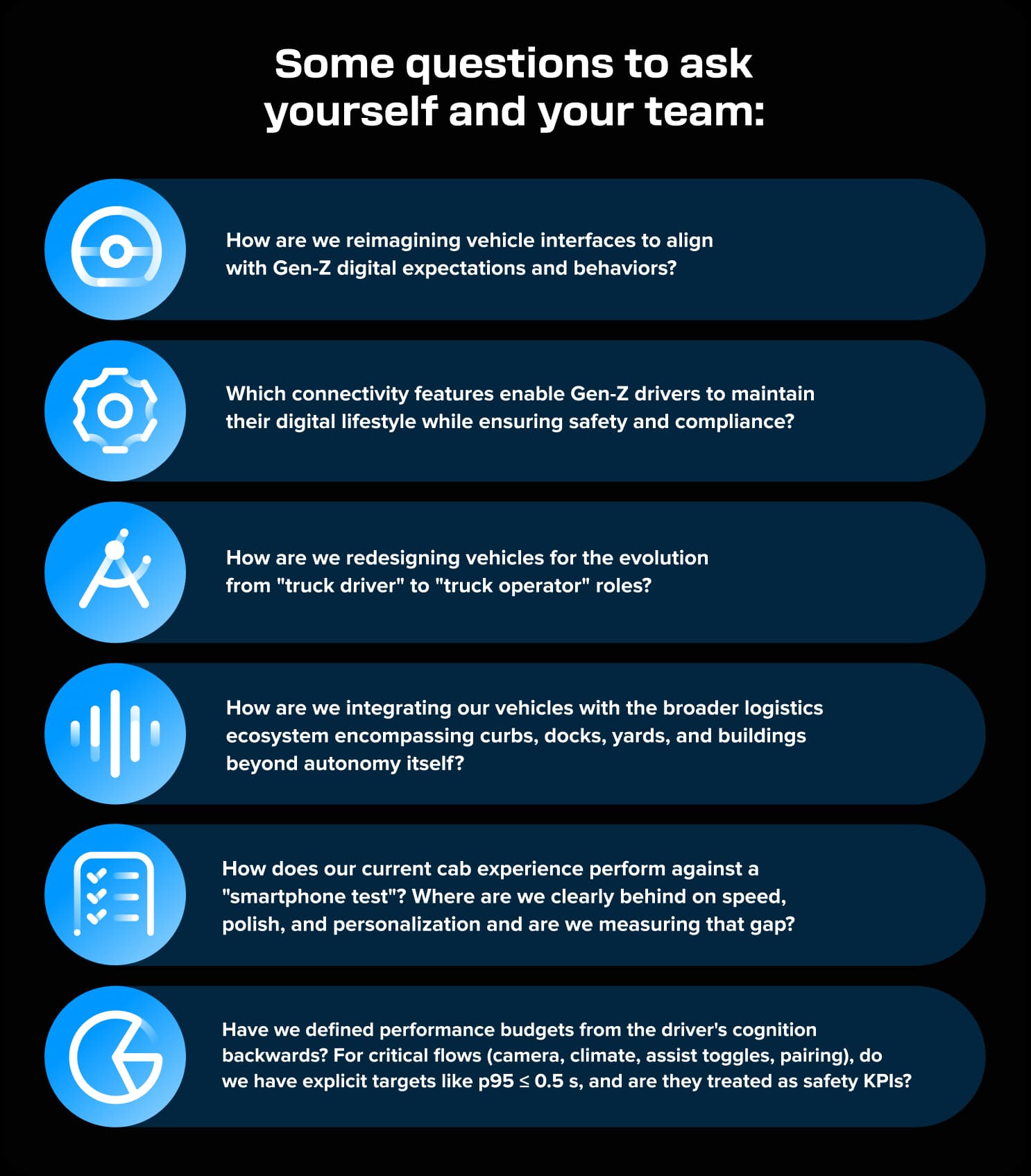
A useful way to operationalize this is the “smartphone test” for your in‑cabin connectivity and car infotainment system: does it feel as fast and coherent as the digital products Gen Z uses every day?
Gen Z drivers live inside smartphone‑grade experiences: taps feel instant, screens do not freeze and responses keep up with their thumbs. Anything slower in a truck breaks trust. For critical flows including camera view, mirrors, climate, assist toggles and phone pairing, the bar is p95 ≤ 0.5 seconds, tracked as strictly as braking performance.
Human‑factors research supports a simple rule: around 0.1 seconds feels instant, ~1 second keeps people in the flow, and beyond that the brain starts to question whether the system is working at all. In a commercial cab, that is the difference between a driver staying eyes‑up on the road or staring at a lagging menu.
Surveys show that the vast majority of Gen Z drivers and workers expect seamless smartphone integration and modern digital tools from their employers, and that technology quality strongly influences their choice between similar roles. For a cohort used to Apple CarPlay‑grade interfaces and instant reactions, a two‑second lag in a work truck is not just an annoyance; it reads as poor engineering and, by extension, a lack of respect for their time and safety.
Closing the work-tech gap
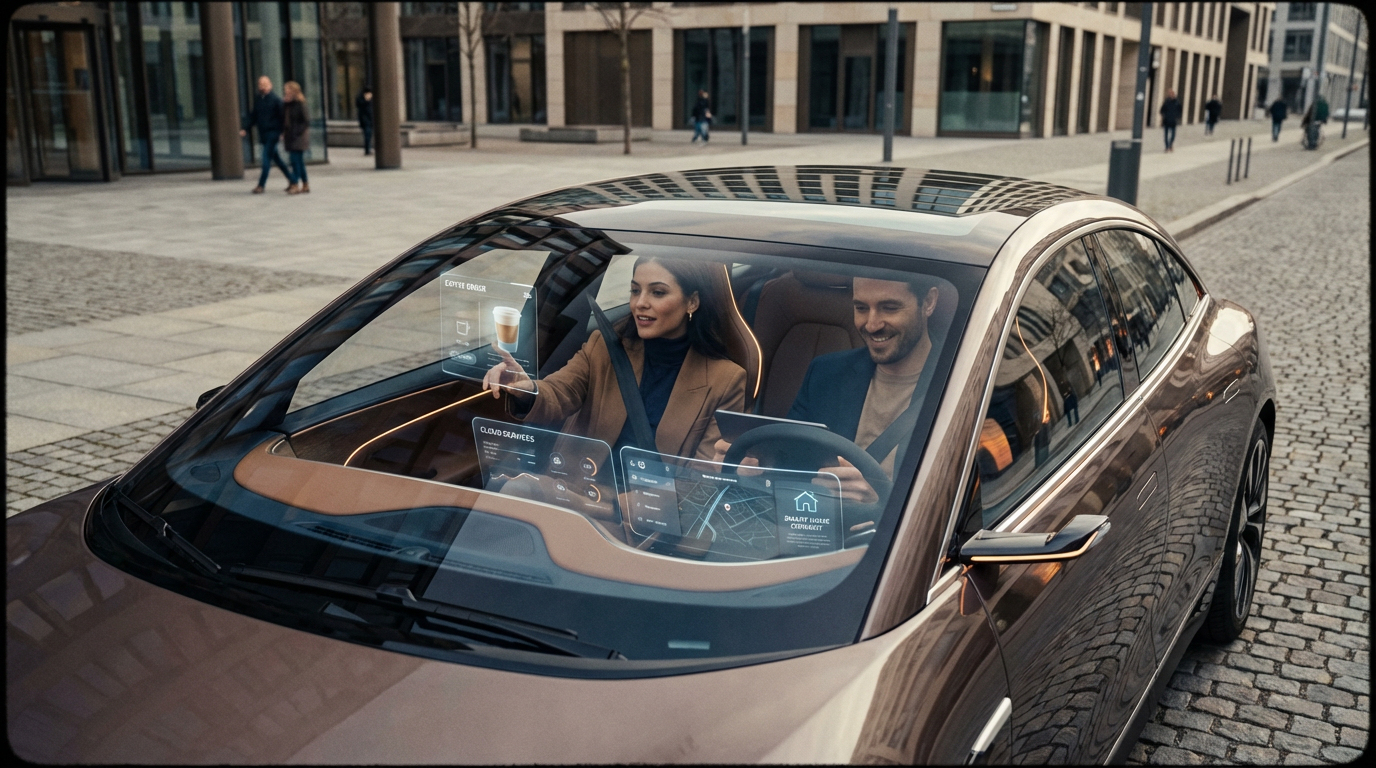
Gen Z walks into any workplace assuming modern work tech as a given: fast devices, single sign‑on, cloud‑based tools, and everything available from any screen. Many OEM digital and HMI teams still design for incremental improvement rather than for digital natives whose benchmark is set by technology companies like Apple, Google, Tesla, Amazon and Uber, not by commercial vehicle brands.
For OEMs serious about attracting and retaining Gen Z drivers, a connected cabin should, at minimum, deliver:
- Rock‑solid in‑car connectivity and mirroring, or OEM‑native experiences that are truly at parity with the best consumer infotainment system
- Multi‑profile, cloud‑based personalization so seat, mirrors, climate, preferred apps and ADAS settings follow the driver from vehicle to vehicle.
- Clear, on‑screen separation of personal and fleet data, so drivers can see what belongs to them, what belongs to the company, and what is recorded for compliance - this is critical for trust building in always‑on connected vehicle solution
In simple terms: instant pairing, instant response and personalized recognition they step in.
5 smart cockpit trends reshaping commercial vehicles
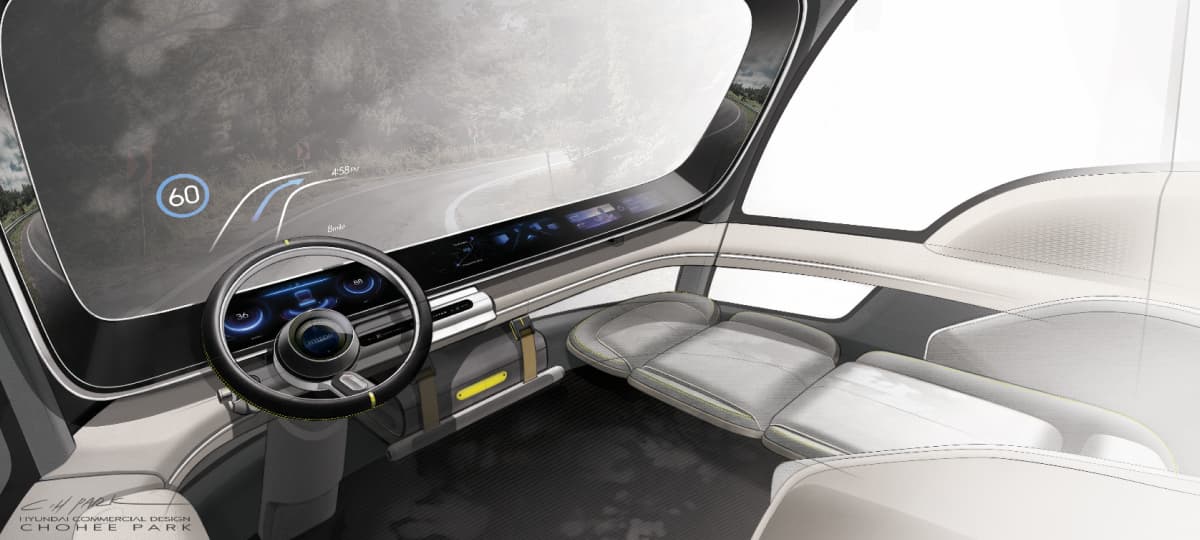
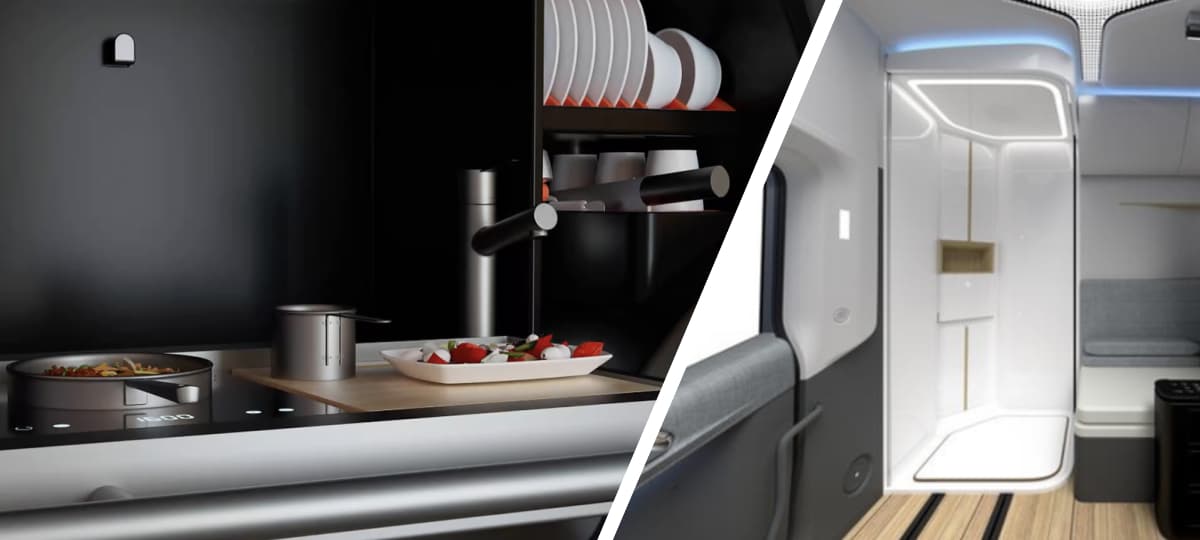
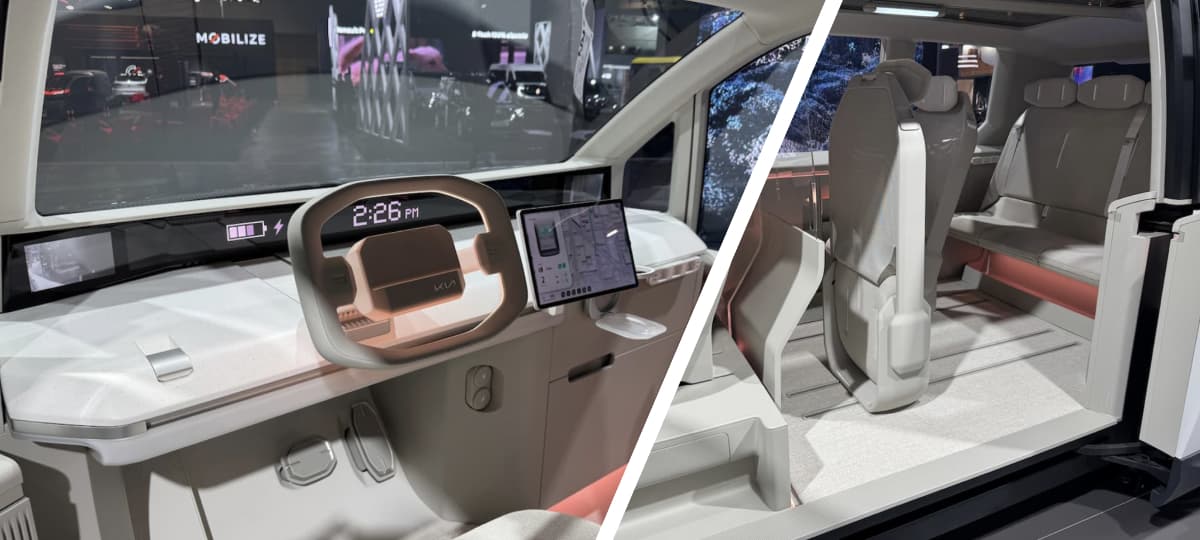

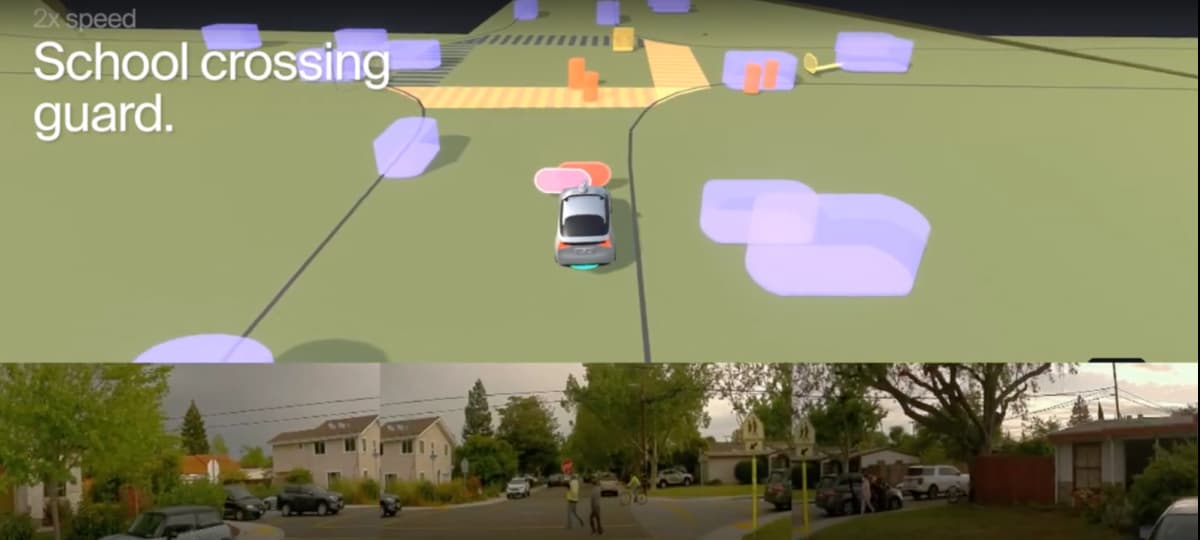
1. Adaptive display
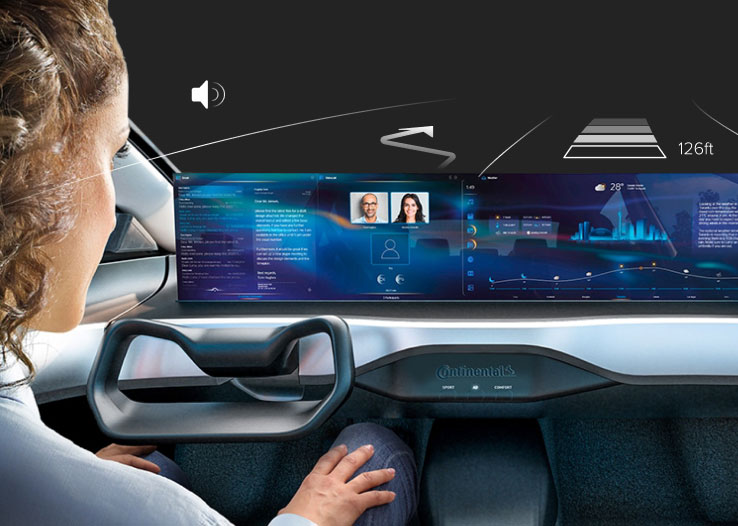
Smart cockpits are shifting to dynamic, context-aware display systems that surface the right information at the right moment to boost driver awareness and reduce cognitive load.
2. Fusion of driving and living
Long-haul cabins are evolving into blended living-work environments that support rest, wellbeing, and comfort, reflecting the expectations of a younger and health-conscious workforce.
3. Modular design and flexible interiors
Modular interiors allow trucks and vans to adapt to different tasks, enabling fleet operators to switch between logistics, ride-hailing or workspace modes without redesigning the vehicle.
4. Sensor integration and visualization
Next-gen cockpits consolidate data from cameras, LiDAR and radar into intuitive 360° visualizations that strengthen situational awareness and support safer, more confident operator oversight.
AI-driven mapping interfaces
Real-time perception fused with low-cost mapping enables cockpits to present seamless, continuously updated road and traffic visuals, improving decision-making in both human-driven and autonomous modes.
How can OEMs design career paths for the next generation of drivers
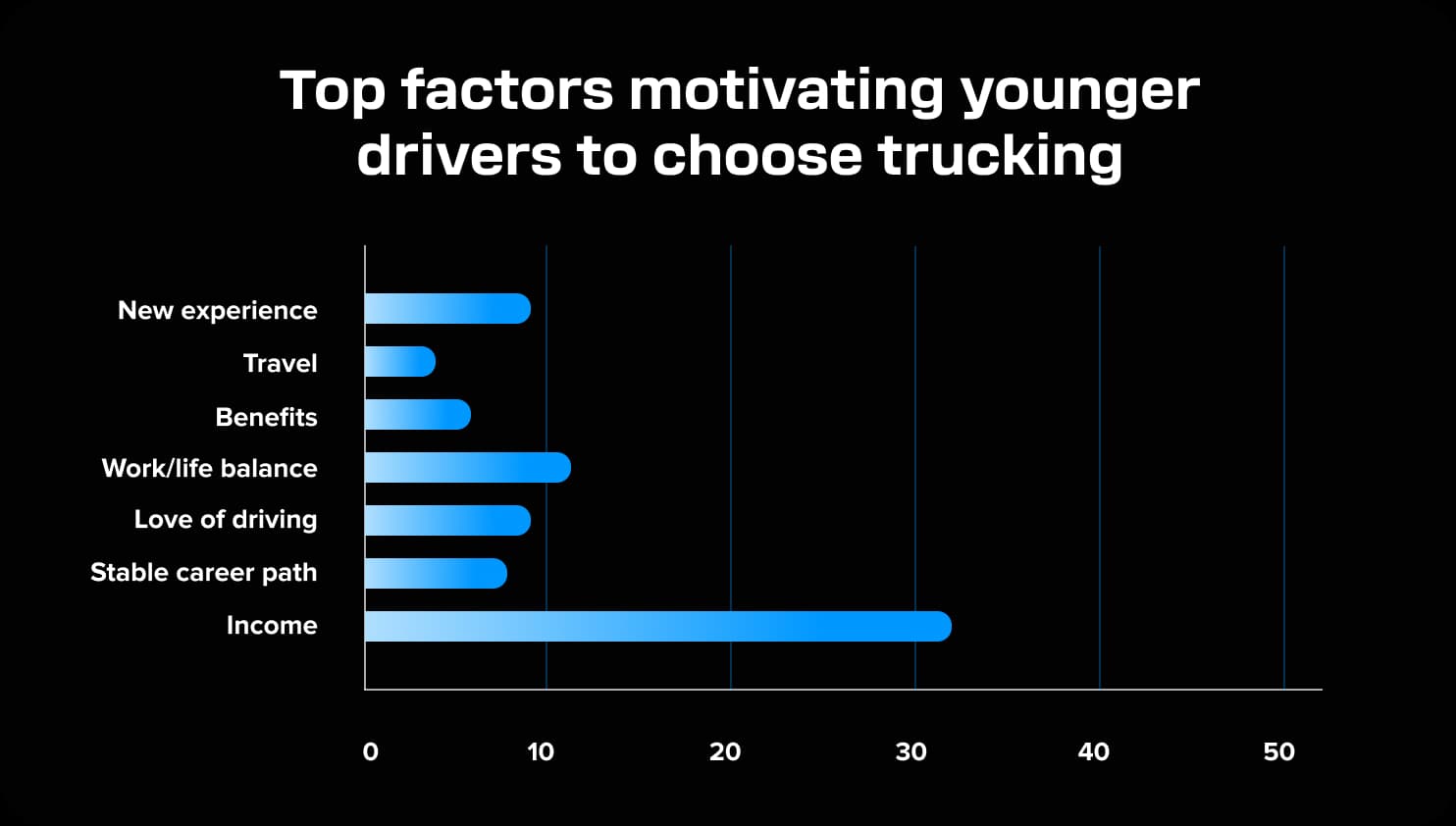
Many young drivers enter the industry for competitive pay, but they often leave when there is no visible progression. This is especially true for Gen Z – they demand meaningful career progression, not just tenure-based promotion. If the career path isn’t clear, they’ll create their own elsewhere.
The traditional driver career path was linear: local routes, then regional, then long-haul, then trainer, then maybe fleet coordinator if you got lucky. That model no longer fits a generation seeking skill development and new challenges. Today’s high turnover is a symptom of unmet ambition and expectations.
Redefining the role for the autonomous era
As trucks move into higher levels of autonomous driving, the role shifts from ‘driver’ to ‘operator,’ responsible for supervising automated systems, handling exceptions and managing remote or multi-vehicle operations. OEMs need to design both the career model and the in‑cabin experience to reflect that evolution and help the next generations of operators grow through specialized, technical and hybrid tracks:
- Specialist track: Operator → Multi-vehicle supervisor → Remote operations coordinator → Autonomy systems trainer
- Technical track: Driver → ADAS-certified operator → Vehicle diagnostics specialist → Fleet tech integration lead
- Hybrid track: Operator → Exception handler → Route optimization analyst → Logistics planner
Designing mastery into the cabin
Don’t bury career paths in HR documents – they should show up where work happens. The truck dashboard can display the operator’s current level and the steps needed to reach the next milestone.
With advanced HMI design, the interface can also host “workshop” and learning modes where certified operators safely experiment with parameters, run scenario-based modules and see how their decisions affect safety and route performance. This makes the cabin feel less like a static workstation and more like a personalized progression system that responds to the operator’s effort and capability.
When we reimagine the role of the cabin from a static space to a progression system and learning platform capable of responding to the operator’s efforts, it can make the overall work experience more rewarding and engaging.
Beyond autonomy: plugging into the ecosystem
An “operator-first” cabin also means it needs to be integrated directly into the logistics stack so there’s no friction between handoffs at the curb, dock, yard and building. This integration must be seamless and practical, for example:
- Curb and dock reservations: arrive with an assigned slot, not a queue.
- Yard management: gate codes, maps and live instructions surfaced in the cabin.
- Building handoff: elevators, docks, security and proof-of-delivery that sync with shipper systems.
- Returns workflows: barcode and condition capture without juggling additional apps.
To deliver this, OEMs need signed data products, API contracts, fast callback SLAs and a unified identity model across fleets, 3PLs and shippers so operators do not re-login at every gate.
Regulatory compliance: how to design for regional rules
But once the cabin becomes a place for growth, learning and operator agency, it must also become a place that regulators can trust. The same systems that empower operators also shape what auditors, Works Councils and cross-border authorities scrutinise. This is why the next generation of operator-centric cabins must be compliant by design.
For instance, the Federal Motor Carrier Safety Administration (FMCSA) audits work best when HOS information can be reached in just a couple of taps from any screen state. When autonomy arrives, the distinction between driving time and monitoring time must be crystal clear in the logs. Regulators are still writing those rules, but your UI has to anticipate them.
In Germany and much of the EU, Works Councils have veto power over employee monitoring. Potential coaching dashboards need explicit consent. Data must be visibly segmented into personal (improvement), operational (fleet) and regulatory (ELD). Clear declarations at pairing, driver-controlled toggles for optional sharing and policies co-authored with councils are the price of market access.
Regulatory uncertainties, such as GDPR’s 'right to erasure' versus FMCSA’s record preservation mandates, pose significant risks. With legal frameworks for autonomous data ownership still undefined, governance models must be architected for adaptability. By integrating regulatory validation directly into CI/CD pipelines through automating checks for UI standards and data schemas. This way, OEMs can prevent costly Type Approval delays and ensure a seamless market launch.
What’s next for the commercial vehicle industry
Every brand and legacy tech stack requires a tailored approach to uncover the needs of tomorrow’s fleet owners, but the direction of travel is clear. We must move beyond legacy constraints and question the status quo. Success won’t come from waiting for perfect consensus, but from adopting a tailored, iterative approach that bridges the gap between today’s "truck driver" and tomorrow’s "logistics operator."
By holding vehicle interfaces to the same rigorous standards as consumer smartphones, treating performance budgets as safety KPIs and integrating seamlessly with the broader logistics ecosystem, OEMs can secure their future workforce. The shift from driving a vehicle to operating a digital node in a complex logistics network is here; the only question is which OEMs will build the interface that makes that transition possible.