

Data Warehouse vs. Data Lake vs. Data Lakehouse
When business leaders start taking data seriously, they quickly encounter a set of terms that seem designed to confuse: data warehouse, data lake, data lakehouse. Technology vendors use them interchangeably. IT teams debate which architecture to adopt. And decision makers, who simply want to use data to run their businesses better, are left wondering which one they actually need.
The goal of this article is to cut through the complexity. By the end, you will understand what each of these approaches means, why they exist, what problems they solve, and how to think about the right architecture for your organization without needing a computer science degree.
Why data infrastructure matters
Every data-driven capability your organization wants to build, from better analytics, AI, to personalized experiences, rests on one requirement: your data needs to be in a form you can actually use.
Most businesses generate data across dozens of systems simultaneously. Your CRM captures customer interactions. Your ERP manages finance, procurement, and operations. Your point-of-sale system records every transaction. Your website tracks every click. Your supply chain platform monitors inventory and logistics in real time. All of this data lives in separate systems, in different formats, governed by different rules, and optimized for different purposes.
These systems are designed to run your business. They are not designed to help you understand it. Bridging that gap is what data infrastructure is for.
The operational systems: Where your data begins
Your organization almost certainly runs on a set of operational systems , sometimes called transactional or OLTP systems. These are the platforms that power your day-to-day business:
- ERP (Enterprise Resource Planning): manages finance, accounting, procurement, supply chain, and HR. Major platforms include SAP and Oracle.
- CRM (Customer Relationship Management): tracks customer relationships, sales pipelines, and service interactions. Salesforce is the dominant player.
- HRM (Human Resource Management): manages workforce data, payroll, and talent. Platforms like Workday are widely used.
- SCM (Supply Chain Management): coordinates procurement, logistics, and inventory. Infor and SAP are leading providers.
- POS (Point of Sale): records transactions at the point of customer purchase.
These systems are excellent at processing individual transactions quickly and reliably. But ask them to run a complex analytical query and you will either crash the system or wait a very long time. Operational systems are built for speed on single transactions. Analytics requires a different architecture entirely.
The data warehouse: Structured intelligence at scale
The data warehouse was the first major answer to this problem, and it remains the foundation of business intelligence for many organizations today.
What is a data warehouse
A data warehouse is a large, centralized database that collects data from multiple operational and transactional systems, consolidates it into a consistent structure, and makes it available for analysis and reporting. Think of it as the central intelligence hub of your organization. Where your operational systems run the business, your data warehouse helps you understand the business.
What is ETL
Data moves from your operational systems into the warehouse through a process called ETL: Extract, Transform, Load:
- Extract: pull raw data from source systems (your ERP, CRM, POS, etc.)
- Transform: clean, reformat, and standardize the data so it is consistent and comparable
- Load: place the transformed data into the warehouse where it can be queried
Data warehouses use relational databases and SQL to store and query data. Business users access insights through Business Intelligence tools like Tableau, Power BI, and Looker — platforms that sit on top of the warehouse and generate reports, dashboards, and visualizations.
What a data warehouse is best for:
- Financial reporting and regulatory compliance
- Sales performance analysis by region, product, and period
- Marketing campaign attribution and ROI measurement
- Operational KPI dashboards and executive scorecards
- Descriptive analytics ("what happened?") and structured predictive modeling
What a data warehouse lacks:
The data warehouse was not designed for the era of big data. Its limitations become apparent when organizations deal with large volumes of unstructured data (text, images, video), rapidly changing data formats, data science and machine learning workloads, and spiraling costs as data volumes grow exponentially.
The data lake: Flexibility and scale without limits
The data lake emerged in response to the limitations of the warehouse, particularly as the volume of unstructured and semi-structured data exploded in the late 2000s and 2010s.
What is a data lake:
A data lake is a centralized repository that stores all types of data, structured, semi-structured, and unstructured, in their raw, native format. Nothing needs to be structured before it enters the lake. You store it first and figure out what to do with it later. This "schema-on-read" approach is the inverse of the warehouse.
What can data lake do:
The data lake was designed to solve three problems: Volume (petabytes of data at a fraction of the cost of warehouse storage), Variety (any type of data can be ingested without prior transformation), and Versatility (data scientists, ML engineers, analysts, and developers can all access raw data for their specific needs).
Without governance and structure, a data lake quickly becomes a "data swamp" so large, so disorganized, and so ungoverned that it is effectively unusable. Key challenges include lack of consistent data quality, poor query performance on raw data, and difficulty managing security and compliance at scale.
A data lake without governance is not a strategic asset. It is a liability.
The data lakehouse: The best of data warehouse and lake
The data lakehouse is the most modern approach and it is rapidly becoming the architecture of choice for organizations building serious data platforms today.
What is a data lakehouse
The data lakehouse combines the flexibility and scale of a data lake with the structure, governance, and query performance of a data warehouse, in a single, unified architecture. Key innovations include open table formats (Apache Iceberg, Delta Lake), metadata layers that catalog what data exists and where, high-performance query engines (Presto, Apache Spark), and unified access control and governance.
Leading platforms built on lakehouse architecture include Databricks, Snowflake, and the major cloud providers' native data services. Modern lakehouses are built on cloud infrastructure from AWS, Microsoft Azure, and Google Cloud, using open formats like Parquet and ORC, meaning organizations are not locked into a single vendor.
Do I need a data warehouse, lake or a lakehouse?
For most mature organizations, the question is not which architecture to pick but how they fit together. Data warehouses and data lakes complement each other. The modern lakehouse is essentially a single platform designed to serve all of these use cases.
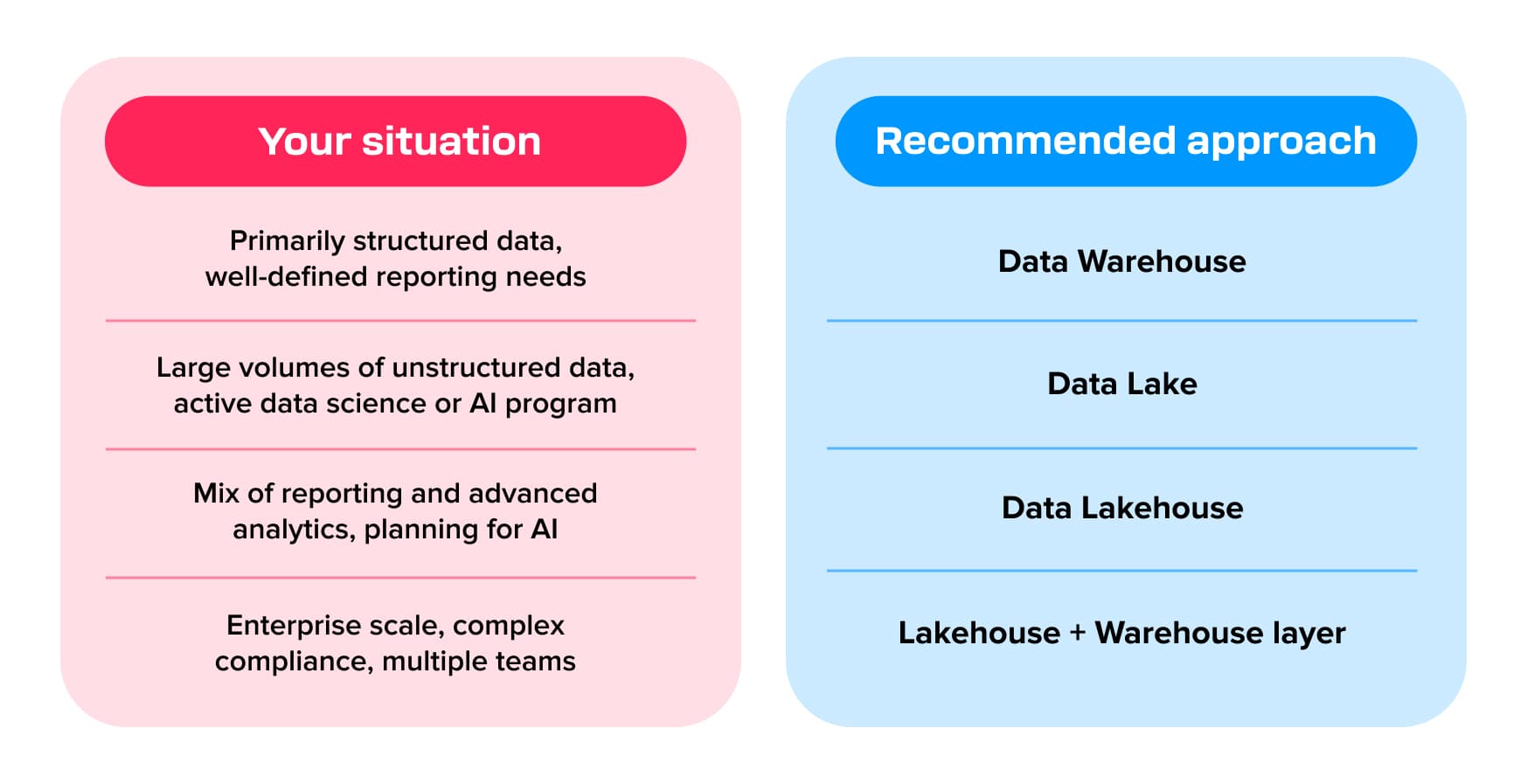
Choosing the right data architecture for AI transformation
Choosing the wrong data architecture can be a strategic business error. Organizations that build data infrastructure without a clear view of their future use cases often create environments where data is fragmented, difficult to access, expensive to manage, and ultimately unfit for advanced analytics and AI. The result is slower decision-making, duplicated effort, rising complexity, and a growing gap between what the business needs and what its systems can support.
The right architecture determines how quickly an organization can generate insight, how confidently it can scale analytics, and how effectively it can embed AI into everyday operations and ultimately transform.
Data warehouses, data lakes, and data lakehouses each reflect a different answer to a critical strategic question: how do you turn data from a byproduct of operations into an asset that drives growth, speed, and intelligence? Warehouses deliver structure, governance, and trust. Lakes provide scale, flexibility, and breadth. Lakehouses aim to combine the best of both. The right choice must be the one that best aligns with your business model, decision-making needs, and AI ambition.
Ready to turn your data into a competitive advantage?
Star helps businesses design modern data foundations, identify the highest-value AI use cases, and build scalable solutions that drive measurable impact.