
Every business leader has heard the phrase: "We need to be more data-driven." But what does that actually mean and more importantly, what does it look like in practice?
A data-driven organization is one that has built the systems, culture, and processes to consistently transform data into decisions. It is an organization where insight drives action at every level, from the boardroom to the front line.
The gap between companies that run on instinct and those that run on data is widening. We are moving from the Knowledge Era into the AI Era, where advantage no longer comes just from having information, but from being able to turn that information into action at speed and scale. In this new landscape, data is the fuel. It powers the models, systems, and decisions that shape everything from customer experience to operational efficiency. And as AI becomes embedded in how businesses operate, the value of high-quality, well-structured, and accessible data only grows.
Understanding data: Structured and unstructured data
Before you can build a data strategy, you need to understand what data actually is and why it comes in such different forms.
Structured data
Structured data is organized, labeled, and easy to query. It lives in the databases, spreadsheets and platforms your business already runs on. It follows a consistent format and can be analyzed using standard business intelligence tools. Examples include:
- Sales transaction records and financial ledger entries
- Customer purchase histories and loyalty program data
- Website click-through rates and campaign performance metrics
- Inventory levels by SKU and supply chain operational data
Structured data is the backbone of traditional business reporting. It is the kind of data most companies have been collecting and analyzing for decades through ERP systems, CRM platforms, and point-of-sale systems.
Unstructured data
Unstructured data has no predefined format. It cannot be dropped into a spreadsheet and easily queried. Yet it represents approximately 80 percent of all data generated in the world today and it is often the most valuable. Examples include:
- Customer reviews, social media comments, and forum discussions
- Email threads, chat logs, and customer service transcripts
- Images, videos, and audio recordings
- Website session recordings and behavioral heatmaps
- PDFs, contracts, and research documents
For most businesses, unstructured data has historically remained untapped. Analyzing it at scale requires modern tools and technologies, such as natural language processing and machine learning, which is precisely why the rise of these capabilities has transformed the value of data for organizations willing to invest.
Semi-structured data
Semi-structured data sits between the two and includes formats like JSON files, XML data, and log files. This is data that has some organizational markers but does not fit neatly into rows and columns. Much of the data generated by digital applications and APIs falls into this category. The most sophisticated data-driven organizations build systems capable of handling all three types simultaneously.
How do you become a data-driven organization?
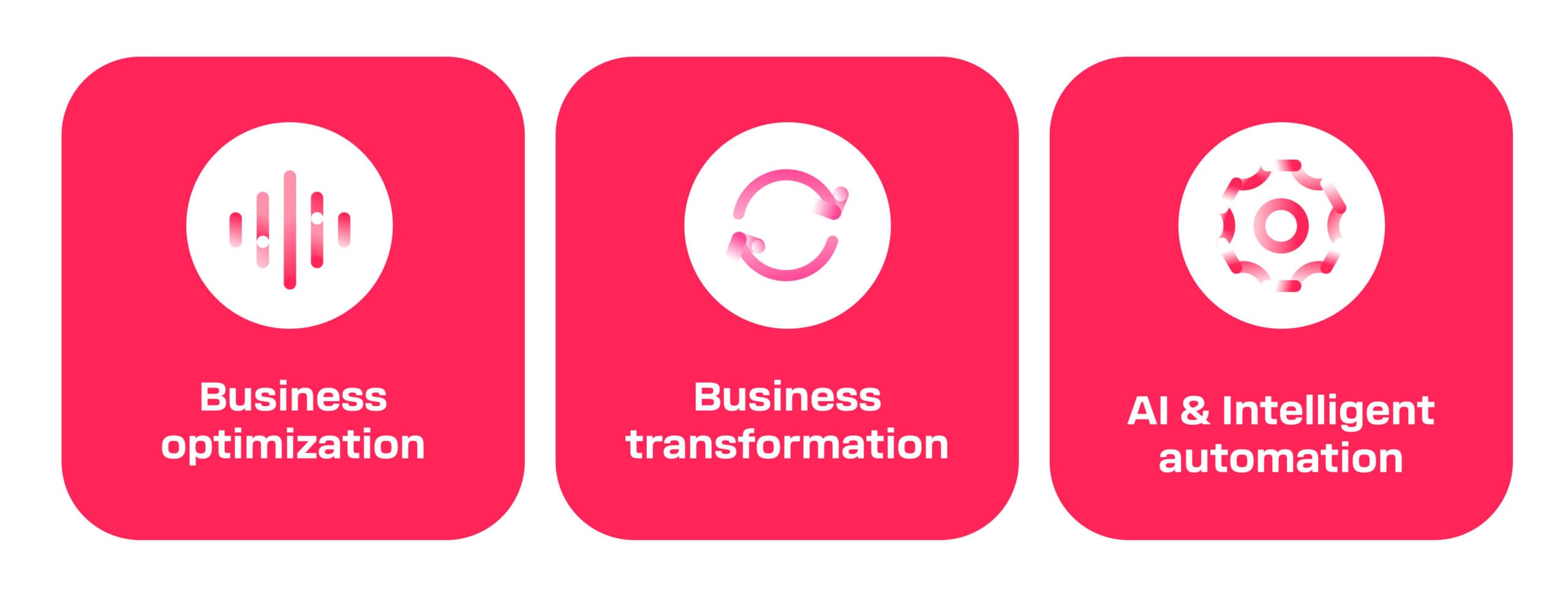
Knowing the types of data is the easy part. The harder question is what you actually do with it. There are three primary modes through which businesses extract value from data.
1. Optimization: Doing what you do better, faster
The first and most common use of data is optimization using data to improve efficiency, reduce costs, eliminate waste, and grow revenue within existing business models. Optimization answers questions like: Which products are underperforming and why? Where are we losing customers in the purchase journey? How can we reduce operational costs without sacrificing quality? Which marketing channels deliver the highest return on investment?
Optimization does not require you to change your business model. It requires you to understand your current model more deeply and execute it more effectively. For most organizations, this is where a data journey begins and the ROI is often immediate and measurable.
2. Transformation: Doing something different
The second mode is transformation using data to create entirely new business models, revenue streams, or customer experiences that were not possible before. Transformation answers questions like: Can we monetize our data as a product in its own right? Can we offer personalized experiences at scale? Can data enable us to move into adjacent markets?
Transformation is harder and more disruptive than optimization. It requires organizational change, cultural shift, and significant investment. But it is also where the most durable competitive advantages are built.
3. AI and intelligent automation
The third mode, increasingly intertwined with optimization and transformation, is not just adopting AI tools but redesigning the business to operate in an AI-native way. This means using AI not only to analyze data or automate isolated tasks, but to reshape workflows, decision-making, team structures, and the operating model itself.
AI-native operations raise bigger questions than traditional automation: Which decisions should humans make, and which should be delegated to AI? How should workflows change when AI can generate insights, content, forecasts, and recommendations in real time? What talent mix do we need when some work is automated, some is augmented, and some becomes newly strategic? How do we redesign teams, governance, and incentives around continuous human-machine collaboration?
This mode is more concrete than simply “deploying AI.” It may involve restructuring customer service around AI-assisted agents, redesigning supply chain planning around predictive models, rebuilding internal functions with copilots embedded into everyday work, or changing hiring plans to prioritize data, product, and AI literacy across the organization. The companies that lead will not be those that simply layer AI onto existing processes, but those that rethink how the business operates when intelligence becomes embedded everywhere.
Data is not the competitive advantage. What you do with it is. Companies that invest in data infrastructure but fail to build the analytical capability to act on it will not outperform their peers.
What is the ROI of a data-driven operating model? Success stories
The clearest way to understand what a data-driven organization looks like is to examine companies that have built their competitive positions on this foundation. Here are some household names and how they operationalize data.
Zara: Real-time retail intelligence
Zara has built one of the most responsive supply chains in the world, not because it has the most designers or the cheapest manufacturing, but because it has built a data infrastructure that converts customer behavior into product decisions in near real time. Store managers and sales staff feed daily data on what customers are asking for, what is selling, and what is being returned back to headquarters. That data directly informs production decisions. New designs go from concept to shelf in as little as two weeks, a fraction of the industry average.
Nike: From products to a data-powered ecosystem
Nike's transformation over the past decade is one of the most studied examples of data-driven business transformation. Beginning with the acquisition of fitness tracking capabilities and accelerating through its Nike Training Club app, Nike has built a direct relationship with tens of millions of consumers and the behavioral data that comes with it. That data powers personalized product recommendations, targeted launches that create scarcity and demand, and a membership ecosystem that ties consumers more tightly to the brand. Nike did not just optimize to sell more shoes through the use of data, it completely reimagined its relationship with the customer.
Spotify: Behavioral data as product
Spotify turns listening behavior into product experience. Every skip, replay, save, search, and pause becomes a signal that helps Spotify refine what each user hears next. The result is a product that feels intuitive, adaptive, and deeply individual. Discover Weekly, released every Monday, is one of the clearest examples of data becoming the product itself: an experience users return to because it consistently makes the platform feel smarter and more relevant, which ultimately translates into deep brand loyalty and sustainable revenue.
What are the characteristics of a data-driven organization
Across industries and business models, the most data-driven organizations tend to share five common characteristics:
- Customer-centricity at the core: every data investment is evaluated by its ability to deliver better customer outcomes
- Democratized access to information: frontline employees and business leaders have self-service access to relevant insights
- Real-time decision making: pricing adjustments, inventory reorders, and campaign optimizations happen continuously, not in quarterly cycles
- A culture that trusts data: leaders model evidence-based decisions over instinct or hierarchy
- The right technology stack: investment in the platforms, tools, and talent to collect, store, process, and analyze data at scale
Where most organizations are today
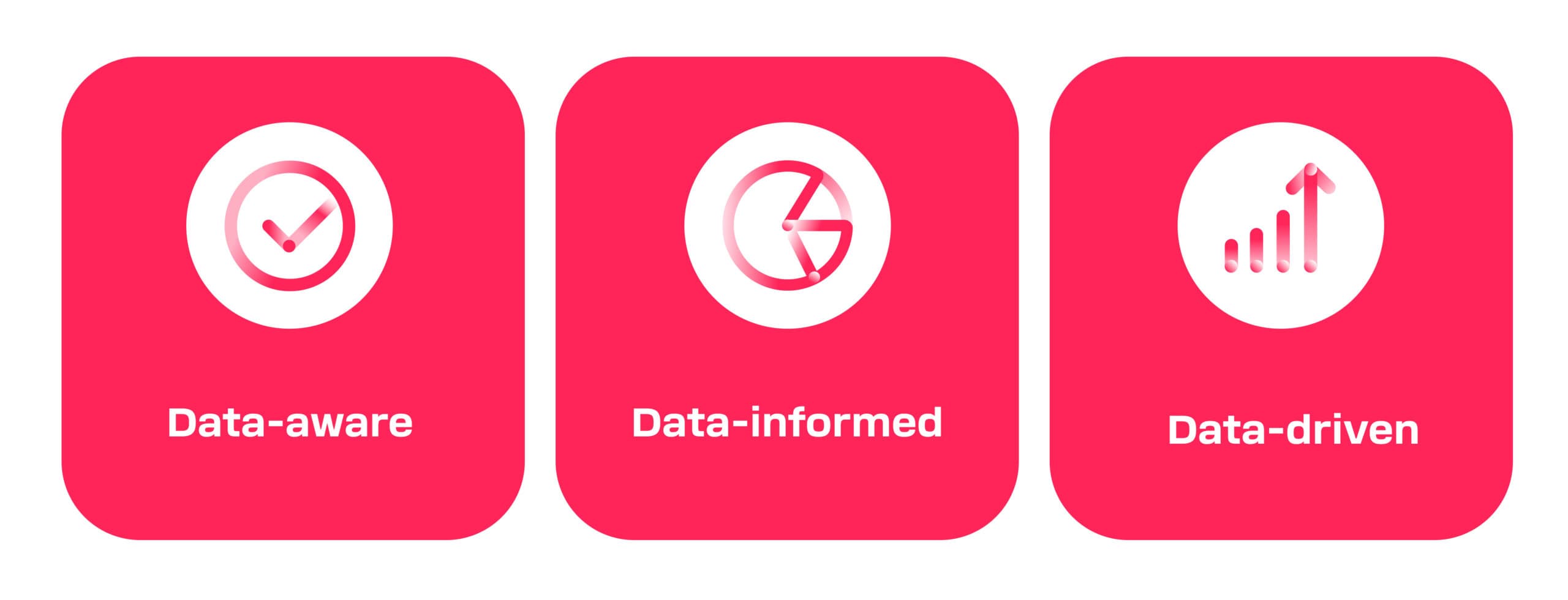
Most organizations sit somewhere on a spectrum between "data-aware" and "data-driven." They collect data, they run some reports, and they use analytics to answer specific operational questions. But they have not yet built the infrastructure or culture to make data a true strategic asset. The gap is not usually a technology gap. It is a strategy gap.
Organizations that are serious about becoming data-driven need to answer three foundational questions:
- What decisions do we need data to make better?
- What data do we have, and what are we missing?
- What platform and infrastructure do we need to act on that data?
The architecture of your data environment — whether a data warehouse, a data lake, or a modern lakehouse — will determine what you can and cannot do with your data.
Conclusion: Data is the strategy
Becoming a data-driven organization is an ongoing strategic commitment to the infrastructure, the culture, and the processes that turn raw information into competitive advantage.
Successful data-driven organizations have made deliberate choices to invest in data capability as a core strategic priority, often before the competitive pressure to do so was fully visible. The question for every business leader today is not whether data will matter to your industry. It already does. The question is whether you will build the capability to use it before your competitors do.