
Most conversations about data strategy focus on the destination: the dashboards, the AI models, the personalized customer experiences. But there is a critical and often overlooked step between the data you generate every day and the intelligence you want to extract from it: the processes that transform and move that data into a form you can actually use.
This is the domain of data transformation and data movement: the engineering and operational backbone of any serious data strategy. Business leaders who understand these techniques make better strategic decisions. They ask better questions of their technology vendors, invest in the right capabilities, and avoid the costly mistakes that come from treating data infrastructure as a black box.
Why data is hard to move
One of the most common misconceptions among business leaders is that connecting data systems is straightforward. In reality, data in most organizations is:
- Fragmented: spread across dozens of operational systems, each with its own format, structure, and logic
- Inconsistent: the same concept may be defined differently in your CRM, ERP, and e-commerce platform
- Messy: real-world data contains errors, duplicates, missing values, and outdated records
- Siloed: different business units own different data, often with no mechanism for sharing or integration
Moving data from its source to where it can be analyzed is not a passive process. Get it right, and your data becomes a strategic asset. Get it wrong, and you build analytics on faulty foundations — generating insights that are unreliable, or worse, actively misleading.
What is ETL: Extract, Transform, Load?
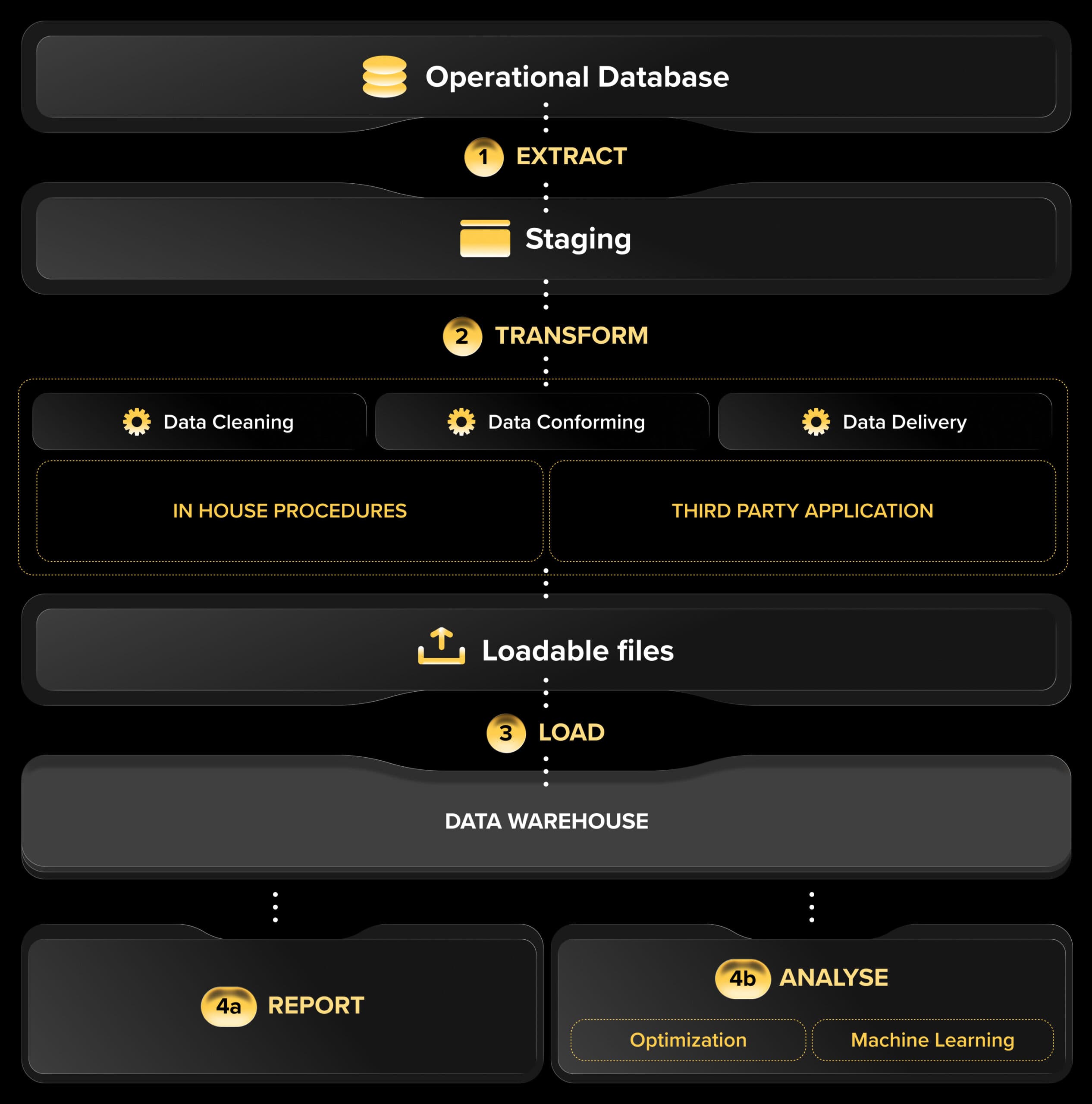
ETL (Extract, Transform, Load) is the original and still widely used approach to moving data from operational systems into analytical environments. Understanding ETL is essential to understanding how any data infrastructure works.
Extract
The first step is extraction. It entails pulling raw data from one or more source systems. Your operational systems continuously generate data as part of their normal operation. Extraction involves connecting to these systems and pulling the relevant data, either on a scheduled batch basis (once a day, once a week) or in near real time (continuous extraction as events occur). A well-designed extraction layer can pull from all your sources reliably and consistently without disrupting the operational systems themselves.
Transform
This is the most critical and complex step. Transformation converts raw, inconsistent source data into clean, standardized, analysis-ready information. It covers:
- Cleaning: removing duplicates, handling missing values, correcting errors, standardizing formats
- Standardizing: applying consistent business rules across data from different systems
- Enriching: adding derived fields such as customer lifetime value, segment, or risk scores
- Filtering: applying business logic to include only valid, in-scope data
The transformation step is where your business logic lives. Done well, it ensures that every analyst and every dashboard is working from the same, consistent, trustworthy view of the business. Done poorly — or skipped — it is the source of endless "but our numbers don't match" arguments that plague many organizations.
Load
The final step is loading the transformed data into its destination, typically a data warehouse or a data lake. This may involve a full load (replacing all existing data) or an incremental load (adding only new or changed records). Incremental loading is far more common at scale, as it is more efficient and reduces the window during which data is unavailable.
What is data transformation?
As cloud data platforms and data lakes became mainstream, a variation emerged: ELT (Extract, Load, Transform). The difference is in the order of operations. In ELT, data is extracted and loaded into the destination in its raw form first without transformation. The transformation then happens inside the destination platform, using its own processing power.
Why ELT has become a leading pattern in modern cloud data platforms
- Cloud computing power is scalable: Transformation can run inside platforms like Snowflake, BigQuery, and Databricks without separate infrastructure
- Raw data is preserved: You can re-run transformations with new business logic or answer questions you did not anticipate when data was first ingested
- Faster time to value: Data is available for exploration immediately, before the full transformation pipeline is complete
- More flexibility for data science: Data scientists often need access to raw, untransformed data for modeling purposes
Modern tools like data build tool (dbt) have made ELT transformation far more accessible, allowing business-aligned data teams to define transformation logic in SQL and manage it like software code with version control, testing, and documentation built in.
What are data pipelines?
A data pipeline is the automated sequence of steps that moves data from a source system through transformation to its destination. Think of it as the arterial system of your data infrastructure, continuously transporting data from where it is generated to where it is needed.
Types of pipelines
- Batch pipelines: Run on a schedule, such as hourly, nightly, or weekly. They are generally simpler to build and manage and are often sufficient for financial reporting, trend analysis, and operational dashboards where some delay is acceptable.
- Streaming pipelines: Process data continuously or in near real time as events occur. They are important for use cases like fraud detection, real-time personalization, live inventory updates, and operational monitoring.
- Multi-stage pipelines: Move data through several layers, such as raw, staging, cleansed, and business-ready, with each step improving structure, quality, and usability. This is a common design pattern in modern data platforms.
Building and managing data pipelines is one of the core responsibilities of modern data engineering teams. The reliability, speed, and quality of those pipelines directly shape the quality of the analytics, applications, and AI systems built on top of them.
What is data integration?
Data integration is the broader discipline of bringing together data from multiple, disparate sources into a coherent, unified view. For most organizations, the challenge is never a lack of data but the fragmentation of data across different systems. Effective data integration creates a consistent, trusted view across fragmented systems.
Key data integration challenges
- Identity resolution: Recognizing that the same customer appears as different records across different systems (different email addresses, IDs, or name spellings)
- Schema mapping: Translating different field names, data types, and structures from different systems into a consistent schema
- Change data capture (CDC): Detecting and capturing changes in source systems in real time without requiring a full data refresh
Why data quality matters
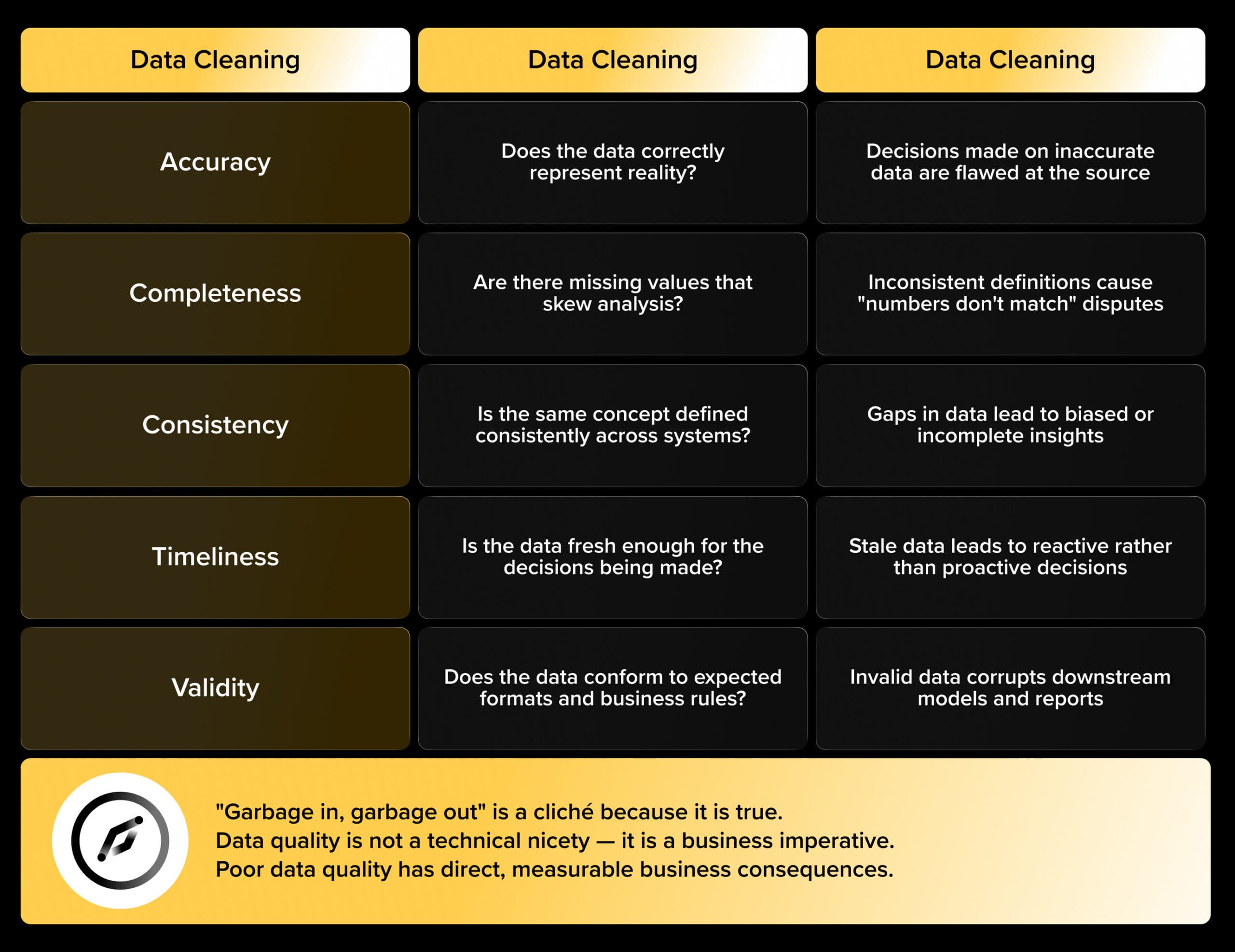
All of these techniques are only as valuable as the quality of the data flowing through them. Data quality refers to the accuracy, completeness, consistency, timeliness, and reliability of your data and it is the most underinvested area in most data programs.
What this means for your organization
Business leaders do not need to build data pipelines, ETL processes, or integration architectures themselves. But they do need to understand how data moves through the business, how it is transformed, and whether their current data platform can support analytics, automation, and AI at scale.
When making infrastructure investments, leaders should ask a clear set of strategic questions:
- How does data move from operational systems into our analytics environment, and how quickly?
- Where does data transformation happen, and who owns the business logic?
- How do we maintain data quality, and who is accountable for it?
- Can our data architecture support AI and machine learning use cases?
- How do we integrate data across business units and systems to create a unified view of the business?
Data transformation and data movement are the foundation of a modern data strategy. They determine whether your organization can trust its data, act on it quickly, and scale analytics and AI with confidence.
Understanding ETL vs. ELT, data pipelines, and data integration gives business leaders a practical framework for making better technology decisions. It helps them choose the right data architecture, ask better questions of vendors and internal teams, and build the capabilities needed to turn data into a real competitive advantage.