
Analytics capability is not something you buy. It is something you build through a combination of the right strategy, the right systems, and the right processes, operating together as a coherent whole.
Many organizations make the mistake of treating analytics as a technology problem: buy a better BI tool, hire a few data scientists, and wait for insights to arrive. But the companies that consistently derive competitive advantage from their data have built analytics into the fabric of how their business operates.
This framework equips business leaders to orchestrate analytics as a strategic multiplier, structured around three interdependent pillars: Strategy, Systems, and Process.
Strategy: Asking the right questions
What is the most common analytics mistake?
Most organizations begin their analytics journey with data. They invest in platforms, build dashboards, and then ask: "What can we learn from all of this?" The most data-driven organizations do the opposite. They begin with the decisions that matter most to their business, and work backward to the data and analytics needed to inform them. This is the difference between analytics that drive business value and analytics that generate interesting charts that nobody acts on.
What are the three types of analytics?
A robust analytics strategy must be clear about which type of analytics it is building because the systems, skills, and processes required are significantly different.
- Descriptive analytics ("What is happening?"): Summarizes historical data for clear reporting. Answers questions about what happened last quarter, which products underperformed, how costs have changed. Valuable, but backward-looking.
- Predictive analytics ("What will happen?"): Uses statistical models and machine learning to forecast future outcomes. Which customers are likely to churn? Which SKUs will run out of stock? The business value is substantially greater as you can act before something happens.
- Prescriptive analytics ("What should we do?"): Recommends the optimal action in response to predicted conditions. Given forecasted demand and supplier lead times, what should we order? This is where analytics moves from reporting to action.
How to define your analytics objectives
A clear analytics strategy begins with three questions:
- What are the most valuable decisions we make? Not all decisions are equal; prioritize analytics investment around the decisions that matter most.
- What data do we already have, and what are we missing? Many organizations are surprised to discover how much valuable data they already own but have never properly utilized.
- What level of analytical sophistication do we need and do we have the capability to support it? Starting with prescriptive analytics before you have reliable descriptive analytics in place is a common and costly mistake.
Systems: How do you operationalize analytics across a business?

Strategy determines what you want to do. Systems determine what you are capable of doing. At a high level, an analytics technology stack can be understood as four interconnected layers.
- Data sources: your operational systems (ERP, CRM, website, apps): the origin of all raw data
- Data platform: your data warehouse, data lake, or lakehouse is the infrastructure that consolidates, stores, and prepares data for analysis
- Analytics and BI tools: the tools through which business users interact with data, such as Tableau, Power BI, Looker, and for data science, Python and Databricks
- Action layer: The systems and workflows through which insights are translated into business actions, automated decision engines, alerts, and structured decision-making processes
The most common failure point is the action layer. Organizations build impressive analytics infrastructure, generate genuine insights, and then have no reliable mechanism for those insights to influence decisions. Analytics without action is a research project, not an organizational capability.
Process: Embedding analytics into how you operate
The most data-driven organizations build an analytics operating rhythm, a cadence of meetings, reviews, and decision processes that are explicitly data-driven:
- Daily operational reviews: use real-time dashboards to monitor KPIs and flag anomalies requiring immediate attention
- Weekly team reviews: use trend data and pipeline metrics to inform near-term priorities and resource allocation
- Monthly business reviews: use descriptive and predictive analytics to assess performance against objectives
- Quarterly strategic reviews: use analytical insights to inform strategic priorities and investment decisions
Technology investment alone will not produce a data-driven culture. This does not mean everyone needs to be a data scientist. It means that everyone who makes decisions should be able to read a chart, interpret a trend, understand what a predictive model is and is not telling them, and know when to ask for help from a data professional. When leaders model data-driven behavior by asking "what does the data show?" before making decisions, the rest of the organization follows.
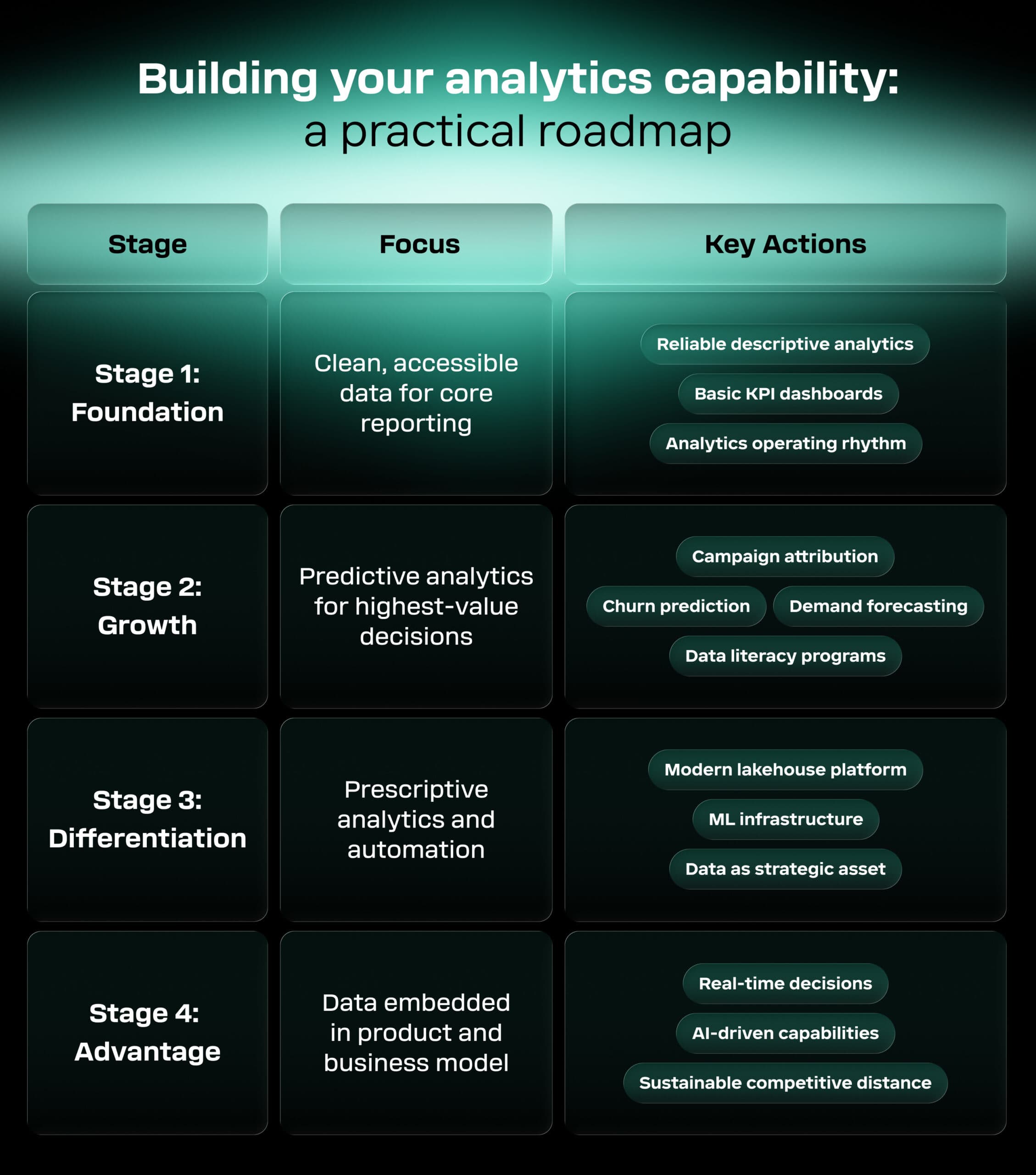
Building your analytics capability: a practical roadmap
The common thread across data-driven organizations is not just better technology or larger budgets. It is the deliberate choice to make data central to how the business operates, competes, and evolves. What creates advantage is not data alone, but the discipline to build the systems, processes, and organizational habits that turn insight into action every day.
The companies that outperform are not necessarily the ones with the most advanced models first. They are the ones that build capability in stages: establishing a trusted data foundation, applying analytics to higher-value decisions, embedding intelligence into operations, and eventually using data and AI to reshape the business itself. In that sense, analytics capability is not a side initiative. It is a roadmap for building long-term competitive advantage.