
For the better part of two decades, brands operated on borrowed intelligence. They reached customers through platforms they did not own, using data they did not control, measured by metrics they could not fully verify. That model is unraveling. And the brands that have not built their own data foundation are discovering that they are exposed in ways they did not anticipate.
To continue to grow, brands must invest in their own data platforms because the entire logic of sustainable competitive advantage in a customer-centric economy depends on it.
Third-party data is depreciating
For years, brands relied on third-party data, from behavioral data collected by advertising platforms to data brokers to publishers, to better understand and reach their audiences. That architecture is being dismantled:
- Apple's App Tracking Transparency framework requires apps to request permission before tracking users and the overwhelming majority of users decline
- Privacy regulations including GDPR (Europe) and CCPA (California) have introduced legal constraints on how user data can be collected, stored, and used
- Consumer awareness of data privacy has grown significantly, with corresponding resistance to intrusive tracking
- Consumers are increasingly using AI assistants, search copilots, and recommendation engines to discover, evaluate, and compare products, which means more of the customer journey is happening inside interfaces where brands have little visibility into intent, consideration, or decision-making behavior
Google’s position on third-party cookies has become more nuanced than many expected. After years of signaling a full phaseout in Chrome, Google has stepped back from a blanket deprecation approach and moved toward giving users more control over privacy choices within the browser. That does not reverse the broader trend. It simply means the decline of third-party data is happening in a more uneven and platform-specific way than marketers originally anticipated.
The effect is a dramatic reduction in the reach and precision of third-party audience targeting. Brands that built their marketing strategy on the assumption that they could always rent audience intelligence from platforms are now finding that the product is getting more expensive, less precise, and legally more complex.
Platform dependency
When a brand's understanding of its customer is entirely mediated through a third-party platform, that brand does not actually know its customer. It knows the customer as that platform defines and segments them. The data lives on the platform's servers, governed by the platform's terms of service, available only through the platform's interfaces.
Building a business strategy on rented data is like building a house on rented land. The structure may be impressive, but the foundation is not yours. Algorithm changes, pricing shifts, and access restrictions can happen overnight.
What is a first-party data platform?
First-party data is data that you collect directly from your customers and prospects through your own channels, with their knowledge and consent. It includes purchase and transaction history, website and app behavioral data, customer service interactions, email and messaging engagement, loyalty program data, survey responses, and social media interactions on owned channels.
This data is uniquely valuable because it is accurate (comes directly from the source), relevant (reflects actual behavior with your brand), yours (you own it and can govern it without platform intermediaries), and defensible (collected with consent, within applicable regulations).
Why do brands need a first-party data strategy?
The brands that have built rich first-party data assets have a form of competitive advantage that is, by its nature, difficult to replicate. Amazon knows more about its customers' purchase intent than any media company. Nike knows more about its consumers' fitness behaviors and product preferences than any retailer. Spotify knows more about its users' emotional states and listening contexts than any record label.
These companies did not acquire this knowledge by buying data from a broker. They built it over years of direct customer interaction, through products and services that customers actively chose to engage with. And they have built the infrastructure to translate that knowledge into continuously improving customer experiences which in turn generates more engagement, more data, and more competitive distance. This is the virtuous cycle that a first-party data strategy enables.
What it really means to be customer-centric
"Customer-centricity" has become one of the most overused phrases in business strategy. But genuine customer-centricity is an organizational capability. You cannot be truly customer-centric without a clear, comprehensive, and current understanding of who your customers are, what they need, how they behave, and how those things change over time.
That understanding does not come from intuition or annual surveys. It comes from data that is continuously collected, integrated into a single view, and made accessible to the teams that serve customers every day.
What is a single customer view?
The foundational product of a customer data platform is the single customer view, a unified profile for each customer that consolidates all the data your organization holds about them into one place. Customer data is typically fragmented across every system that has ever touched a customer:
- The CRM holds contact information and sales interactions
- The e-commerce platform holds purchase history
- The customer service platform holds support tickets
- The email marketing platform holds engagement data
- The loyalty system holds points balances and redemption history
- The website analytics platform holds behavioral data
Once you have a unified customer view, the use cases multiply: personalize every customer interaction based on actual history, identify high-value customers at risk of churning, segment by behavior rather than demographics, measure true lifetime value, attribute revenue accurately across channels, and ensure compliance with privacy regulations.
Traditional marketing treats customers as members of broad segments. Brands with rich first-party data platforms can move beyond segmentation to individual-level personalization, delivering precise product recommendations based on each customer’s purchase history, recent engagement, and predictive models. This is the level of personalization delivered by companies like Amazon, Nike, and Spotify, and it cannot be achieved without owning customer data.
What a brand data platform looks like

Building your own data platform does not mean building from scratch. It means making deliberate technology and architecture choices that put your organization in control of its own data assets. A modern brand data platform typically includes the following components:
Customer Data Platform (CDP)
A CDP is the operational layer that collects, unifies, and activates first-party customer data. It ingests data from all customer touchpoints in real time, resolves identity across sources, and makes unified customer profiles available to marketing tools, analytics systems, and operational applications. Unlike a CRM (which primarily serves sales and service teams) or a data warehouse (which primarily serves analytics teams), a CDP is designed to serve the full breadth of customer-facing use cases in real time.
Data Warehouse or Lakehouse
The analytical layer that stores historical data at scale and supports business intelligence, data science, and AI workloads. The modern lakehouse architecture is increasingly the right choice for organizations with both structured reporting needs and advanced analytics ambitions.
Marketing activation layer
The tools through which insights are translated into customer communications and touchpoints. The key capability is the ability to activate audience segments and individual-level signals from your first-party data platform directly into channels such as email, paid media, personalization engines, push notifications, and loyalty programs, and to let decisioning engines continuously optimize who sees what, where, and when based on real-time behavior rather than third-party platform data. This is where an AI-native marketing platform can make first-party data and intelligence tangible across the customer journey.
Data governance and privacy management
The processes and tools that ensure your data is collected, stored, and used in compliance with applicable regulations, and that customers can exercise their privacy rights reliably. As privacy regulation continues to evolve globally, governance capability is a legal requirement and a customer trust issue.
The VRIO Test: Is your data a sustainable competitive advantage?
The VRIO framework ( Valuable, Rare, Inimitable, Organized ) is one of the most rigorous tests of sustainable competitive advantage. First-party customer data, built through direct customer relationships over time, passes all four tests:
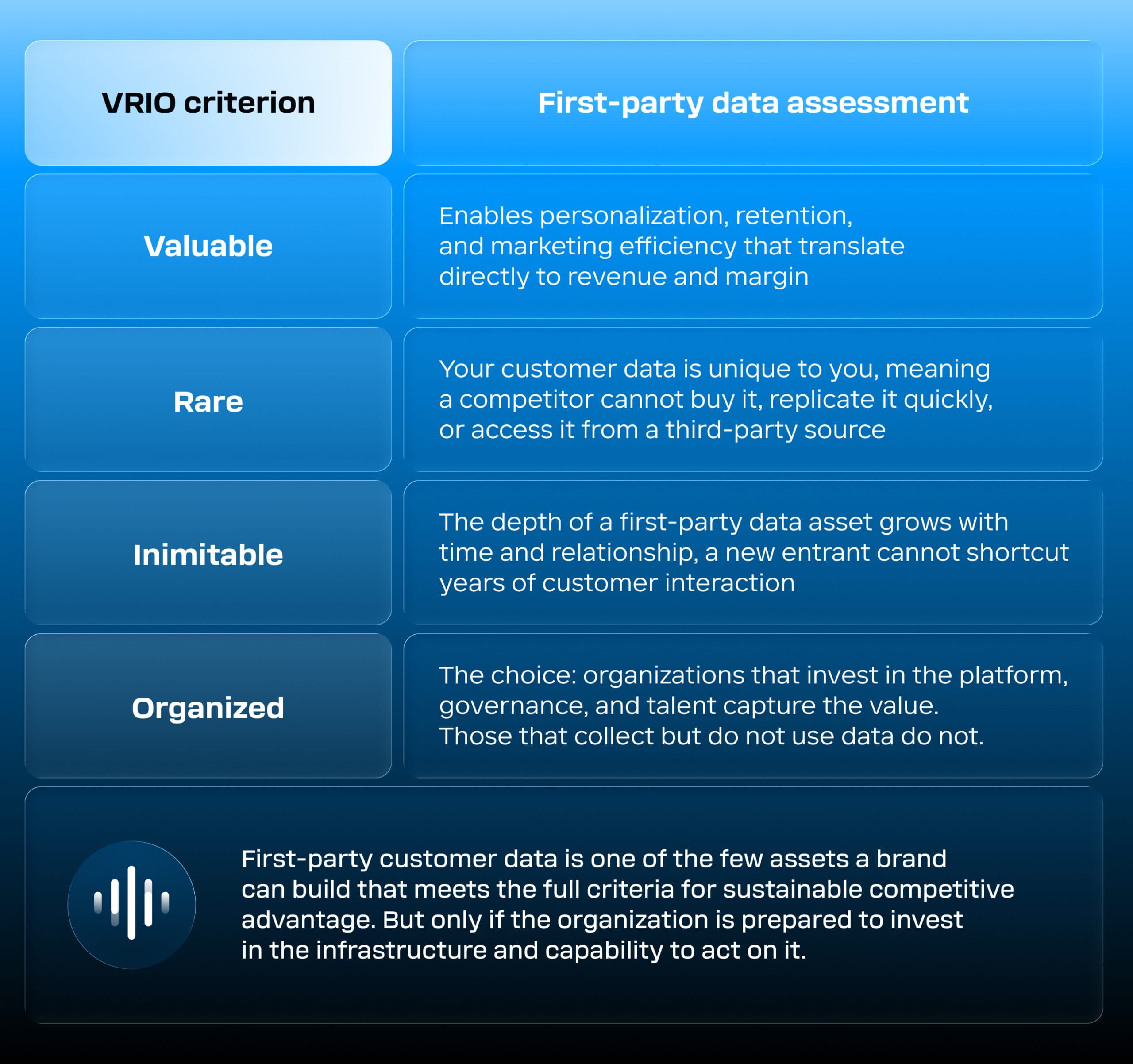
First-party customer data is one of the few assets a brand can build that meets the full criteria for sustainable competitive advantage. But only if the organization is prepared to invest in the infrastructure and capability to act on it.
Own your customer data, own your future
The data you fail to collect today cannot be collected tomorrow
Customer behavioral data is perishable. The visit that happened last month, the product that was viewed and abandoned last quarter, the customer who nearly churned six months ago, if you were not capturing and using that data in the moment, it is gone. The longer you delay building your data infrastructure, the larger the gap between what you know about your customers and what you could know.
Competitors who are already building will compound their advantage
The brands that invested early in first-party data are already building the analytical models that personalize at individual scale. Each month of data they collect makes their models more accurate. Each interaction that is personalized increases customer engagement. The competitive distance grows and it grows faster than most leaders appreciate.
AI makes owned data significantly more valuable
The AI capabilities that are transforming business require data to train, validate, and improve. The brand with a rich proprietary data asset has a foundation for AI advantage that is unavailable to brands that depend on third-party data. Every AI capability your competitors build on their first-party data is a capability you cannot replicate with rented intelligence.
The brands that will lead their categories in five years are the ones that, today, are making deliberate investments in understanding their customers through data they own, infrastructure they control, and capabilities they build. This is a strategic commitment to customer-centricity and the recognition that genuine understanding of the customer is the foundation of every durable competitive advantage.
Ready to move beyond off‑the‑shelf tools?
Work with Star to architect a custom data platform that becomes your competitive advantage. We design the right data architecture, implement modern platforms, and build AI-powered use cases that turn raw signals into measurable outcomes across the customer journey.