TL;DR
Managing several AI agents within a single marketing campaign introduces real operational complexity. It’s relatively straightforward to get the agents up and running. The harder part is making sure they share the right information and context, avoid conflicting actions, and work toward the same campaign objective.
Effective multi-agent coordination becomes essential once an agency moves from using isolated AI agents to deploying several agents across the same campaign workflow. Agencies generally select either an orchestrator AI agent that manages the workflow centrally, or an agent swarm AI model where specialized agents interact directly. The right model for an agency depends on how predictable the campaign workflow is, how much autonomy agents can have over media spend and optimization, and where human approval is required to protect client commitments, brand guidelines, and compliance.
Why AI agent architecture matters
The architecture you choose shapes how work, information, and decision-making authority flow across the system. For example, an agent interpreting a campaign brief must reliably pass approved context to agents responsible for audience research, media planning, and compliance. During a live campaign, other agents may simultaneously monitor budget, channel delivery, audience response, and creative performance.
Without a clear coordination model, agents may work from inconsistent information, duplicate tasks, or produce conflicting recommendations. The architecture, therefore, affects more than technical performance. It also determines:
- Control: How authority is distributed across agents and where human approval is required
- Risk tolerance: Which decisions agents can make independently, and which must be escalated
- Scalability: How easily the workflow can accommodate more agents, tasks, and data
- Transparency: How clearly teams can trace actions, reasoning, and outcomes
Not every workflow benefits from the same approach, so the workflow itself should determine the AI agent architecture rather than any assumption that one model is more advanced than the other. Campaign setup is typically predictable, with approved budgets, defined platforms, and clear launch requirements. Here, a visible chain of command and explicit approvals help maintain control and reduce risk before launch. Live optimization is less predictable. Conditions shift across multiple channels simultaneously, so specialist agents must analyze signals in parallel and respond quickly to changing circumstances.
These coordination choices form part of a wider shift from isolated AI tools to connected media operations. Understanding Multi-Agent Media Operations explores how that shift affects workflows, accountability, governance, and the agency operating model.
Orchestrator vs. swarm model explained
The orchestrator model
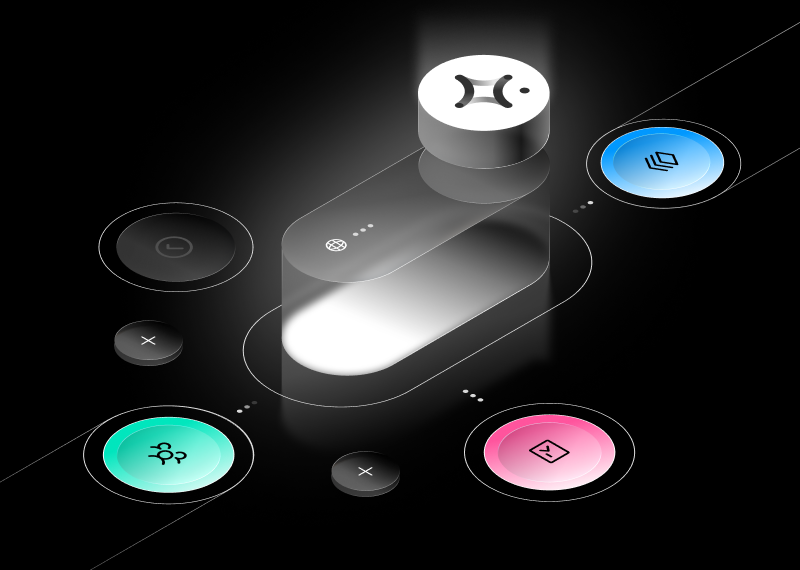
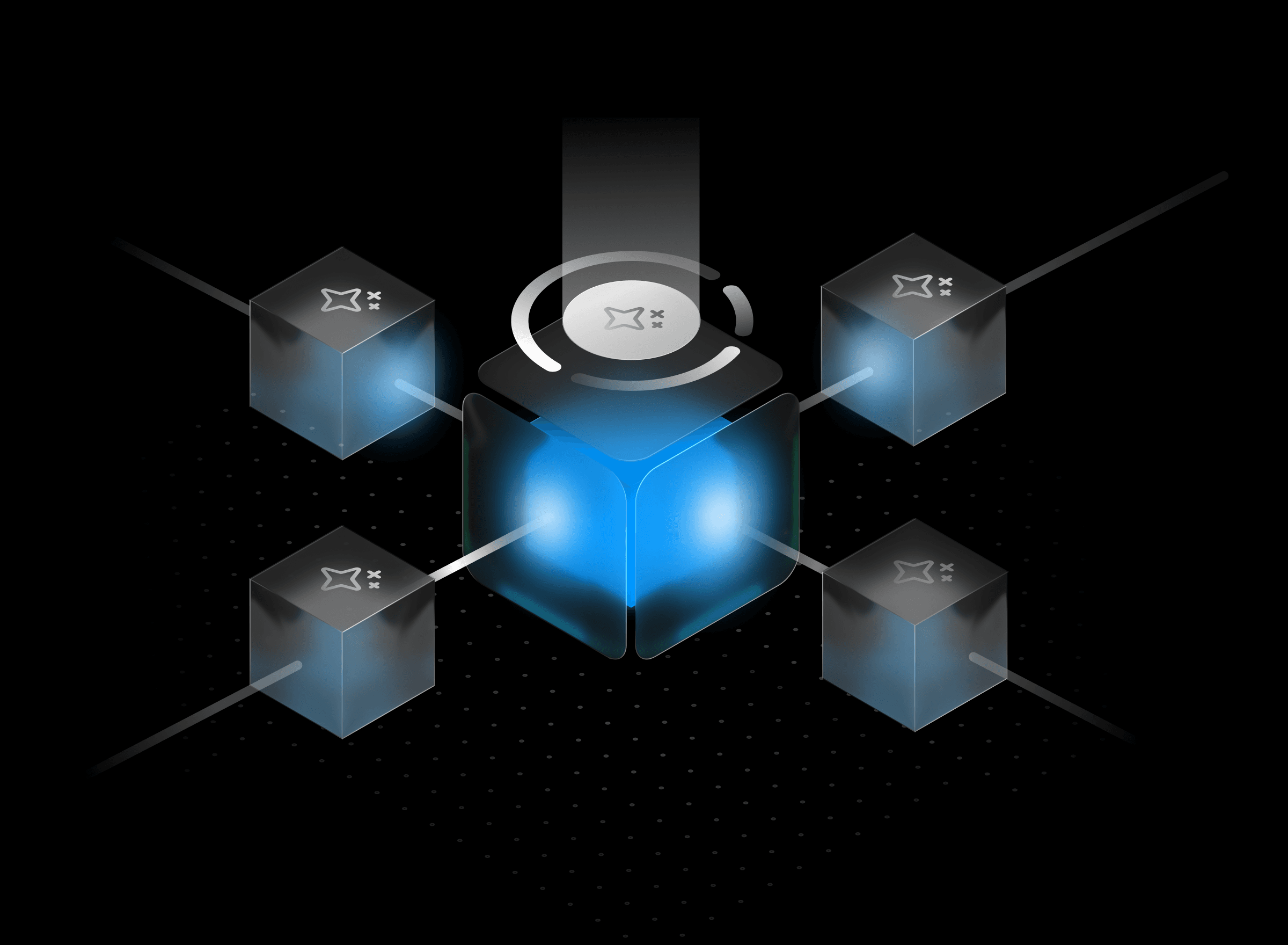
In an orchestrator model, one central agent directs the workflow. It receives the objective, divides it into tasks, assigns work to specialist agents, and consolidates the results. This creates a clear chain of command, making the workflow easier to manage, trace, and troubleshoot.
The model is best suited to structured, predictable workflows such as end-to-end campaign setup. The orchestrator might ask one agent to generate platform requirements, another to check creative availability, and another to validate tracking. It can then gather the outputs, flag unresolved issues, and request human approval before launch.
However, centralizing coordination also creates a single point of failure. If the orchestrator misinterprets the objective, loses context, or becomes unavailable, the wider workflow may stall or deliver inaccurate results.
The swarm model
In a swarm model, coordination is decentralized. Specialist agents communicate peer-to-peer and adapt their actions without a central agent controlling every stage. This makes the model more resilient and scalable: if one agent fails, others may continue working, and new capabilities can be added more flexibly.
Swarms are best suited to unpredictable, variable environments such as real-time optimization across multiple channels. A channel agent might detect underdelivery while audience, creative, and budget agents assess related signals in parallel. Together, they can develop a coordinated recommendation without every observation passing through a central controller.
However, this flexibility can also make swarms harder to govern. Without clear limits and escalation rules, agents may duplicate work, conflict, or enter loops without reaching a resolution.
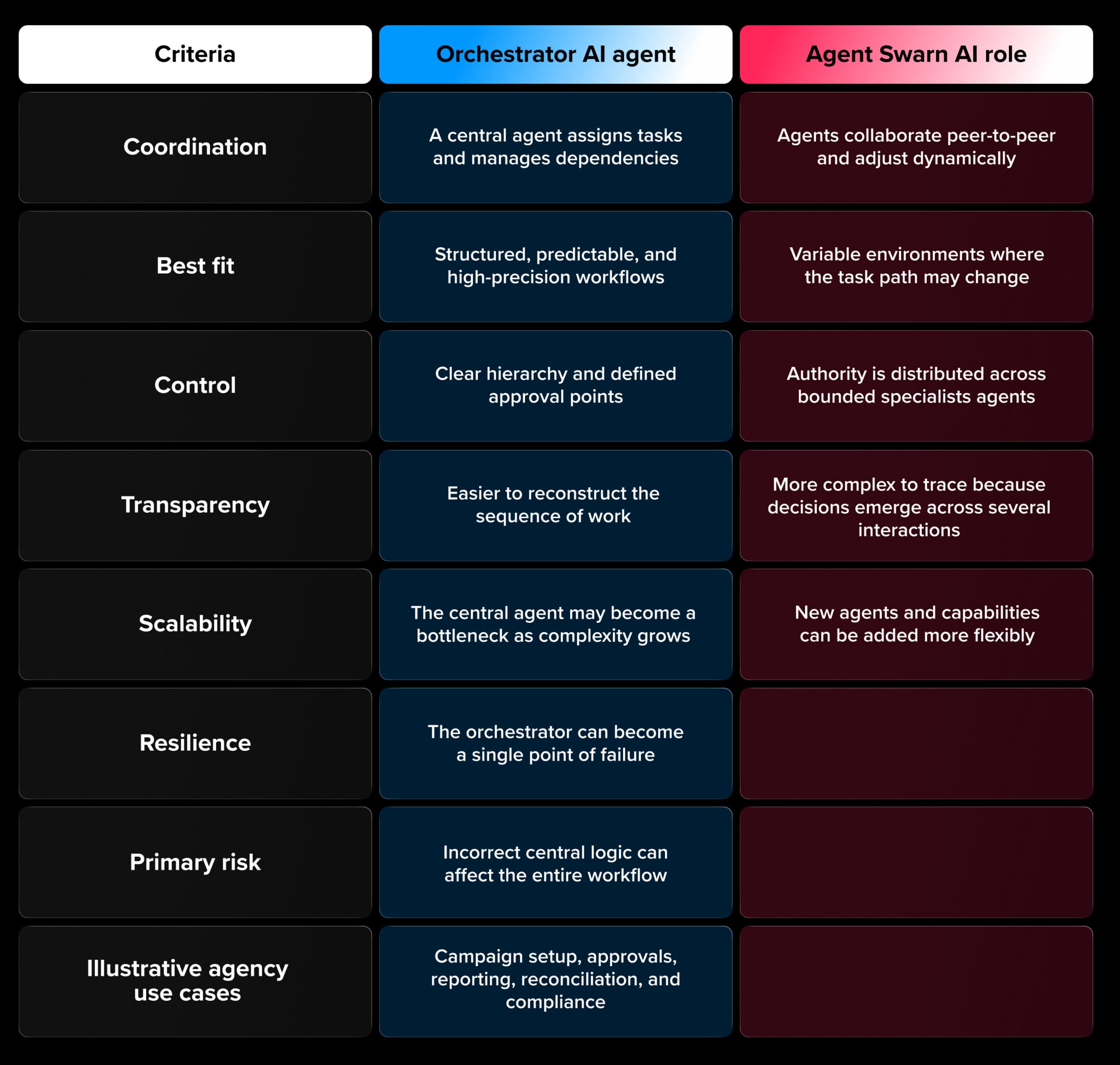
Neither model is automatically better. They distribute authority differently.
The orchestrator model is strongest when control, precision, and traceability matter most. Swarm logic is better suited to environments where agents need to work in parallel and adapt to conditions that cannot be fully anticipated.
So how should agencies decide which coordination model is right for a particular workflow?
Five questions to choose the right multi-agent coordination model
Selecting the right coordination model is a strategic decision that depends on the specific demands of each workflow and, at times, even the distinct phases within a single process.
You have to start from the need and then work out how best to fulfill it. In some cases, the answer might be something simple. In others, it might be a large number of interconnected agents.

Lolly Mason
Head of Strategic Accounts
The five questions below are designed to help you determine whether orchestrator or swarm logic will deliver the most value in each context.
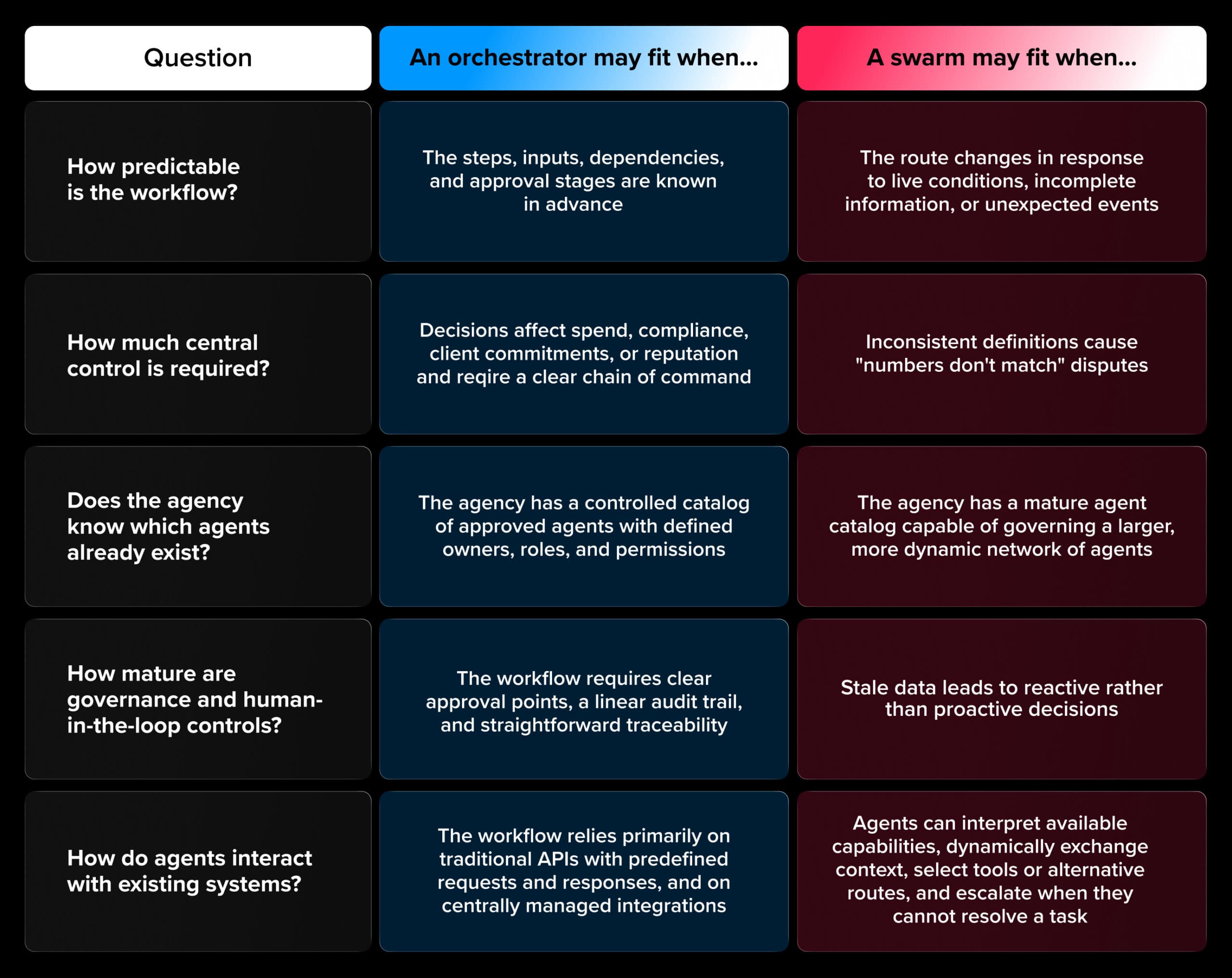
Agencies do not always need to choose between one model and the other. In many workflows, using orchestrator and swarm logic simultaneously offers the benefits of both.
Why most agencies will use a hybrid agentic AI workflow
A media planning process might rely on an orchestrated sequence for core activities, but shift to a small-swarm approach when exploring new scenarios. Similarly, a live optimization workflow can use distributed agents to monitor real-time signals, while a central orchestrator maintains budget discipline and ensures that significant changes are reviewed by humans.
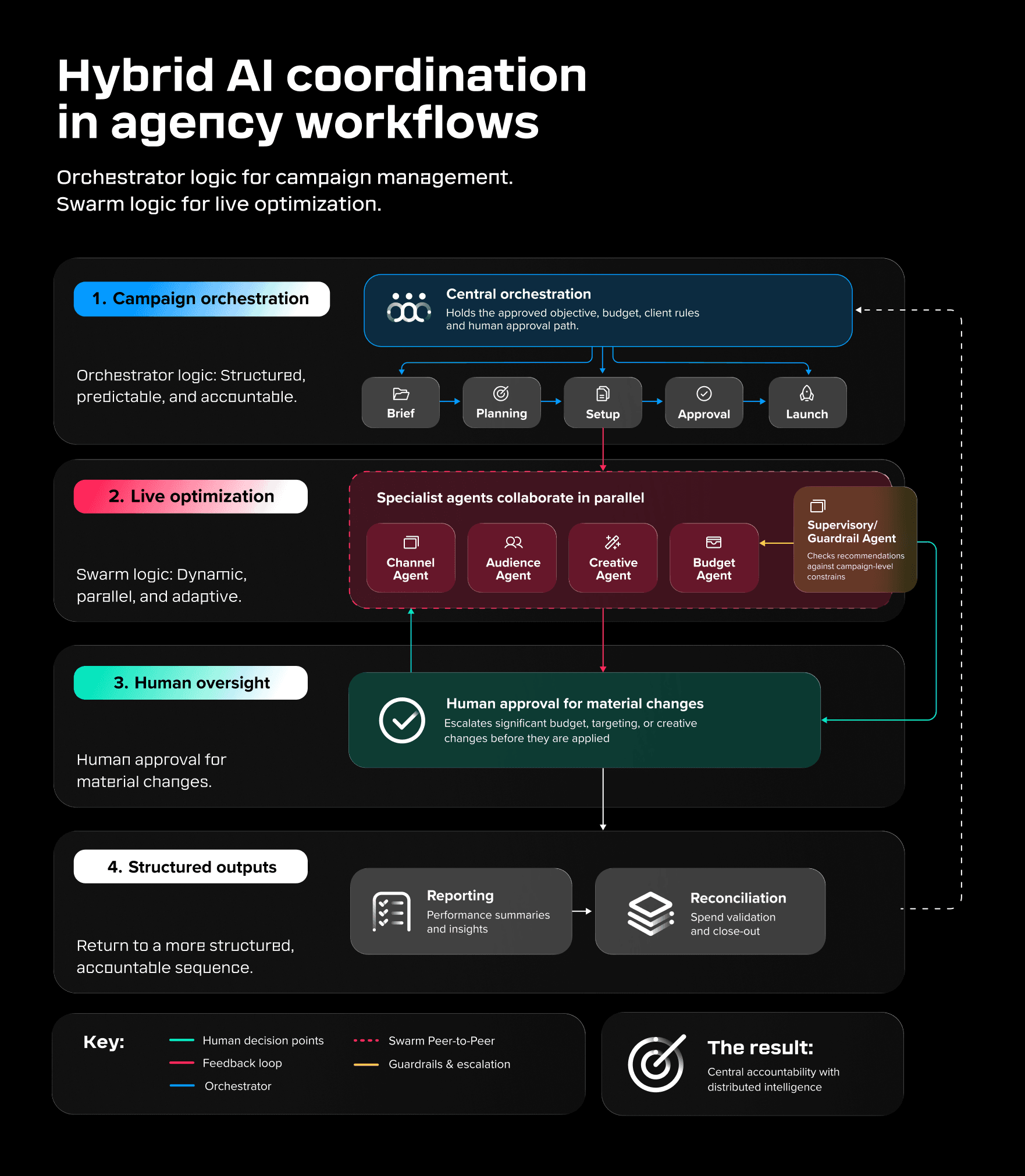
At the campaign level, a central orchestrator can hold the approved objective, budget, client rules, and human approval path. Within those boundaries, specialist agents can monitor channel delivery, audience engagement, and creative performance in parallel, adjusting recommendations as new data emerges.
A typical hybrid workflow could look like this:
- A central orchestrator receives the approved brief and media plan.
- Specialist agents handle setup, tracking, and creative quality control.
- A human approves launch.
- Channel, audience, and creative agents monitor performance simultaneously once the campaign is live.
- A supervisory agent reviews their recommendations to ensure alignment with campaign-level constraints.
- Material changes return to the orchestrator for human approval.
- Reporting and reconciliation return to a structured, sequential process.
This approach brings together central accountability and distributed intelligence, matching the level of oversight to the risk and impact of each decision. Creative exploration benefits from flexibility, while budget changes and reporting require more structured governance. Agencies that calibrate their workflows in this way can respond faster to market shifts without compromising control or compliance.
What must be in place for effective multi-agent system design?
Choosing a coordination model is only one part of the decision. Agencies also need the operational foundations to support it. The Agentic Workflow Readiness Checklist helps teams assess their workflows, data, governance, people, and integrations before development begins.
1. An agent catalog
Coordinating multiple agents requires a clear, organization-wide view of which agents are already deployed and what roles they serve.
Without a shared inventory, teams often develop assistants, pilot third-party solutions, or build client-specific agents in isolation. As these efforts multiply, organizations risk losing oversight and find themselves reacting to governance issues rather than proactively managing them.
A practical agent catalog should capture:
- Purpose and capability
- Business and technical owner
- Data, tools, and models used
- Clients and workflows supported
- Actions the agent can take
- Human approval requirements
- Connections to other agents and systems
- Monitoring and retirement status
Without a clear record of approved agents, orchestrators cannot assign work safely or reliably. Similarly, dynamic agent swarms depend on up-to-date information about agent permissions and reliability to function as intended.
2. Governance that matches the architecture
The way you coordinate agents directly shapes the governance structures you need to put in place.
Orchestrator models typically offer more straightforward auditability. With a single control point, agencies can set clear approval checkpoints, track the flow of work, and maintain a direct audit trail. Even so, it is essential to define the orchestrator’s scope of authority, specify which data sources it can use, and establish a fallback process for situations where the orchestrator cannot reach a confident decision.
A swarm requires stricter distributed guardrails because decisions result from the interactions of multiple agents rather than a single authority. Controls may include shared campaign constraints, agent-level permissions, global budget thresholds, conflict-resolution rules, and loop detection.
Supervisory agents add a further layer of oversight. Instead of executing tasks, they monitor the broader system, flagging repeated exchanges, unexpected process steps, cost increases, or actions that fall outside the defined objectives.
Regardless of the coordination approach, effective governance depends on controls at three critical layers:
- Input monitoring: Is the request appropriate, complete, and within scope?
- Reasoning monitoring: Is the system using approved tools and remaining within its constraints?
- Output monitoring: Is the final recommendation or action accurate, compliant, and safe?
Human approval should remain in place for higher-risk decisions, including significant budget changes, compliance issues, and actions that exceed an agent’s defined authority.
3. APIs and interoperability
Traditional APIs are usually designed around known requests and expected responses. Agentic systems can be more dynamic: an agent may need to select a tool, choose a specialist agent, or try another route when an integration fails.
As agents begin to coordinate across agencies, publishers, and advertising platforms, protocols such as AdCP and AAMP are creating a new infrastructure for agentic media buying, helping agents exchange context, discover capabilities, and operate across organizational boundaries. That makes several questions important:
- How are capabilities described?
- What context can agents exchange?
- How are identity and authorization managed?
- Can the agent retry or choose another route?
- When must it stop and escalate?
- How are calls and decisions logged?
Centralized orchestrator AI agents can manage these exchanges directly. In distributed agent swarms, consistent communication and permission protocols are essential across the entire network to maintain control and accountability.
The better the connectivity, the more useful the agentic workflows are.
Lolly Mason
Head of Strategic Accounts
What holding-company platforms show
Omnicom and WPP are both building centralized platforms that connect specialist agents, shared intelligence, and end-to-end marketing workflows.
Omnicom describes Omni as a centrally orchestrated platform with one workflow spanning strategy, execution, and performance. Its agents coordinate intelligence across creativity, media, commerce, and measurement, while the platform connects teams, data, and existing tools.
WPP Open follows a similar platform-level structure. Agents work across strategy, creative, media, and production using Open Intelligence as a shared intelligence layer. Its Agent Hub also provides a central catalog of verified agents that have been reviewed for expertise, data privacy, and output quality.
These examples suggest that large holding companies are prioritizing central coordination, shared context, agent cataloging, and enterprise governance. However, neither company publishes enough technical detail to determine whether individual workflows use a pure orchestrator model, swarm-style collaboration, or a combination of both.
When deciding between coordination models, agencies should avoid replicating architectures that are not fully transparent. The priority is to determine whether the platform can reliably deliver the core capabilities required: coordination, shared intelligence, agent governance, and interoperability.
What to decide before you build
Once the foundations are in place, agencies need to make five practical build decisions:
- Which workflow should come first? Choose a bounded, high-friction use case with a measurable business outcome.
- Where should each coordination model be used? Decide which stages need central orchestration, swarm-style collaboration, or a combination of both.
- How much autonomy is appropriate? Set action limits, approval thresholds, and escalation points according to the risk of each decision.
- What should be built, bought, or integrated? Build where it creates a meaningful advantage, use existing tools where capabilities are commoditized, and integrate where connectivity unlocks greater value.
- How will success be measured? Define targets for quality, speed, cost, reliability, and human intervention before piloting the workflow.
These decisions create the foundation for implementation. How to Implement Multi-Agent AI in Your Media Buying Stack sets out a practical route from bounded agents and individual use cases toward coordinated production workflows.
The objective is not maximum autonomy. It is the right level of autonomy for the task, within a system that people can understand and govern.
How Star can help
Every agency’s starting point is different. Using our Endgame Thinking approach, Star starts with the business outcome you want to achieve, then identifies where multi-agent coordination can remove friction and tailors the approach around your workflows, technology, and governance requirements.
We combine media and advertising expertise with product, data, and engineering capabilities to move from a defined use case to an operational system. The result is a coordination model that delivers measurable progress toward your endgame while maintaining human oversight and control.
Move from isolated agents to coordinated operations
Identify the right workflow, define the coordination and governance model, and build a production-ready multi-agent system around your agency’s goals.
FAQ
An orchestrator AI agent centrally assigns tasks, manages dependencies, and controls the workflow. In an agent swarm AI model, specialist agents communicate peer to peer and adapt their actions more independently. Orchestrators provide clearer control and traceability, while swarms offer greater flexibility, resilience and parallel decision-making.