

Nearly a decade ago, introducing a personal assistant into a vehicle was a competitive advantage. It demonstrated digital maturity, introduced a new interface, and positioned the brand as a provider of connected, intelligent experiences.
Now, drivers expect in-car assistants to understand natural language, control vehicle functions, connect to digital services, and respond in a way that feels fluid. As LLM automotive integration accelerates, technical capabilities are advancing rapidly, creating a new challenge for OEMs: convergence.
Drivers often encounter similar wake words, voices, conversational flows, and platform integrations across brands. While the assistant may be functional, it often lacks a meaningful connection to the specific vehicle. This raises a strategic question: If AI in-car assistants are now expected, what is the business case for continued investment? The answer lies in capability and brand differentiation.
The vehicle has long been a comprehensive expression of an automotive brand. Customers experience the brand through exterior and interior design, materials, sound, HMI, lighting, controls, and driving dynamics. The in-car assistant introduces a new dimension, a behavioral layer – the touchpoint that talks back.
A well-designed assistant enhances brand consistency, recognition, and emotional presence throughout the ownership journey. A poorly designed assistant can feel generic, undermining the carefully crafted cabin experience. For premium brands, this threatens the value customers expect. For volume brands, it misses the chance to differentiate in a market where features and services are converging.
The next design challenge is not only to make assistants smarter, but also to ensure they clearly reflect the brand.
The race no OEM can afford to ignore
OEMs have two primary reasons to continue investing in in-car assistants: one defensive and one offensive.
The defensive case is simple. Once a capability is expected, it goes unnoticed when functioning well, but becomes highly visible when it fails. An outdated or frustrating assistant is not experienced as a small technology issue. To the driver, it becomes part of the vehicle. This is critical as software quality, connected services, and digital experiences increasingly influence brand perception. A weak assistant may cause drivers to abandon the feature, cancel subscriptions, lose trust in the digital ecosystem, or reconsider the brand for future purchases.
The offensive case is more interesting: the assistant can become a new source of brand differentiation. As vehicle hardware and digital features continue to converge, the brand becomes the mental anchor that helps customers choose. A strong brand is not only a badge or a design language, it’s also a consistent set of expectations. Customers know what a BMW, Mercedes-Benz, MINI, Toyota, or Hyundai should feel like before they enter the vehicle. They bring assumptions about emotion, status, reliability, simplicity, performance, comfort, and control.
Brand archetypes are valuable here because they provide a practical framework for expressing brand identity through behavior rather than just appearance. For example, a brand based on the ruler, caregiver, explorer, entertainer, rebel, or everyman archetype sets clear expectations for how the assistant should communicate, respond, apologize, assist, guide, use humor, remain silent, or take initiative.
This is especially important for in-car assistants, which represent the brand through their actions, not just as interfaces. Archetypes provide design teams with a consistent framework to determine which elements should remain constant, which can adapt, and where personalization may compromise the brand.
The assistant must reinforce and participate in this brand system. The more consistent the system, the easier it is for customers to recognize, remember, and trust the brand. A strong assistant doesn’t need to be loud or theatrical, but it must embody the same promise the driver already associates with the vehicle, whether that promise is performance, calm, simplicity, status, reliability, or everyday ease.
If a calm, precise, premium vehicle is paired with a generic assistant, the experience becomes disjointed. Similarly, a playful brand with a mechanical assistant weakens its emotional promise. Without alignment to the cabin, interface, sound design, or driving context, the assistant becomes a utility rather than a brand asset. Assistant character design is a strategic discipline, integral to the in-vehicle user experience, service model, and the long-term relationship between the driver and the brand.
The assistant can become the behavioral manifestation of the brand — a real-life talking version of it. – Jana Kapitz, Head of Innovation Strategy
Brand character is not the same as customization
In a world shaped by smartphones, apps, and AI tools, personalizing a digital environment feels natural and is expected. Drivers want to configure the wake word, select a voice, adjust the assistant’s level of proactivity, or choose how much personality it shows.
For OEMs, that creates a design challenge. Give the driver too little flexibility, and the assistant feels rigid. Give them too much, and the brand disappears. The task is to separate what can flex from what must remain fixed.
The art is finding the balance between protecting the brand personality and giving customers room to adjust the experience. – Jana Kapitz, Head of Innovation Strategy
A useful way to think about this is in terms of a two-layer model.
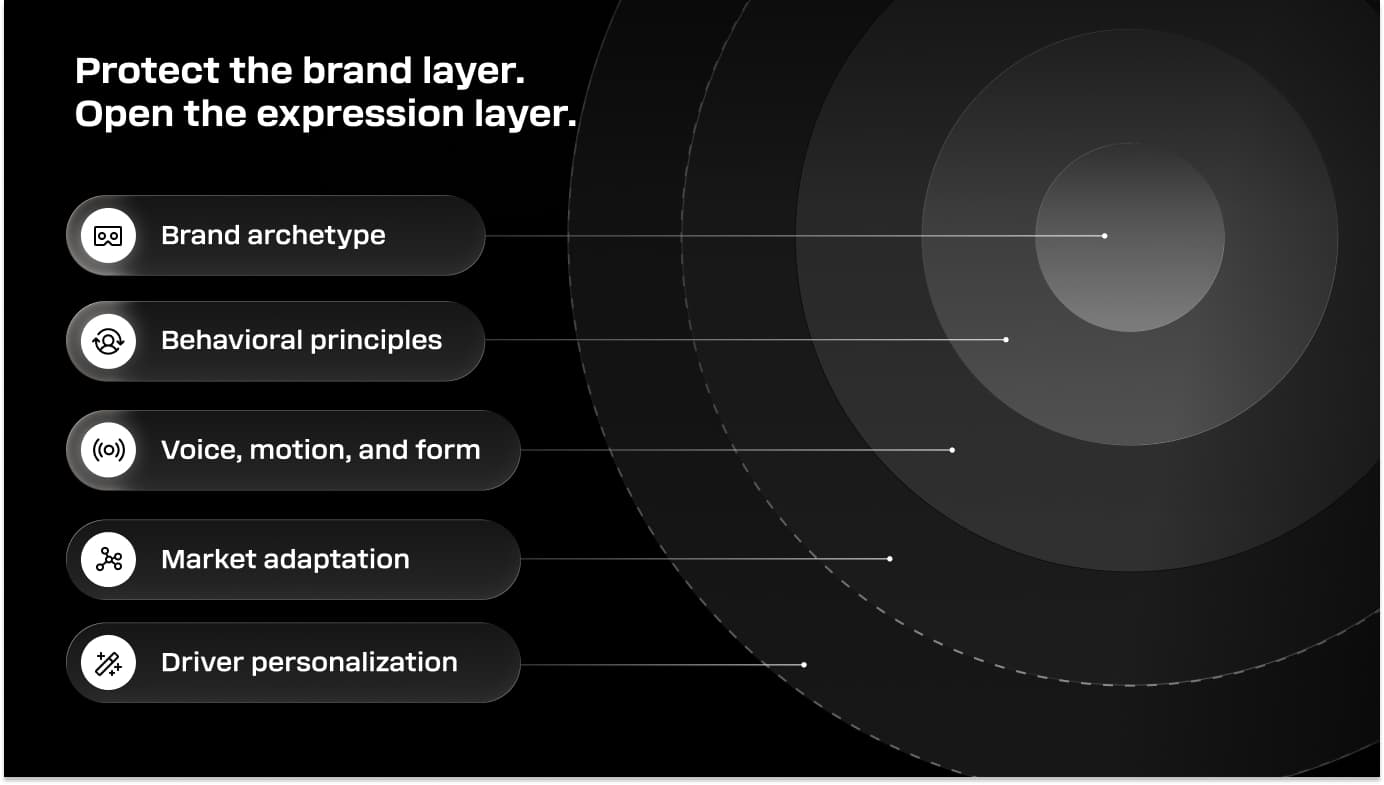
The first layer is the locked brand layer: the assistant’s core character, tone, behavioral principles, emotional register, motion logic, response style, and rules for handling uncertainty. These elements should not be overwritten by a settings menu. They are what make the assistant feel like it belongs to the brand.
The second layer is the open expression layer, where drivers can personalize the assistant without altering its core identity. Voice options, display preferences, avatar variations, wake words, or levels of proactivity may be included here, depending on the brand and vehicle context.
The design decision is not about hiding the brand from the driver. It is about protecting the brand layer from being overwritten by personalization. – Dominik Fink, Senior UX Designer & Creative Technologist
The archetype helps define boundaries between brand layers. An entertainer-style brand like MINI allows more play and surface-level customization, reinforcing its entertainer energy. In contrast, a ruler-style premium brand such as Mercedes-Benz would draw the line differently because too much flexibility could weaken the sense of control, polish, and authority. For everyman brands, broader customization supports accessibility, inclusion, and everyday usefulness.
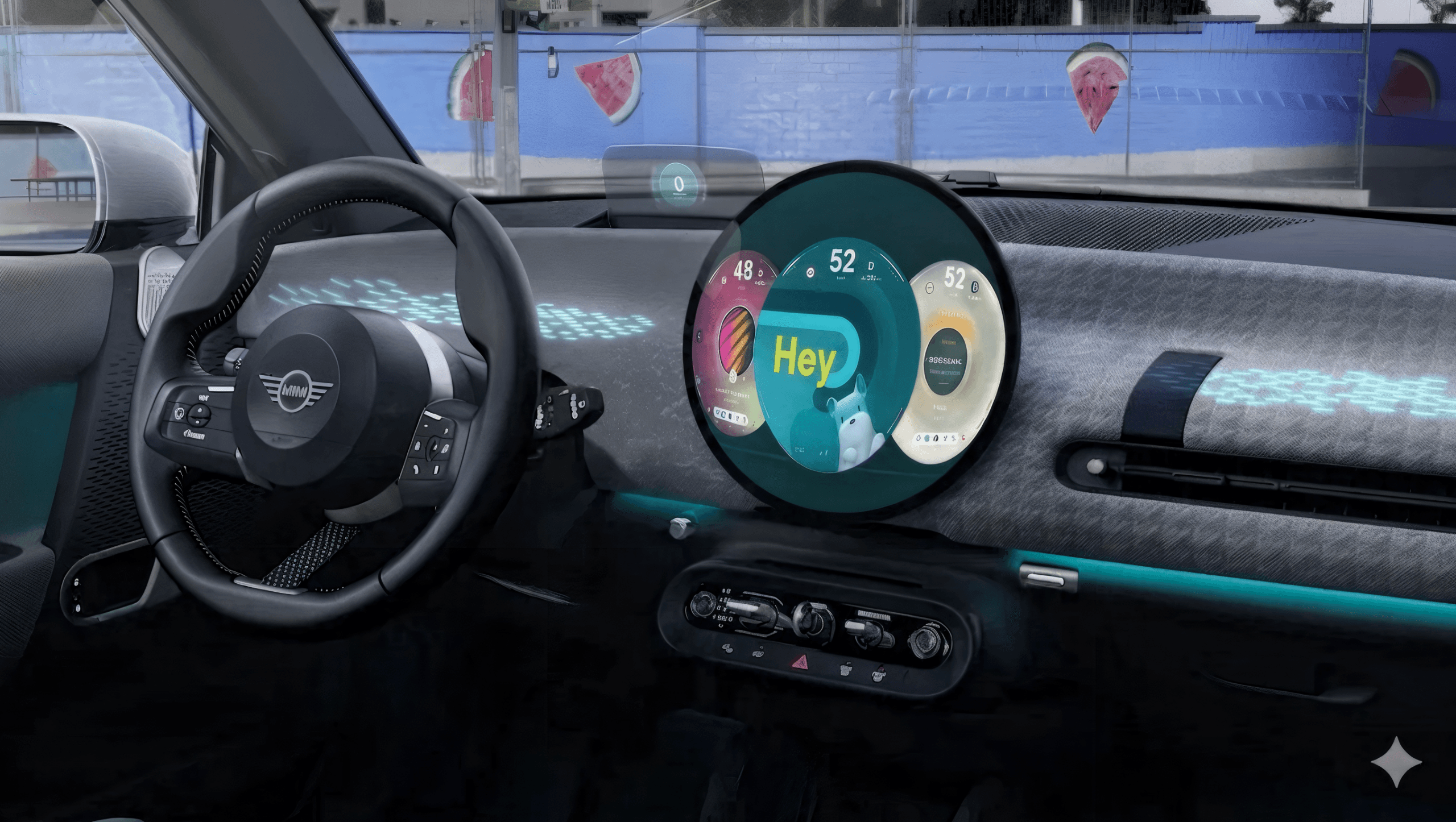
The principle is not “more” or “less” customization, but controlled personalization. Drivers should be able to personalize the assistant without compromising its brand identity.
The assistant character has to be designed as a system
The easiest way to weaken an in-car assistant's brand identity is to define it with adjectives alone.
Warm. Helpful. Confident. Premium. Playful. Human.
These words may be useful starting points, but they are not enough to guide real product decisions. They do not explain how the assistant behaves when it mishears a request, when it has no answer, when the driver is stressed, when the vehicle is stationary, when the car is moving at speed, or when a local market expects a different level of warmth or social distance. A character that resonates with real drivers must be intentionally architected. For OEMs, the question is not only how to design an AI in-car assistant that feels like the brand, but making sure that character holds across personalization, localization, model ranges, and software updates.
NIO’s NOMI demonstrates why these decisions matter. By giving the assistant a physical presence in the cabin, NOMI creates interactions that are visible, recognizable and emotionally engaging. The lesson is not that every OEM needs a physical assistant, but that the assistant’s form and behavior should be selected to reinforce the brand character, not to follow trends.
Once that form is chosen, the next question is how it behaves in use. Above voice or visual design, character is also carried through timing, movement, restraint, and response.
Every movement should communicate a state. It should not just fill time. – Dominik Fink, Senior UX Designer & Creative Technologist
In practice, that means animations, whether listening, processing, confirming or failing, should clarify what the assistant is doing. The motion vocabulary must align with the brand’s emotional tone. A premium assistant may move with more restraint and weight, while a youthful brand may use quicker transitions and playful visuals.
It's important to remember that the car is not a phone. The assistant operates in a moving vehicle where distraction and safety constraints matter. Restraint is part of the design language, and the assistant must be expressive enough to feel present, yet subtle enough to remain appropriate to the driving context. Effective assistant character design prioritizes coherence, safety, and recognition, not just charm.
Before designing the assistant, OEMs need to resolve six connected considerations.
Six considerations before designing an in-car assistant character






AI changes in months. A brand has to last for years.
The automotive production cycle creates a hard design problem. Vehicle programs run for 4 to 6 years, while the AI market moves in months. A capability that feels advanced during concept development can feel ordinary by launch. A conversational model that feels current today may be outdated before the vehicle reaches customers.
Attempting to lock every aspect of the assistant is a mistake. OEMs must separate the assistant’s capabilities from its core character.
The capability layer should evolve continuously. Data access, LLM performance, connected services, speech recognition, personalization, knowledge, and feature control must improve over time. Without this evolution, the vehicle will quickly feel outdated.
The character layer should remain stable. The assistant’s values, tone, emotional register, response principles, and brand relationship should be defined early and carefully protected. This character layer should be anchored in the brand archetype, so new capabilities can be interpreted through the same underlying logic rather than treated as disconnected additions. While the character can evolve by learning new things, its personality should not fundamentally change.
A helpful analogy: people learn and adapt, but their core character remains stable. Similarly, new assistant capabilities should align with the brand character, not appear as disconnected features.
This approach distinguishes a character system that grows from one that accumulates patches. A growing system has documented core logic, allowing future designers, developers, market teams, and platform partners to make decisions in new situations. A patched system becomes a history of one-off choices.
For every new feature, the key question is: How would this assistant, as an expression of the brand, use this capability?
This is the difference between evolution and trend-following. A trend-led assistant changes tone, behavior, or visual style whenever the market shifts. A brand-led assistant can adopt new capabilities, but interprets them through the same character logic. To the driver, the experience must feel better over time, not like a stranger has invaded the car through a software update.
Localization in automotive HMI design is not translation
For global OEMs, assistant character design becomes even more complex. The same brand is perceived differently in Germany, China, and the US, with expectations varying both linguistically and emotionally. Drivers in one market may welcome a proactive, expressive assistant, while others may find such behavior intrusive. Some markets prefer anthropomorphic characters; others value restraint and clarity. Language is only the surface, and the deeper issue is the emotional contract between driver, vehicle, and assistant.
Therefore, localization should be approached as a design challenge rather than a translation task. A strong global assistant system requires a fixed brand layer and an adaptable market layer. The brand layer defines what does not move: core values, tone, emotional register, behavioral rules, and the assistant’s relationship to the vehicle. The market layer defines what can adapt: language, degree of warmth, social behavior, humor, visual expression, proactivity, gesture, voice, and interaction pacing.
The core archetype should remain recognizable, but its cultural expression may need to change. A brand seen as confident and helpful in one market may appear intrusive or cold in another if the assistant’s pacing, language, warmth, or social distance are not adjusted. Localization involves more than translating prompts; it requires understanding how local drivers perceive the brand and how this perception aligns with the brand’s intended image.
This process begins with research. OEMs must understand current brand perception in each market, local expectations for in-car technology, and any gaps between intended and actual brand image.
Without this understanding, global brands risk deploying assistants that succeed in one market but feel out of place in another.
European OEMs entering China and Chinese OEMs entering Europe face this challenge from opposite perspectives. While the assistant may reflect the same core brand character, the appropriate level of anthropomorphism, proactivity, humor, warmth, or restraint can differ greatly by market. – Jana Kapitz, Head of Innovation Strategy
The goal is not to develop a separate assistant for each country, but to define which elements are fixed and which local teams can adapt. The clearer this framework is, the easier it is to maintain brand consistency while allowing the assistant to demonstrate cultural intelligence and feel natural to users.
Designing one in-vehicle user experience across multiple vehicle models
The assistant must also function effectively across the entire model range. Drivers of a compact city car and a flagship SUV may share the same brand, but their emotional contexts differ. Tasks, cabin atmosphere, purchase motivations, and expected experience all vary. This doesn’t mean a different assistant for each model, but rather an assistant capable of adapting its emotional register.
It’s an actor playing the same character in different scenes. The character’s values, instincts, and voice remain stable, but the performance shifts with the situation. A light scene does not require the same pacing as an intense one. A quiet moment does not call for the same energy as a dynamic one. – Dominik Fink, Senior UX Designer & Creative Technologist
For automotive assistant design, the challenge is knowing what stays constant and what can flex. Across a model range, the constants that make the assistant recognizable are: response logic, voice principles, motion grammar, honesty about uncertainty, error handling, escalation behavior, and relationship to the brand’s core promise. These elements hold the identity together.
The contextual layer can then adapt around those constants. A city car assistant might feel lighter, quicker, and more everyday in its behavior. A flagship SUV assistant might feel calmer, more measured, and more substantial. The pacing, visual weight, degree of proactivity, animation intensity, or type of support may change, but the underlying character should still feel familiar.
The chosen archetype determines the assistant’s range. Ruler or sage archetypes require stricter guidelines to maintain authority, expertise, and consistency. Everyman or caregiver archetypes allow greater flexibility, as relatability and support can vary across vehicle contexts.
The key is understanding what maintains brand identity as emotional contexts shift. Each expression feels appropriate to the vehicle while still unmistakably belonging to the same brand.
Premium and volume brands face different versions of the same pressure
Both premium and volume brands need a clear character logic. The difference is what that character needs to protect or discover.
For premium brands, the assistant usually has to protect existing equity. The archetype is already strongly formed, so the work is about precision: ensuring every behavior strengthens the aura customers already pay for.
For volume brands, the assistant can be more exploratory. If the brand is anchored in the everyman archetype, for example, the assistant may lean into usefulness, simplicity, personalization and everyday relevance. If the brand’s digital identity is still emerging, the assistant can also help shape that identity over time.
That does not make the design problem easier. It makes it differently difficult. Premium assistant design often starts with a clearer emotional territory and stronger existing brand equity. Volume assistant design may start with more freedom, but also a higher risk of becoming generic because the competitive segment is converging quickly.
Premium brands often begin with strong brand equity and a clearer emotional aspiration. The challenge is precision: translating that equity into a character that feels genuinely premium rather than simply polished. That may justify a more distinctive physical form, a highly crafted voice persona, tighter motion control, or richer multimodal expression.
The approaches differ, but the underlying pressure is the same. As vehicle experiences converge, every OEM has to decide what role the assistant should play in making the brand easier to recognize, remember, and trust.
Branded voice assistant or platform default? The choice still shapes the brand
Not every OEM needs to develop a fully bespoke assistant from scratch. For many brands, this investment is not yet justified. Costs extend beyond initial design and build to include ongoing model performance, localization, compliance, software maintenance, updates, and engineering support.
Choosing a third-party platform can be the right decision, but it still carries consequences. If an OEM uses a platform assistant without adapting its character, drivers notice the difference. The assistant might be helpful, but it doesn’t feel like it belongs. OEMs need to pay attention to this difference.
The intelligence layer may come from an external supplier or third-party platform, but the branded in-cabin behavior still has to be owned by the OEM. Even with a third-party system, the assistant should match the car’s brand expression: tone, visual style, motion behavior, interaction rhythm, name, wake word, color logic, error messages, and the way it appears within the wider HMI.
It must also be intelligent in a vehicle-specific manner, integrating closely with the car’s functions and context, including driving modes, battery status, climate, route, service needs, cabin state, and connected services. Drivers should interact with it naturally, as they would with an intelligent assistant, rather than as if they are operating a disconnected machine.
When a driver asks for help, it should feel like the car itself is responding, not like a separate service popping up on the screen.
Brands must retain control over the interface, behavior, and key moments. Things like colors, animations, response tone, error messages, and car-specific actions all matter. Each choice might seem small, but together they decide if the assistant feels truly integrated or just added on.
If you outsource the brain, you still need to own the behavior. Having a basic character design is so important. An OEM might not need a custom avatar or a fully developed visual persona at first. But key elements like the assistant’s name, wake word, voice, tone, greetings, visual style, brand colors, and how it handles mistakes should all be chosen carefully. – Jana Kapitz, Head of Innovation Strategy
These choices are far less costly than developing a fully bespoke assistant ecosystem, yet they significantly influence whether the assistant feels purpose-built for the vehicle or simply inherited from a platform default.
Failure states reveal the assistant’s intelligence
When everything works, almost any assistant seems polished. The real test comes when the assistant is wrong, uncertain, unsupported, disconnected, or unable to complete the task.
Most assistant designs begin with the ideal scenario: the driver asks a question, the assistant understands, provides a useful answer, and the interaction concludes smoothly.
In reality, the assistant might mishear, misunderstand, lack the right information, fail to finish a task, or encounter situations it can’t handle. These aren’t rare cases; they’re real tests of the brand experience.
This is where the assistant’s smartness is revealed. Instead of pretending failure will never happen, a strong assistant is defined by how clearly, safely, and appropriately it recovers. Does the assistant clearly admit uncertainty? Does it apologize excessively? Does it blame the user? Does it repeat itself? Does it offer a useful next step? Does it escalate appropriately? Does it remain calm without becoming passive? Most importantly, does it respond in a manner consistent with the brand?
It is unrealistic to pretend the assistant will never fail in a real driving scenario. Poor connectivity, unclear speech, incomplete data, unsupported requests, environmental noise or system limitations can all affect the interaction. AI can help detect, classify and recover from some of these situations more intelligently, but OEMs still need to design the failure behavior deliberately.
This means creating a library of common interactions, ideal scenarios, error cases, and unusual situations. It also means setting rules for movement, tone, and escalation. Testing should happen in safe settings that closely mimic real driving, so you can see how the assistant responds under stress or distraction.
For safety-critical interactions, failure-state design should also be considered as part of the broader compliance and risk management process. This is especially important in automotive, where an assistant’s response is not only a matter of tone or convenience, but can affect driver attention, trust, and decision-making.
For an in-car assistant, failure isn’t only a technical problem; it’s a moment that shapes the brand.
How Star can help
As in-car assistants become more capable, OEMs need more than conversational AI integration. They need assistant character systems that protect brand identity, support localization, scale across model ranges, and operate safely in real-world driving conditions. Star helps automotive teams connect strategy, UX, HMI design, AI integration, and in-vehicle experience design to create assistants that feel native to the brand — not added on top of it.
Our Brand Booster approach, including the brand strategy compass, helps teams align internal brand intent with external customer perception across markets and target audiences. That foundation supports brand-guided decision-making throughout the design process, from archetype definition and assistant character principles to personalization boundaries, localization rules, motion behavior, and failure-state design. Star also supports research, prototyping, and validation to test whether the assistant feels recognizable, useful, safe, and emotionally aligned before full-scale implementation.
Speak to the experts
Explore Star’s perspective on in-car digital assistants or speak to our automotive experience team about designing the next generation of branded in-car assistant experiences.
FAQs
An AI in-car assistant is a voice, visual, or multimodal interface that helps drivers and passengers interact with vehicle functions, connected services, and digital information. As AI and LLM capabilities advance, the in-car assistant is evolving from a command-based feature into a more conversational part of the in-vehicle user experience.