
Connected fleet services have moved past telematics. The next fight is the operating layer.
For years, commercial vehicle connectivity was sold as visibility — location, fault codes, trip history, driver behavior, maintenance alerts. The truck sent data. The portal displayed it. The fleet manager still had to decide what mattered, who should act, and how to coordinate the repair.
That model is changing. Leading OEMs are now building full service platforms: remote diagnostics, predictive maintenance, OTA software updates, dealer workflow integration, EV fleet management, driver apps, and subscription-based digital services. Daimler Truck has already surpassed 1 million connected trucks globally. The direction is clear — connectivity is becoming the primary lever for uptime, safety, and service revenue.
But most major OEMs already have connected services. The real question is whether those services help fleets make faster, better operational decisions. That's where the market still has a gap.
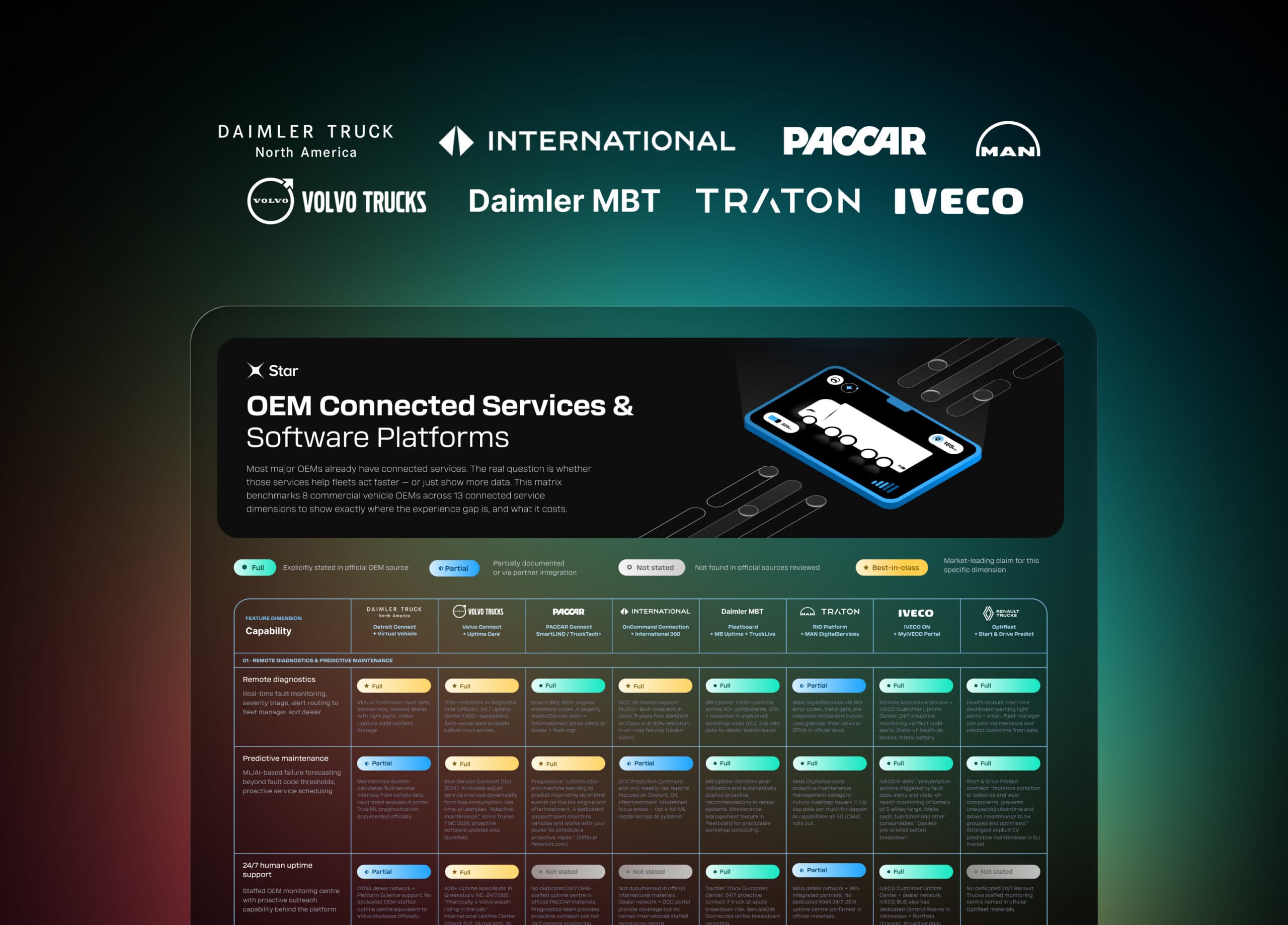
Star benchmarked 8 major commercial vehicle OEMs across 13 connected service dimensions— from remote diagnostics and OTA to EV fleet workflows, driver apps, and AI-readiness. This commercial vehicle fleet portal benchmark shows where platforms are converging, where certain OEMs lead, and where experience gaps still limit fleet value and service revenue.
The battlegrounds: where connected truck services UX stand in 2026
Across the commercial vehicle market, the connectivity feature set is converging. Most leading OEMs now offer vehicle health monitoring, remote diagnostics, fault alerts, mobile access, and a fleet portal. The difference is no longer whether the data exists. The difference is how far each OEM has moved from raw data toward operational action. The last year sharpened that gap considerably: software-defined vehicle platforms moved from strategy slides into real commercial programs, OTA started showing measurable uptime impact, and AI entered the fleet portal as a direct response to dashboard overload — not as a future roadmap item.
1. Remote diagnostics is the most mature category. Volvo's uptime model is built around a 24/7 specialist centre and dealer integration. International's OnCommand Connection guides service technicians through specific repair steps and parts identification. Volvo, DTNA, and International stand out in the benchmark for depth of support, diagnostic routing, and all-makes coverage.
2. OTA has crossed a measurable threshold. Volvo Trucks North America reported that automatic over-the-air updates increased the share of trucks running current software from 25% to over 80% in six months, with a 24% reduction in unplanned stops. That changes the customer expectation: a truck delivered today should improve after delivery. OTA is no longer a convenience feature — it is a direct uptime lever.
3. EV fleet UX is present but still immature. Diesel portals were built around fuel, faults, service intervals, and utilisation. EV operations require battery state, range confidence, depot charging, route readiness, charger conflicts, and energy cost. Daimler MBT, MAN, IVECO, and Renault Trucks show stronger EV-specific service layers than most North American platforms, but EV functionality across the market is still largely bolted onto systems designed for diesel.
4. API openness is now strategic. Geotab reported in 2025 that the average fleet includes vehicles from 13 different manufacturers. Penske's platform was built to connect with virtually any truck, engine configuration, or telematics provider. That is the reality OEMs must design for — even if an OEM wants to own more of the fleet relationship, the fleet customer lives in a mixed-brand, mixed-system world. Volvo Group and Daimler Truck launching Coretura in 2025 — a shared software-defined vehicle platform — signals that even the largest OEMs recognise the infrastructure layer must be open and shared before differentiation can happen above it.
5. AI is entering the fleet portal — not as abstract innovation, but as a direct response to dashboard overload. It is not replacing fleet managers. It is changing the interface between fleet managers and connected vehicle data. The next generation of fleet software will not ask users to interpret every alert, chart, and report manually. It will summarise risk, explain trade-offs, recommend action, and help coordinate the next step. Star explored how this shift from software-defined to AI-defined vehicles is reshaping the broader mobility experience in our analysis of the SDV-to-AIDV transition.
The experience gap: fleets do not need more dashboards
Most OEM platforms still expose connectivity through product-centric structures: vehicle health, location, service, driver behavior, electric vehicles, subscriptions, and reports. This setup makes sense internally, but often does not match how fleet operations actually work.
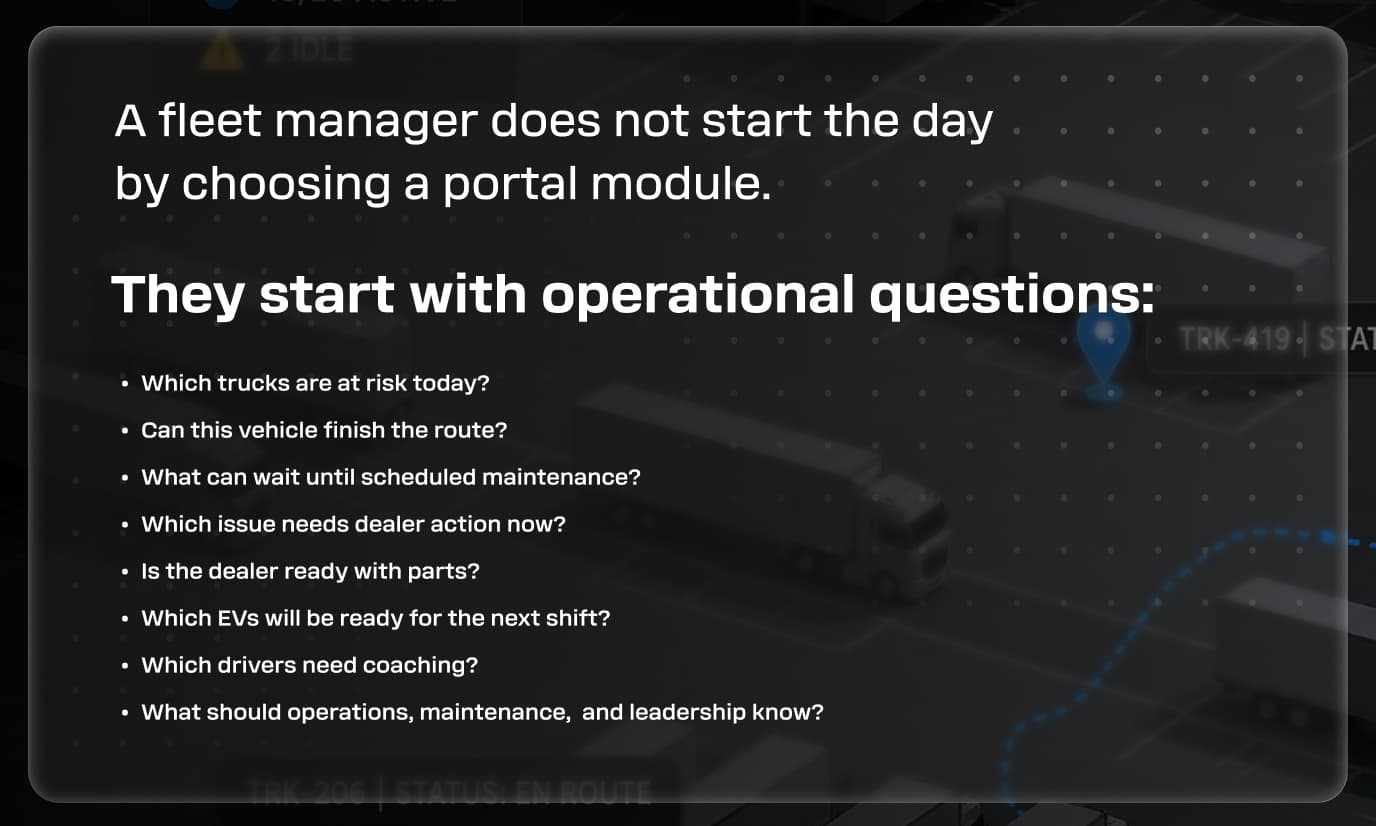
Star’s benchmark report shows every OEM reviewed has strong infrastructure in at least part of the stack: telematics hardware, connected portals, diagnostic data, OTA capability, service products, dealer networks, partner ecosystems, or EV data. The universal failures are consistent: weak fault triage, limited mixed-fleet visibility, immature EV exception handling, incomplete service-event workflows, inconsistent safety and ADAS visibility, and driver apps that do not meet consumer-grade expectations. The problem is not the absence of data. The problem is orchestration.
Why connected fleet experience design now matters for OEMs and fleets
For OEMs: service growth, retention, and recurring value
Connected services now sit at the intersection of product strategy, aftersales revenue, fleet retention, software monetization, dealer performance, and customer experience. A strong connected service platform can support:
- Increased digital service attachment and subscription renewals.
- Reduced unplanned downtime and stronger uptime positioning.
- Dealer-service pull-through for parts, labor, and repair workflows.
- Paid software, analytics, and support tiers.
- EV transition support across mixed-powertrain operations.
- Differentiation beyond vehicle hardware.
- Long-term fleet loyalty from embedded telematics and service value.
The opposite is also true. If the portal is hard to use, alerts are unclear, service handoffs are manual, EV workflows are fragmented, and data cannot integrate with mixed-fleet operations, the OEM’s influence weakens after the sale. Fleets turn to third-party telematics platforms, internal tools, spreadsheets, phone calls, and whatever system gives the fastest operational answer.
There is a direct revenue implication. When OEM telematics identifies a fault and routes the vehicle to an authorized dealer, that generates parts and labor revenue. Connected services are a service-lane optimization tool as much as a subscription product. When the portal experience is weak, that route breaks down.
For OEMs: service growth, retention, and recurring value
For fleet owners and managers, the upside is practical. Better connected services mean fewer surprise failures, faster triage, less manual coordination, better service planning, clearer driver communication, and stronger control across mixed ICE, EV, and eventually autonomous operations. The real value is not seeing more data. It is reducing the number of decisions that require guesswork.
The strongest connected fleet tools will answer what happened, why it matters, how urgent it is, what the cost of waiting may be, who should act, what the next best action is, and how that action connects to dealer, driver, dispatcher, and maintenance workflows. AI can help here, but only when grounded in reliable vehicle data, service logic, user permissions, fleet context, and clear UX. Manufacturer-grade data must be translated into operational decisions.
How Star helps OEMs turn connected infrastructure into fleet value
Commercial vehicle OEMs have already invested in the hardware, cloud, telematics, OTA rails, and service infrastructure behind connected fleets. The next advantage comes from the experience layer: the portals, workflows, AI decision support, and service journeys that help fleets act faster.
Star helps OEMs design and engineer that layer — from connected fleet portals and remote diagnostics workflows to EV operations, dealer-service coordination, driver apps, and AI-powered fault triage. Whether you are modernizing an existing platform or defining the next generation of connected services, we can help you turn infrastructure into a product experience fleets rely on every day.
Book a connected fleet experience audit to identify the biggest UX, workflow, and monetization opportunities in your platform.
FAQ
A commercial vehicle fleet portal benchmark compares how major truck OEMs structure, design, and deliver connected services through their fleet-facing platforms. This includes fleet portal UX, remote diagnostics, predictive maintenance, OTA updates, EV workflows, driver apps, safety analytics, API openness, and AI-enabled decision support.